

Health Dictionary
Reliable, easy-to-read patient information on common medical conditions — written in plain language, free of jargon, and grounded in current evidence. Browse the most frequent diagnoses, understand what they mean for everyday life, and learn which steps and questions help you have a focused conversation with your doctor.
Recurrent nerve
Introduction
Overview
Overview
The recurrent laryngeal nerve is a branch of the vagus nerve (tenth cranial nerve) that supplies motor function and sensation to the larynx (voice box). It travels within the endoneurial sheath.
Path
Path
It is referred to as “recurrent” because the branches of the nerve innervate the laryngeal muscles in the neck through a rather circuitous route: they descend down into the thorax before rising up between the trachea and esophagus to reach the neck.
The left branch loops under and around the arch of the aorta (ligamentum arteriosum) before ascending, whereas the right branch loops around the right subclavian artery.
The nerve splits into anterior and posterior rami before supplying muscles in the voice box — it supplies all laryngeal muscles except for the cricothyroid, which is innervated by the external branch of the superior laryngeal nerve.
Clinical significance
Clinical significance
The nerve is best known for its importance in thyroid surgery, as it runs immediately posterior to this gland. If it is damaged during surgery, the patient will have a hoarse voice. Nerve damage can be assessed by laryngoscopy, during which a stroboscopic light confirms the absence of movement in the affected side of the vocal cords.
Similar problems may also be due to invasion of the nerve by a tumor or after trauma to the neck.
- If the damage is unilateral, the patient may present with voice changes including hoarseness.
- Bilateral nerve damage can result in breathing difficulties and aphonia, the inability to speak.
- The right recurrent laryngeal nerve is more susceptible to damage during thyroid surgery due to its relatively medial location.
History
History
Galen is said to have first described the clinical syndrome of recurrent laryngeal nerve paralysis.
Veterinary medicine
Veterinary medicine
In Veterinary medicine, ‘roars’ refers to a deficit in the left recurrent laryngeal nerve causing characteristic stenuous sounds upon inspiration.
It is treatable by specialists in equine medicine.
Additional images
Additional images
-
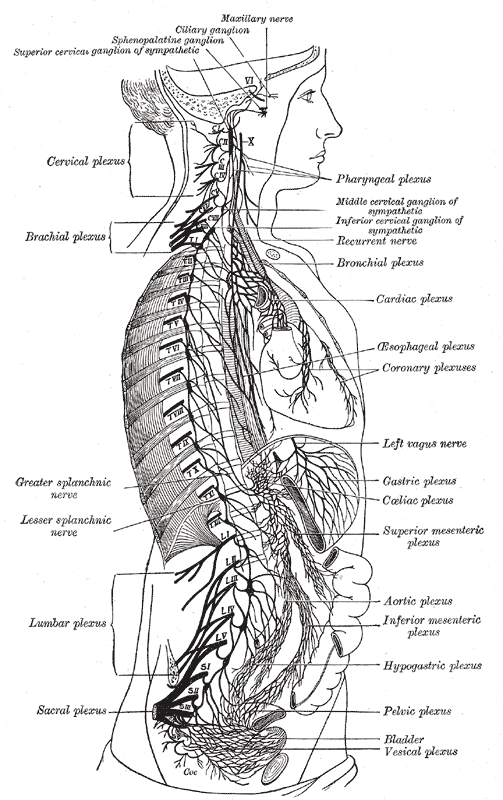 The right sympathetic chain and its connections with the thoracic, abdominal, and pelvic plexuses.
 -
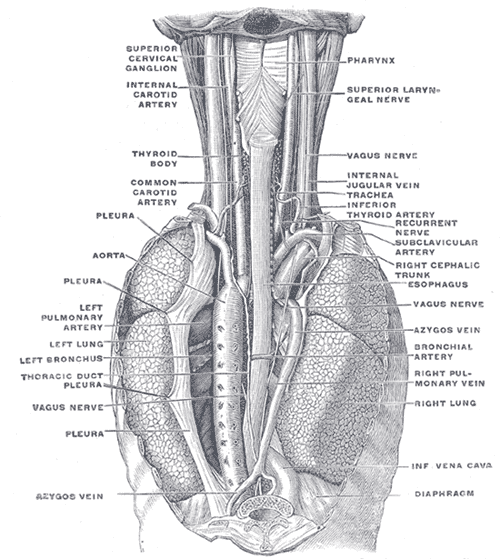 The position and relation of the esophagus in the cervical region and in the posterior mediastinum. Seen from behind.


Editor-In-Chief: C. Michael Gibson, M.S., M.D. [1]