

Health Dictionary
Reliable, easy-to-read patient information on common medical conditions — written in plain language, free of jargon, and grounded in current evidence. Browse the most frequent diagnoses, understand what they mean for everyday life, and learn which steps and questions help you have a focused conversation with your doctor.
Renal emboli
Introduction
Overview
Overview
Renovascular disease is disease of the renal arteries and veins. It is a progressive disease causing narrowing of the arteries and veins of kidneys.
References
Editor-In-Chief: C. Michael Gibson, M.S., M.D. [1]
Historical Perspective
Please help WikiDoc by adding more content here. It’s easy! Click here to learn about editing.
References
Pathophysiology
Please help WikiDoc by adding more content here. It’s easy! Click here to learn about editing.
References
Causes
Overview
Causes
- Atherosclerotic Renal Artery Stenosis (ARAS)[1] [2]
- Atherosclerosis accounts for approximately 90% of the cases of RAS and is the predominant lesion detected in patients >50 years of age
- The presence and number of diseased coronary arteries predicts the likelihood of ARAS
- RAS resulting from atherosclerotic disease is common in (18% to 20%) individuals undergoing coronary angiography (1)
- RAS resulting from atherosclerotic disease is even more common (35% to 50%) in individuals undergoing peripheral vascular angiography for occlusive disease of the aorta and legs (2)
- Fibromuscular dysplasia
- Unknown etiology
- Second most common cause of RAS
- Affects middle-aged women
- More common in first-degree relatives and in the presence of the ACE-I allele.
- Renal artery involvement is seen in 60% of cases – frequently bilateral compromise.
- Progressive renal stenosis is seen in 37% of cases and loss of renal mass in 63%
- Nephroangiosclerosis (HTN injury)
- Diabetic Nephropathy (small vessels)
- Renal thromboembolic disease
- Atheroembolic renal disease
- Aortorenal dissection
- Post renal transplant RAS
- Renal artery vasculitis
- Trauma
- Neurofibromatosis
- Thromboangiitis obliterans
- Scleroderma
References
- ↑ Rihal CS, Textor SC, Breen JF, McKusick MA, Grill DE, Hallett JW; et al. (2002). “Incidental renal artery stenosis among a prospective cohort of hypertensive patients undergoing coronary angiography”. Mayo Clin Proc. 77 (4): 309–16. doi:10.1016/S0025-6196(11)61782-5. PMID 11936924.
- ↑ Olin JW (2002). “Atherosclerotic renal artery disease”. Cardiol Clin. 20 (4): 547–62, vi. PMID 12472042.
Editor-In-Chief: C. Michael Gibson, M.S., M.D. [1]
Differentiating Renovascular disease from other Diseases
Please help WikiDoc by adding more content here. It’s easy! Click here to learn about editing.
References
Epidemiology and Demographics
Please help WikiDoc by adding more content here. It’s easy! Click here to learn about editing.
Overview
Epidemiology and Demographics
-
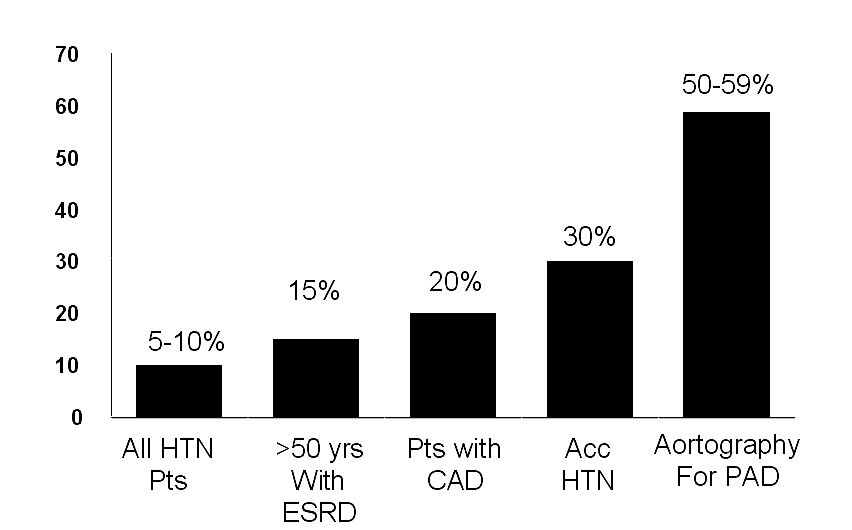 Prevalence of Renal Artery Stenosis
 -
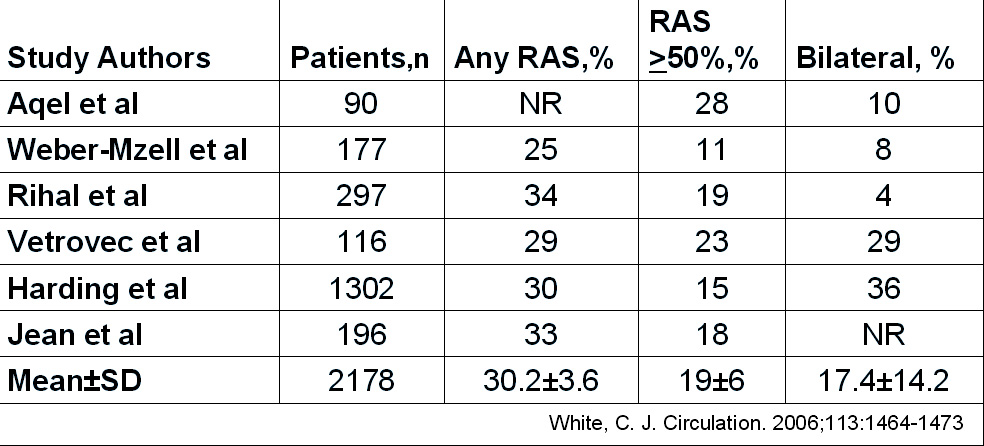 Prevalence RAS at Cardiac Cath


References
Editor-In-Chief: C. Michael Gibson, M.S., M.D. [1]
Risk Factors
Please help WikiDoc by adding more content here. It’s easy! Click here to learn about editing.
References
Screening
Please help WikiDoc by adding more content here. It’s easy! Click here to learn about editing.
References
Natural History, Complications and Prognosis
Please help WikiDoc by adding more content here. It’s easy! Click here to learn about editing.
Overview
Natural History
Complications
- Renovascular hypertension[1]
- Ischemic Nephropathy
- Accelerated CV Disease
- Congestive Heart Failure
- Stroke
- Secondary aldosteronism
Prognosis
References
- ↑ Garovic VD, Textor SC (2005). “Renovascular hypertension and ischemic nephropathy”. Circulation. 112 (9): 1362–74. doi:10.1161/CIRCULATIONAHA.104.492348. PMID 16129817.
Editor-In-Chief: C. Michael Gibson, M.S., M.D. [1]
Diagnosis
Diagnosis
History and Symptoms | Physical Examination | Laboratory Findings | Electrocardiogram | Chest X Ray | CT | MRI | Echocardiography or Ultrasound | Other Imaging Findings | Other Diagnostic Studies
Treatment
Treatment
Medical Therapy | Surgery | Primary Prevention | Secondary Prevention | Cost-Effectiveness of Therapy | Future or Investigational Therapies
Editor-In-Chief: C. Michael Gibson, M.S., M.D. [1]