

Health Dictionary
Reliable, easy-to-read patient information on common medical conditions — written in plain language, free of jargon, and grounded in current evidence. Browse the most frequent diagnoses, understand what they mean for everyday life, and learn which steps and questions help you have a focused conversation with your doctor.
Renal pyramids
Introduction
Renal pyramids (or malpighian pyramids) are cone-shaped tissues of the kidney. The renal medulla is made up of 8 to 18 of these conical subdivisions. The broad base of each pyramid faces the renal cortex, and its apex, or papilla, points internally. The pyramids appear striped because they are formed by straight parallel segments of nephrons.
Additional images
Additional images
-
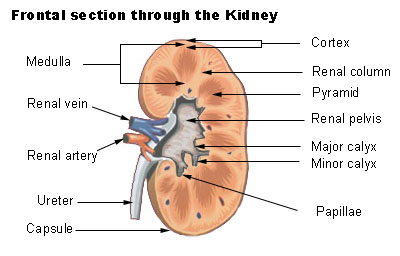 Frontal section through the kidney

The base of each pyramid originates at the corticomedullary border and the apex terminates in a papilla, which lies within a minor calyx.
Editor-In-Chief: C. Michael Gibson, M.S., M.D. [1]