

Health Dictionary
Reliable, easy-to-read patient information on common medical conditions — written in plain language, free of jargon, and grounded in current evidence. Browse the most frequent diagnoses, understand what they mean for everyday life, and learn which steps and questions help you have a focused conversation with your doctor.
Right ventricular myocardial infarction history and symptoms
Introduction
Overview
Overview
Since the right ventricle has a remarkable tendency to recover function rapidly, diagnostic tests are most reliable when performed soon after presentation. Clinical suspicion and a careful physical examination demonstrating the signs are the first step.
History and Symptoms
History and Symptoms
-
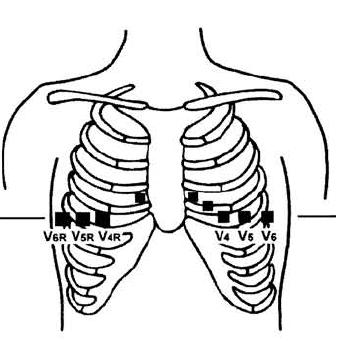 Places of chest leads during EKG recording for suspected RVMI.

- Ischemia or infarction of the right ventricle results in decreased right ventricular compliance, reduced filling, and diminished right-sided stroke volume with concomitant right venticular dilation and alteration in septal curvature. [1] These hemodynamic and geometric changes lead to decreased left ventricular filling and contractile function with a concomitant fall in cardiac output. [2] [3] [4] [5] [6] [7] The net effect is that left-sided filling pressures may be below normal despite clinical signs of high pressure on the right side. This disparity has important implications for therapy.
References
References
- ↑ Brookes, C, Ravn, H, White, P, et al. Acute right ventricular dilatation in response to ischemia significantly impairs left ventricular systolic performance. Circulation 1999; 100:761. PMID 10449700.
- ↑ Williams, JF. Right ventricular infarction. Clin Cardiol 1990; 13:309. PMID 2189611
- ↑ Kinch, JW, Ryan, TJ. Right ventricular infarction. N Engl J Med 1994; 330:1211. PMID 8139631
- ↑ Setaro, JF, Cabin, HS. Right ventricular infarction. Cardiol Clin 1992; 10:69. PMID 1739961
- ↑ Cohn, JN. Right ventricular infarction revisited. Am J Cardiol 1979; 43:666. PMID 420117
- ↑ Zeymer, U, Neuhaus, K-L, Wegscheider, K, et al. Effects of thrombolytic therapy in acute inferior myocardial infarction with and without right ventricular involvement. J Am Coll Cardiol 1998; 32:876. PMID 9768705
- ↑ Shiraki, H, Yoshikawa, T, Anzai, T, et al. Association between preinfarction angina and a lower risk of right ventricular infarction. N Engl J Med 1998; 338:941. PMID 9521981
Editor-In-Chief: C. Michael Gibson, M.S., M.D. [1]