

Health Dictionary
Reliable, easy-to-read patient information on common medical conditions — written in plain language, free of jargon, and grounded in current evidence. Browse the most frequent diagnoses, understand what they mean for everyday life, and learn which steps and questions help you have a focused conversation with your doctor.
Spermatic cord
Introduction
Overview
Overview
The spermatic cord is the name given to the cord-like structure in males formed by the vas deferens and surrounding tissue that run from the abdomen down to each testicle.
Contents of spermatic cord
Contents of spermatic cord
- arteries: testicular artery, deferential artery, cremasteric artery
- nerves: nerve to cremaster (genital branch of the genitofemoral nerve) , sympathetic nerves
- vas deferens
- pampiniform plexus
- lymphatic vessels
- processus vaginalis (remains of)
Coverings
Coverings
The spermatic cord is ensheathed in three layers of tissue:
- external spermatic fascia, an extension of the innominate fascia that overlies the aponeurosis of the external oblique muscle
- cremasteric muscle and fascia, formed from a continuation of the internal oblique muscle and its fascia
- internal spermatic fascia, continuous with the transversalis fascia
Clinical significance
Clinical significance
The spermatic cord is sensitive to torsion, in which the testicle rotates within its sac and kinks off its own blood supply. Testicular torsion may result in irreversible damage to the testicle within hours.
The contents of the abdominal cavity may protrude into the spermatic cord, producing an indirect inguinal hernia.
Additional images
Additional images
-
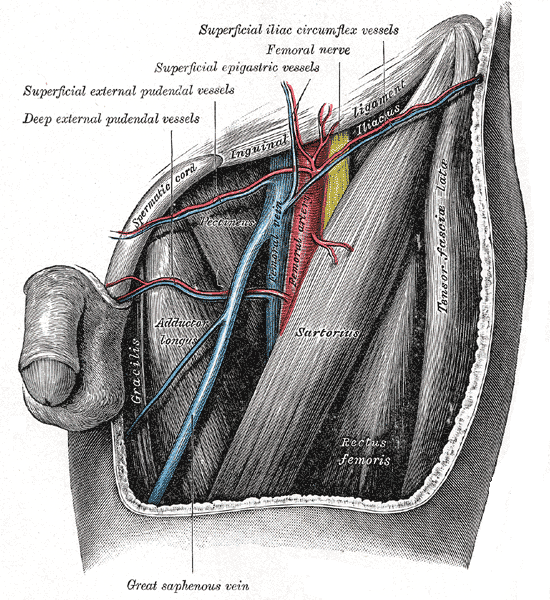 The left femoral triangle.
 -
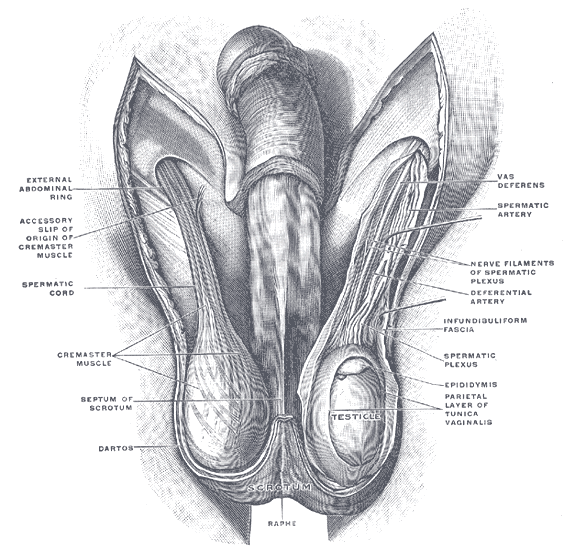 The scrotum.
 -
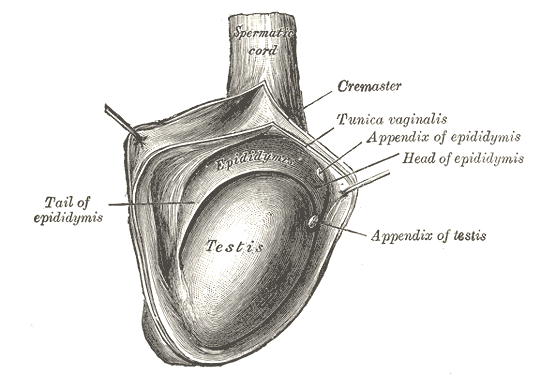 The right testis, exposed by laying open the tunica vaginalis.


External links
External links
- Template:SUNYAnatomyFigs – “The inguinal canal and derivation of the layers of the spermatic cord.”
- Template:SUNYAnatomyImage
- Template:ViennaCrossSection
- Template:ViennaCrossSection
- Template:NormanAnatomy (Template:NormanAnatomyFig)
Template:Male reproductive system
Editor-In-Chief: C. Michael Gibson, M.S., M.D. [1]