

Health Dictionary
Reliable, easy-to-read patient information on common medical conditions — written in plain language, free of jargon, and grounded in current evidence. Browse the most frequent diagnoses, understand what they mean for everyday life, and learn which steps and questions help you have a focused conversation with your doctor.
Spermatogonia
Introduction
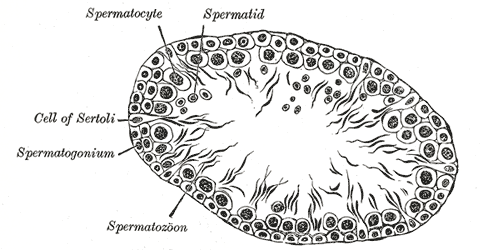
A spermatogonium (plural: spermatogonia) is an intermediary male gametogonium (a kind of germ cell) in the production of spermatozoa.
There are two subtypes:
Type A(d) cells have dark nuclei and they divide to produce copies of themselves, thereby ensuring a constant supply of spermatogonia to fuel spermatogenesis.
Type A(p) cells have pale nuclei and they divide by mitosis to produce Type B cells and these Type B cells divide again to give rise to primary spermatocytes.
Each primary spermatocyte duplicates its DNA and subsequently undergoes meiosis I to produce two haploid secondary spermatocytes. Each of the two secondary spermatocytes further undergo meiosis II to produce two spermatids (haploid). (1 primary spermatocytes => 4 spermatids)
The spermatids then undergo spermiogenesis to produce spermatozoa.
Additional images
Additional images
-
-
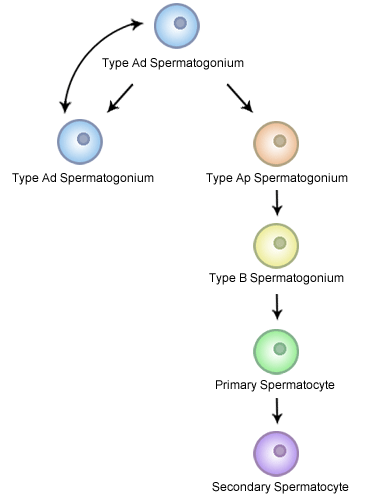 Schematic diagram of Spermatocytogenesis

