

Health Dictionary
Reliable, easy-to-read patient information on common medical conditions — written in plain language, free of jargon, and grounded in current evidence. Browse the most frequent diagnoses, understand what they mean for everyday life, and learn which steps and questions help you have a focused conversation with your doctor.
Sphenoid bone
Introduction
Overview
Overview
The sphenoid bone (from Greek sphenoeides, “wedgelike”) is a bone situated at the base of the skull in front of the temporals and basilar part of the occipital bone.
The sphenoid bone somewhat resembles a butterfly or bat with its wings extended.
Portions
Portions

It is divided into the following parts:
- a median portion, known as the body of sphenoid bone
- two greater wings and two lesser wings
- Pterygoid processes of the sphenoides which project from it posteriorly (below)
Two sphenoidal conchae are situated at the anterior and posterior part of the body.

Named features
Named features
Various other named features of the sphenoid bone exist:
- pterygoid notch
- pterygoid fossa
- scaphoid fossa
- vaginal process
- pterygoid hamulus
- pterygoid canal
- pterygospinous process
Additional images
Additional images
-
 Facial bones.
 -
 Lateral wall of nasal cavity, showing ethmoid bone in position.
 -
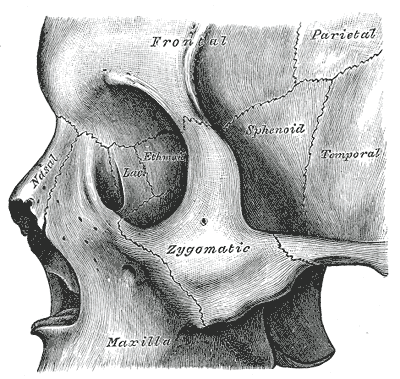 Sphenoid bone visible center right.
 -
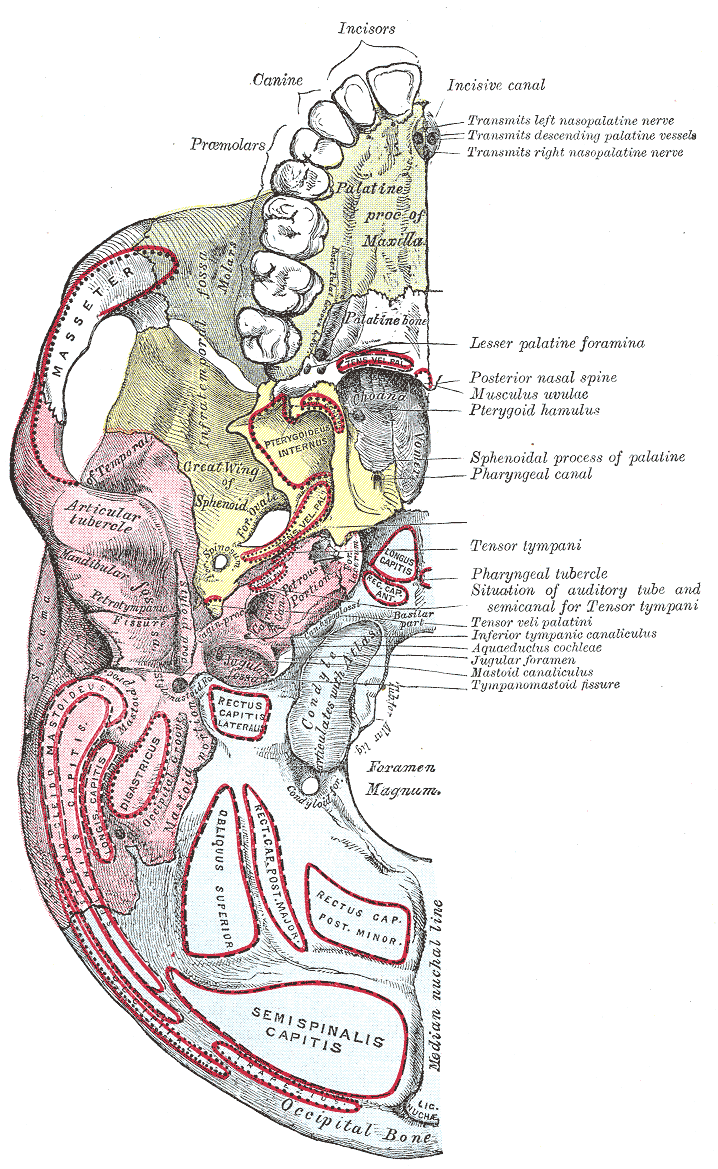 Base of skull. Inferior surface.
 -
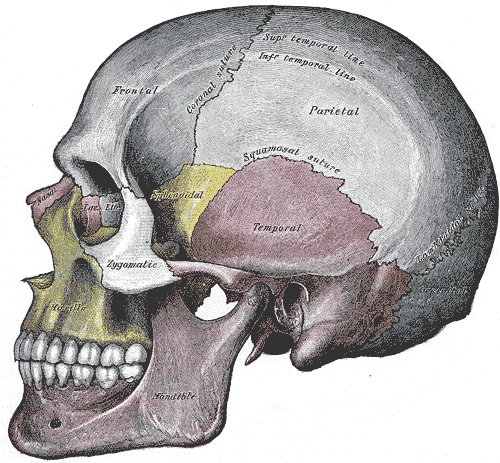 Lateral view of the skull.
 -
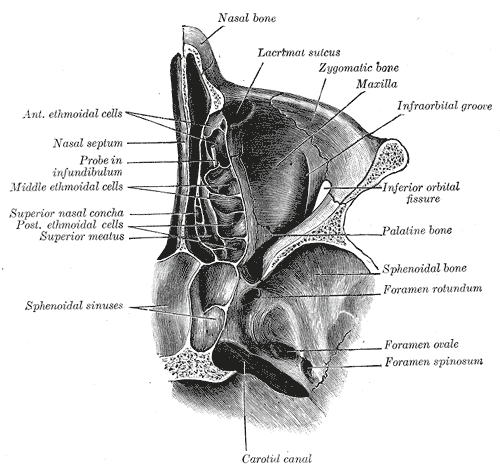 Horizontal section of nasal and orbital cavities.
 -
 Floor of the skull.
 -
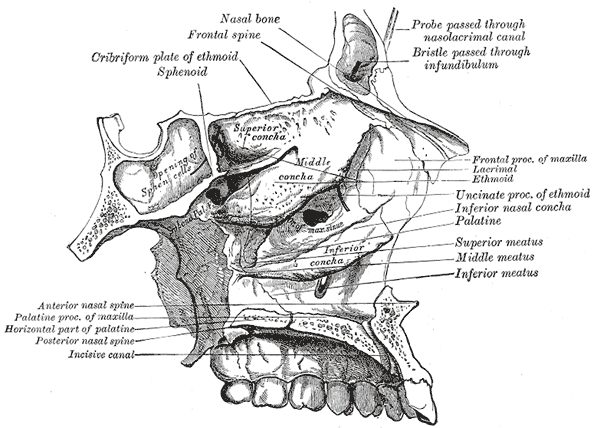 Roof, floor, and lateral wall of left nasal cavity.


See also
See also
External links
External links
- Template:SUNYAnatomyFigs – “Lateral view of skull.”
Template:Cranium Template:Gray’s
ca:Esfenoide da:Kileben de:Keilbein it:Osso sfenoide la:Os sphenoidale lt:Pleištakaulis nl:Wiggenbeen no:Kilebeinet sk:Klinová kosť sl:Zagozdnica fi:Kitaluu uk:Клиноподібна кістка
Editor-In-Chief:
C. Michael Gibson, M.S., M.D. [1]