

Health Dictionary
Reliable, easy-to-read patient information on common medical conditions — written in plain language, free of jargon, and grounded in current evidence. Browse the most frequent diagnoses, understand what they mean for everyday life, and learn which steps and questions help you have a focused conversation with your doctor.
Spontaneous intracranial hypotension
Introduction
Overview
Overview
Intracranial hypotension refers to a decreased pressure (hypotension) of the intracranial pressure.
It may be generated during the treatment of hydrocephalus.[1]
“Spontaneous intracranial hypotension” (SIH), also known as a spontaneous low CSF (Cerebrospinal fluid) pressure headache, usually presents without any preexisting trauma or known violation of the epidural or thecal space.
Symptoms
Symptoms
The headache is usually orthostatic and related to traction on pain-sensitive intracranial and meningeal structures. The condition is benign and self limited. It may be associated with nausea, vomiting, horizontal diplopia, unsteadiness, vertigo, altered hearing, neck pain/stiffness, interscapular pain, and occasionally visual field cuts.
Diagnosis
Diagnosis
The diagnosis is made based on history, exclusion of competing differential diagnoses, and the following studies: MRIs with gadolinium may display diffuse patchy meningeal enhancement, “sagging” of the brain, tonsilar descent, and posterior fossa crowding. This condition is associated with low CSF opening pressure on lumbar puncture (normal CSF pressure is at least 60 mmH2O or 590 Pa).[2]
MR imaging is relatively sensitive and specific in the detection of benign or spontaneous intracranial hypotension.
The classic imaging features include:
- Thick linear enhancement of the pachymeninges, no enhancement of the sulci or brain surface, enhancement above and below the tentorium
- Enlargement of the pituitary gland
- Descent of the brain (low cerebellar tonsils)
- Subdural effusions (or hemorrhage in some patients)
-
 Subdural effusions
 -
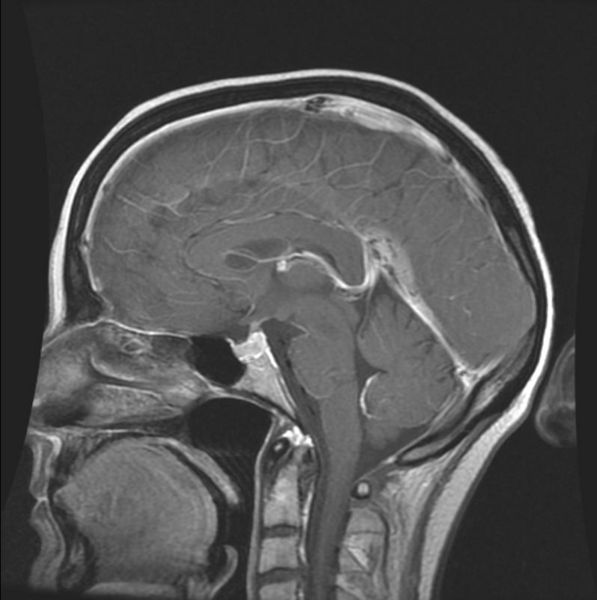 Descent of the brain
 -
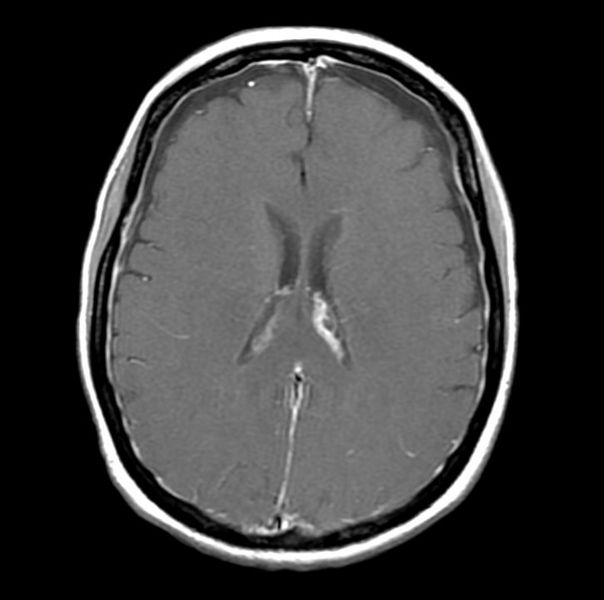 Enhancement of the pachymeninges
 -
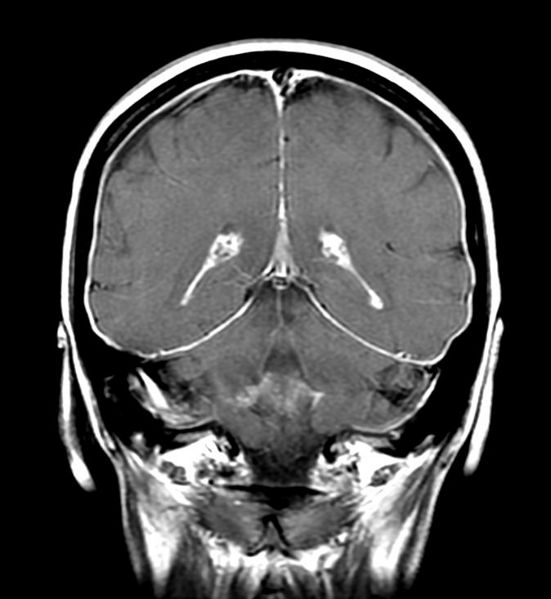 Enhancement of the pachymeninges


Treatment
Treatment
Although conservative management should by attempted, an epidural blood patch should be attempted, as it is the treatment of choice.
References
References
- ↑ Bromby A, Czosnyka Z, Allin D, Richards HK, Pickard JD, Czosnyka M (2007). “Laboratory study on “intracranial hypotension” created by pumping the chamber of a hydrocephalus shunt”. Cerebrospinal Fluid Res. 4: 2. doi:10.1186/1743-8454-4-2. PMC 1851975. PMID 17386089.
- ↑ Lay CM. Low Cerebrospinal Fluid Pressure Headache.Curr Treat Options Neurol. 2002 Sep;4(5):357-363
Editor-In-Chief: C. Michael Gibson, M.S., M.D. [1]