

Health Dictionary
Reliable, easy-to-read patient information on common medical conditions — written in plain language, free of jargon, and grounded in current evidence. Browse the most frequent diagnoses, understand what they mean for everyday life, and learn which steps and questions help you have a focused conversation with your doctor.
Stratum spinosum
Introduction
In the skin, the stratum spinosum is a multi-layered arrangement of cuboidal cells that sits beneath the stratum granulosum. Adjacent cells are joined by desmosomes, giving them a spiny appearance when the cells shrink during the staining process while the desmosomes hold firm. Their nuclei are often darkened (a condition called pyknosis), which is an early sign of cell death. Their fate is sealed because the nutrients and oxygen in interstitial fluid have become exhausted before the fluid is able to reach them by diffusion.
Cells of the stratum spinosum actively synthesize intermediate filaments called cytokeratins, which are composed of keratin. These intermediate filaments are anchored to the desmosomes, joining adjacent cells to provide structural support, helping the skin resist abrasion.
Additional images
Additional images
-
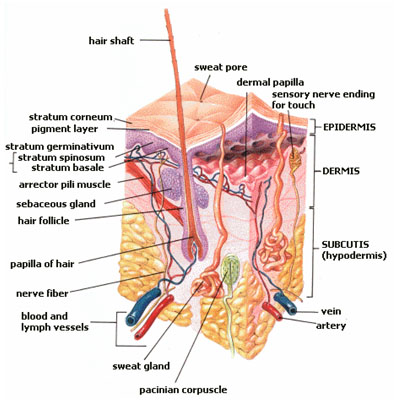 Cross-section of all skin layers.

External links
External links
- Histology image: 08422loa – Histology Learning System at Boston University – “Integument: thick skin”