

Health Dictionary
Reliable, easy-to-read patient information on common medical conditions — written in plain language, free of jargon, and grounded in current evidence. Browse the most frequent diagnoses, understand what they mean for everyday life, and learn which steps and questions help you have a focused conversation with your doctor.
Superficial branch of the radial nerve
Introduction
The superficial branch of the radial nerve passes along the front of the radial side of the forearm to the commencement of its lower third.
It lies at first slightly lateral to the radial artery, concealed beneath the Brachioradialis. In the middle third of the forearm, it lies behind the same muscle, close to the lateral side of the artery.
It quits the artery about 7 cm. above the wrist, passes beneath the tendon of the Brachioradialis, and, piercing the deep fascia, divides into two branches: lateral and medial.
Lateral branch
Lateral branch
The lateral branch, the smaller, supplies the radial side of the thumb (by a digital nerve), the skin of the radial side and ball of the thumb, joining with the volar branch of the lateral antibrachial cutaneous nerve.
Medial branch
Medial branch
The medial branch communicates, above the wrist, with the dorsal branch of the lateral antibrachial cutaneous, and, on the back of the hand, with the dorsal branch of the ulnar nerve.
It then divides into four digital nerves, which are distributed as follows: the first supplies the ulnar side of the thumb; the second, the radial side of the index finger; the third, the adjoining sides of the index and middle fingers; the fourth communicates with a filament from the dorsal branch of the ulnar nerve, and supplies the adjacent sides of the middle and ring fingers.
Additional images
Additional images
-
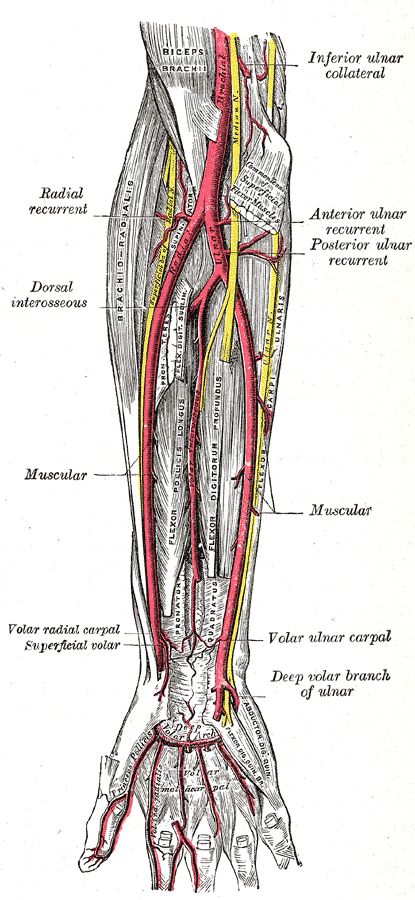 Ulnar and radial arteries. Deep view.
 -
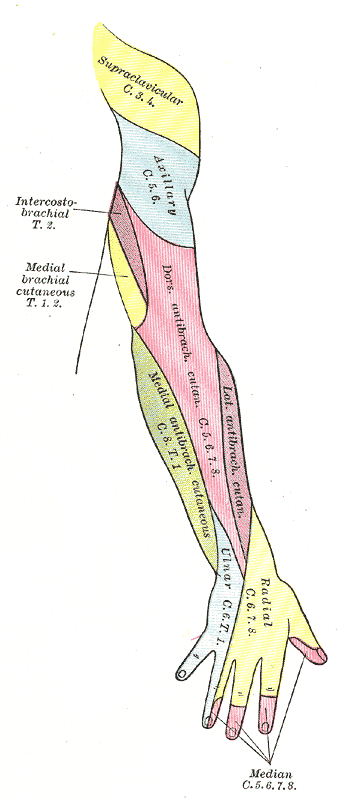 Diagram of segmental distribution of the cutaneous nerves of the right upper extremity. Posterior view.
 -
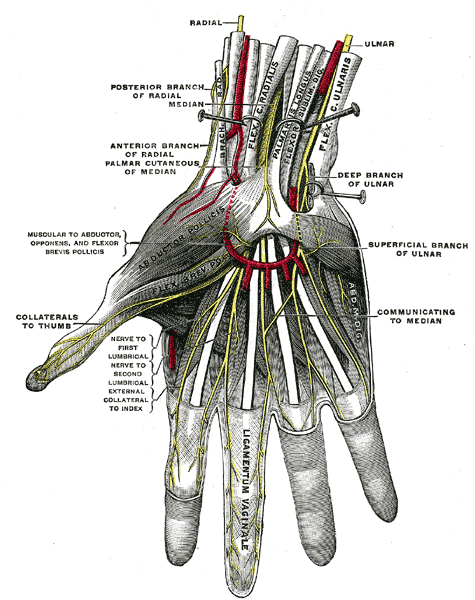 Superficial palmar nerves.
 -
 Deep palmar nerves.
 -
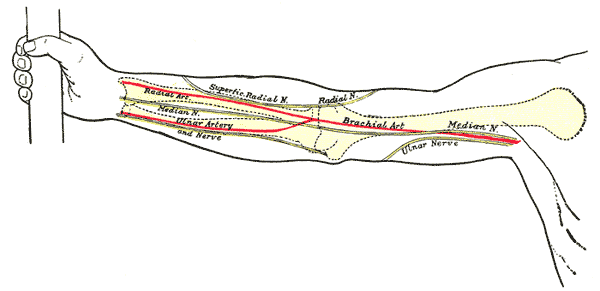 Front of right upper extremity, showing surface markings for bones, arteries, and nerves.


External links
External links
Editor-In-Chief: Template:Infobox Nerve C. Michael Gibson, M.S., M.D. [1]