

Health Dictionary
Reliable, easy-to-read patient information on common medical conditions — written in plain language, free of jargon, and grounded in current evidence. Browse the most frequent diagnoses, understand what they mean for everyday life, and learn which steps and questions help you have a focused conversation with your doctor.
Superficial temporal
Introduction
- Lua error in Module:Redirect at line 65: could not parse redirect on page “Superficial temporal”.
Overview
Overview
In human anatomy, the superficial temporal artery is a major artery of the head. It arises from the external carotid artery when it bifurcates into the superficial temporal artery and maxillary artery.
Its pulse is palpable superior to the zygomatic arch, anterior and superior to the tragus.
Anatomical details
Anatomical details
The superficial temporal artery, the smaller of the two terminal branches of the external carotid, appears, from its direction, to be the continuation of that vessel.
It begins in the substance of the parotid gland, behind the neck of the mandible, and crosses over the posterior root of the zygomatic process of the temporal bone; about 5 cm. above this process it divides into two branches, a frontal and a parietal.
Relations
As it crosses the zygomatic process, it is covered by the Auricularis anterior muscle, and by a dense fascia; it is crossed by the temporal and zygomatic branches of the facial nerve and one or two veins, and is accompanied by the auriculotemporal nerve, which lies immediately behind it.
Clinical relevance
Clinical relevance
The superficial temporal artery is often affected in temporal arteritis and biopsied if the diagnosis is suspected.
Additional images
Additional images
-
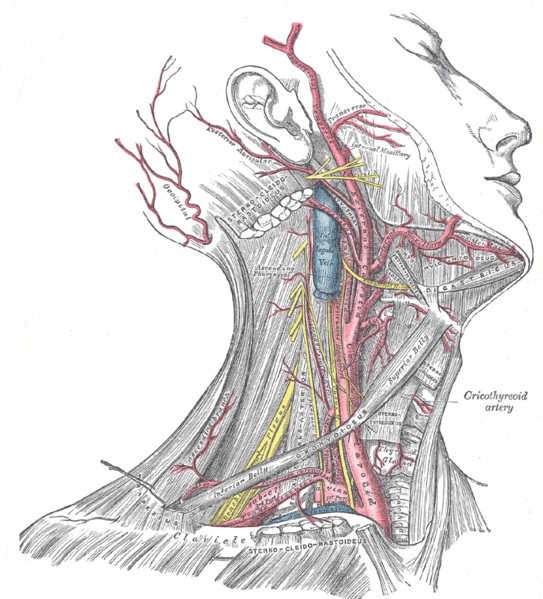 Superficial dissection of the right side of the neck, showing the carotid and subclavian arteries.
 -
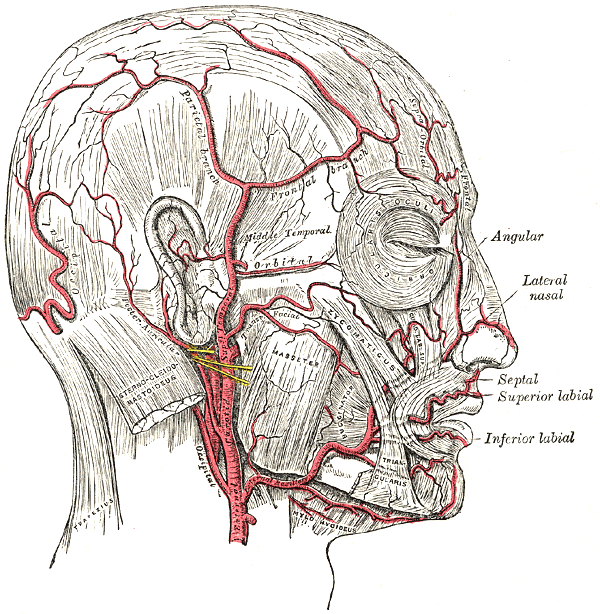 The arteries of the face and scalp.
 -
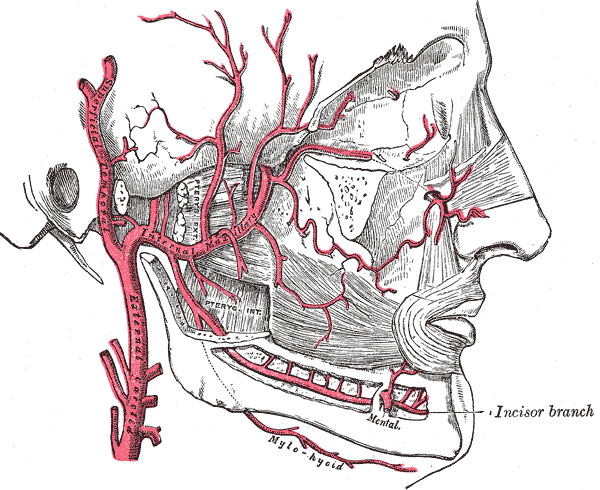 Plan of branches of internal maxillary artery.
 -
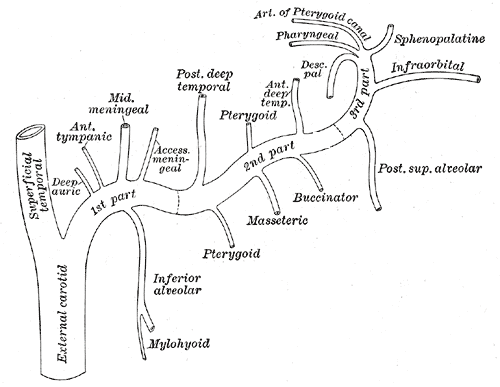 Plan of branches of internal maxillary artery.
 -
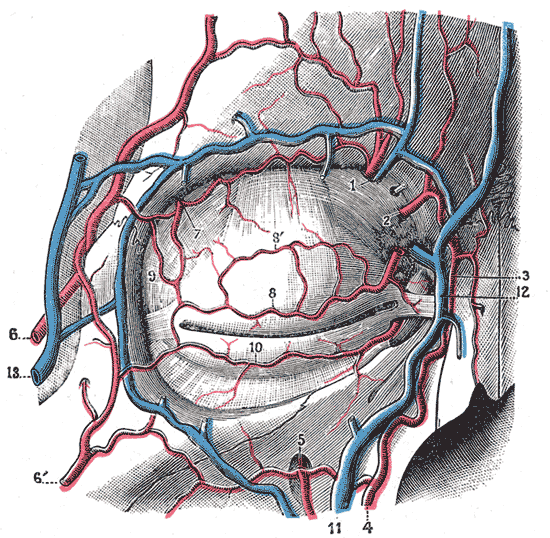 Bloodvessels of the eyelids, front view.


Editor-In-Chief: C. Michael Gibson, M.S., M.D. [1]