

Health Dictionary
Reliable, easy-to-read patient information on common medical conditions — written in plain language, free of jargon, and grounded in current evidence. Browse the most frequent diagnoses, understand what they mean for everyday life, and learn which steps and questions help you have a focused conversation with your doctor.
Superior clunial nerves
Introduction
The superior clunial nerves innervate the skin of the upper part of the buttocks. They are the terminal ends of the posterior rami of lumbar spinal nerves (L1, 2, 3).
Clinicals
Clinicals
Superior Cluneal Nerve Entrapment
The medial branch of the superior cluneal nerve passes over the iliac crest through a tunnel formed by the thoracolumbar fascia and the superior rim of the iliac crest. This branch of the superior cluneal nerve may become restricted in its osteofibrous tunnel against the iliac crest, just as osteofibrous tunnels affect other nerves, such as in carpal tunnel syndrome. Active release is a common treatment.
Additional images
Additional images
-
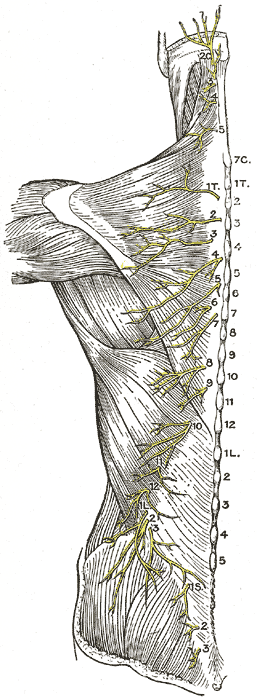 Diagram of the distribution of the cutaneous branches of the posterior divisions of the spinal nerves.
 -
 Areas of distribution of the cutaneous branches of the posterior divisions of the spinal nerves.


External links
External links
- Template:EMedicineDictionary
- Template:NormanAnatomy
- Template:SUNYAnatomyLabs – “Superficial Anatomy of the Lower Extremity: Cutaneous Nerves of the Posterior Aspect of the Lower Extremity”
References
References
- Hammer, Warren. 1998. “Superior Cluneal Nerve Entrapment — An Overlooked Cause of Low Back Pain,” Dynamic Chiropractic, 16(10). link
Editor-In-Chief: Template:Infobox Nerve C. Michael Gibson, M.S., M.D. [1]