

Health Dictionary
Reliable, easy-to-read patient information on common medical conditions — written in plain language, free of jargon, and grounded in current evidence. Browse the most frequent diagnoses, understand what they mean for everyday life, and learn which steps and questions help you have a focused conversation with your doctor.
Sympathetic trunks
Introduction
Overview
Overview
The sympathetic trunk (sympathetic chain, gangliated cord) is a bundle of nerve fibers that runs from the base of the skull to the coccyx. There are two sympathetic trunks in the body, a right one and a left one.
Structure
Structure
The sympathetic trunk travels inferiorly from the skull, just lateral to the vertebral bodies. It interacts with the spinal nerves or their ventral root by way of rami communicantes.
The superior end of it is continued upward through the carotid canal into the skull, and forms a plexus on the internal carotid artery; the inferior part travels in front of the coccyx, where it converges with the other trunk at a structure known as the ganglion impar.
Along the length of the sympathetic trunk are ganglia known as paravertebral ganglia.
Function
Function
The sympathetic trunk is a fundamental part of the sympathetic division of the autonomic nervous system. It allows nerve fibers to travel to spinal nerves that are superior and inferior to the one in which it originated. Also, a number of nerves, such as most of the splanchnic nerves, arise directly from the trunks.
Additional images
Additional images
-
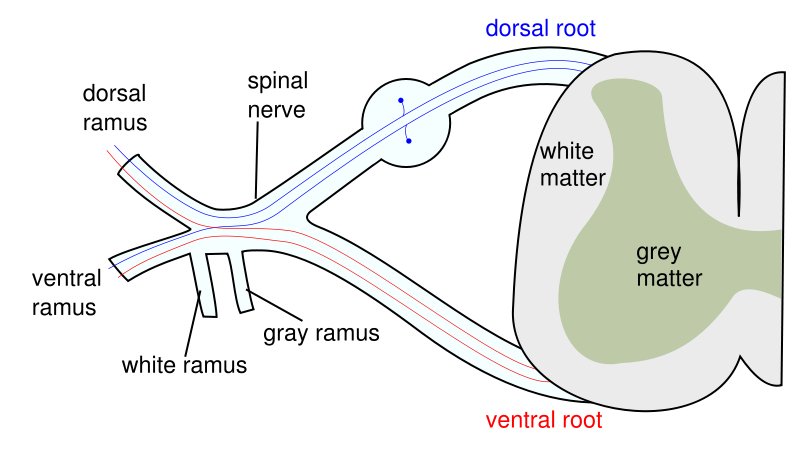 The formation of the spinal nerve from the dorsal and ventral roots.
 -
 Transverse section of thorax, showing relations of pulmonary artery.
 -
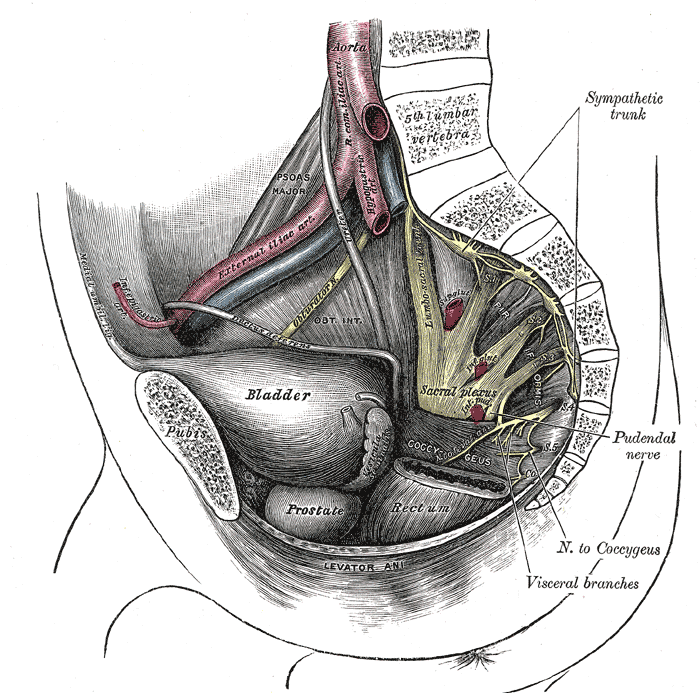 Dissection of side wall of pelvis showing sacral and pudendal plexuses.
 -
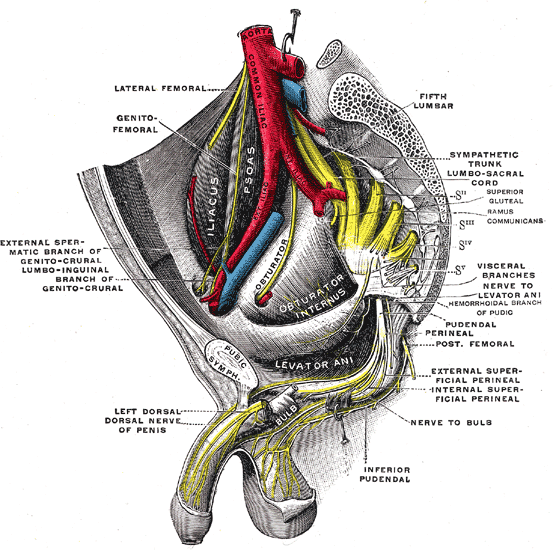 Sacral plexus of the right side.


External links
External links
- Template:SUNYAnatomyFigs – “The position of the right and left vagus nerves, and sympathetic trunks in the mediastinum.”
- Template:SUNYAnatomyLabs – “The Female Pelvis: The Posterolateral Pelvic Wall”
- Template:GPnotebook
- Template:EMedicineDictionary
- Template:UMichAtlas – “Autonomic Connections of the Spinal Cord”
- Diagram at umm.edu
Template:Gray’s Template:Autonomic Template:Spinal cord
Editor-In-Chief: C. Michael Gibson, M.S., M.D. [1]