

Health Dictionary
Reliable, easy-to-read patient information on common medical conditions — written in plain language, free of jargon, and grounded in current evidence. Browse the most frequent diagnoses, understand what they mean for everyday life, and learn which steps and questions help you have a focused conversation with your doctor.
Trapezoid bone
Introduction
The trapezoid bone (lesser multangular bone) is a carpal bone in tetrapods, including humans. It is the smallest bone in the distal row. It may be known by its wedge-shaped form, the broad end of the wedge constituting the dorsal, the narrow end the palmar surface; and by its having four articular facets touching each other, and separated by sharp edges.
The etymology derives from the Greek trapezion which means “irregular quadrilateral,” from tra- “four” and peza “foot” or “edge.” Literally, “a little table” from trapeza meaning “table” and -oeides “shaped.”
Surfaces
Surfaces
The superior surface, quadrilateral, smooth, and slightly concave, articulates with the scaphoid.
The inferior surface articulates with the proximal end of the second metacarpal bone; it is convex from side to side, concave from before backward and subdivided by an elevated ridge into two unequal facets.
The dorsal and palmar surfaces are rough for the attachment of ligaments, the former being the larger of the two.
The lateral surface, convex and smooth, articulates with the trapezium.
The medial surface is concave and smooth in front, for articulation with the capitate; rough behind, for the attachment of an interosseous ligament.
See also
See also
- Bone terminology
- Terms for anatomical location
- Trapezoid distinguishing meanings of trapezoid and trapezium in American English and British English
Additional images
Additional images
-
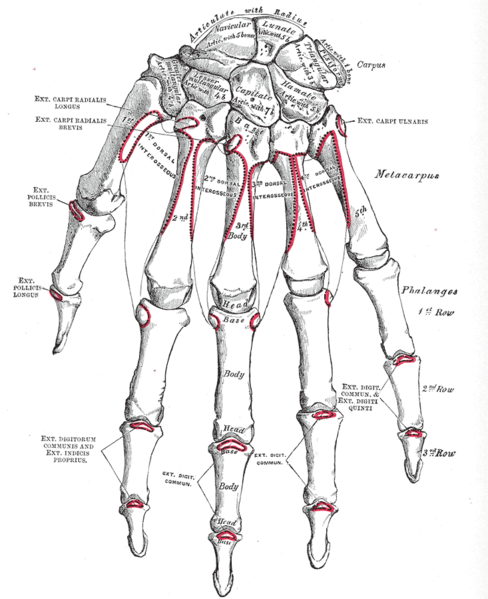 Bones of the left hand. Dorsal surface.
 -
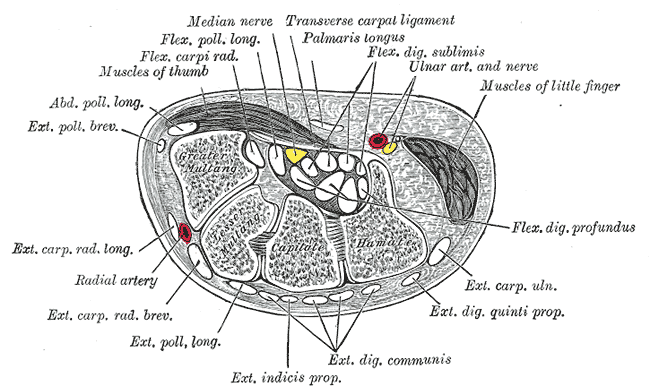 Transverse section across the wrist and digits.


Template:Bones of upper extremity
ar:العظم شبه المنحرف de:Kleines Vieleckbein eu:Trapezoidea (hezurra) it:Trapezoide hu:Kis trapézcsont nl:Os trapezoideum sk:Lichobežníkovitá menšia kosť th:กระดูกทราพีซอยด์
Editor-In-Chief: C. Michael Gibson, M.S., M.D. [1]