

Health Dictionary
Reliable, easy-to-read patient information on common medical conditions — written in plain language, free of jargon, and grounded in current evidence. Browse the most frequent diagnoses, understand what they mean for everyday life, and learn which steps and questions help you have a focused conversation with your doctor.
Triglyceride biochemistry
Introduction
Overview
Overview
Triglyceride (more properly known as triacylglycerol, TAG or triacylglyceride) is glyceride in which the glycerol is esterified with three fatty acids.[1] It is the main constituent of vegetable oil and animal fats.
Biochemistry
Biochemistry
Structure
The chemical formula is RCOO-CH2CH(-OOCR’)CH2-OOCR”, where R, R’, and R” are longer alkyl chains. The three fatty acids RCOOH, R’COOH and R”COOH can be all different, all the same, or only two the same.
Chain lengths of the fatty acids in naturally occurring triglycerides can be of varying lengths but 16, 18 and 20 carbons are the most common. Natural fatty acids found in plants and animals are typically composed only of even numbers of carbon atoms due to the way they are bio-synthesised from acetyl CoA. Bacteria, however, possess the ability to synthesise odd- and branched-chain fatty acids. Consequently, ruminant animal fat contains odd numbered fatty acids, such as 15, due to the action of bacteria in the rumen.
Most natural fats contain a complex mixture of individual triglycerides; because of this, they melt over a broad range of temperatures. Cocoa butter is unusual in that it is composed of only a few triglycerides, one of which contains palmitic, oleic and stearic acids in that order. This gives rise to a fairly sharp melting point, causing chocolate to melt in the mouth without feeling greasy.
-
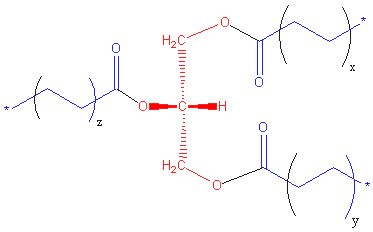 General structure of a triglyceride
 -
 Example of an unsaturated fat triglyceride. Left part: glycerol, right part from top to bottom: palmitic acid, oleic acid, alpha-linolenic acid, chemical formula: C55H98O6


Industrial Uses
Triglycerides are also split into their components via transesterification during the manufacture of biodiesel. The fatty acid monoalkyl ester can be used as fuel in diesel engines. The glycerin has many uses, such as in the manufacture of food and in the production of pharmaceuticals.
Other examples are the Triglyceride process in the decaffeination of coffee beans.
Staining
Staining
Staining for fatty acids, triglycerides, lipoproteins, and other lipids is done through the use of lysochromes (fat-soluble dyes). These dyes can allow the qualification of a certain fat of interest by staining the material a specific color. Some examples: Sudan IV, Oil Red O, and Sudan Black B.
References
References
- ↑ “Nomenclature of Lipids”. IUPAC-IUB Commission on Biochemical Nomenclature (CBN). Retrieved 2007-03-08.
Editor-In-Chief: C. Michael Gibson, M.S., M.D. [1]