

Health Dictionary
Reliable, easy-to-read patient information on common medical conditions — written in plain language, free of jargon, and grounded in current evidence. Browse the most frequent diagnoses, understand what they mean for everyday life, and learn which steps and questions help you have a focused conversation with your doctor.
Tubular glands
Introduction
If a gland retains its shape as a tube throughout it is termed a tubular gland.[1]
[2]
Tubular glands are further classified as one of the following:
| Name | Description | Location |
| “simple tubular” or “simple straight tubular”[3] or “straight tubular”[4] | if there is no division | large intestine (Crypts of Lieberkühn), uterine glands |
| “simple branched tubular”[5] or “compound tubular”[6] | if branching occurs | pyloric glands of stomach |
| “coiled tubular” or “simple coiled tubular”[7] | if the gland is coiled without losing its tubular form | sweat glands |
References
References
- ↑ Template:EMedicineDictionary
- ↑ http://www.siumed.edu/~dking2/intro/glands.htm#tubule
- ↑ Histology at University of Southern California epi/c_43 – “Simple Straight Tubular Gland”
- ↑ http://www.lab.anhb.uwa.edu.au/mb140/CorePages/Epithelia/Epithel.htm#labtube
- ↑ Histology at KUMC glands-glands12
- ↑ Histology at University of Southern California epi/c_57 – “Compound Tubular Gland”
- ↑ Histology at University of Southern California epi/c_46 – “Simple Coiled Tubular Gland”
Additional images
Additional images
-
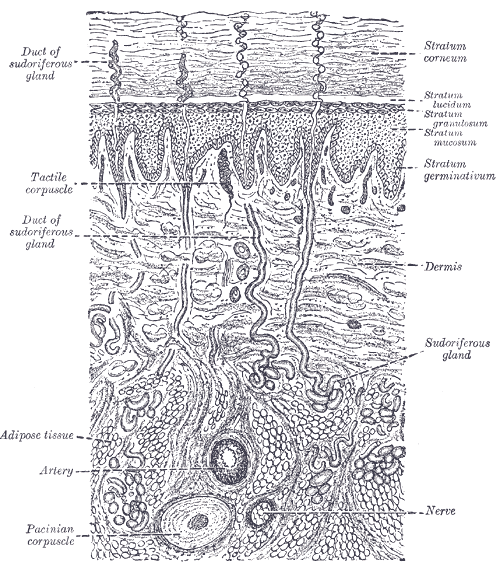 A diagrammatic sectional view of the skin (magnified).
 -
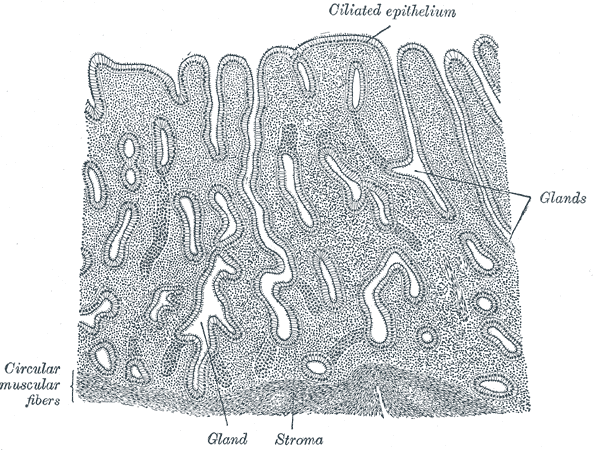 Vertical section of mucous membrane of human uterus.
 -
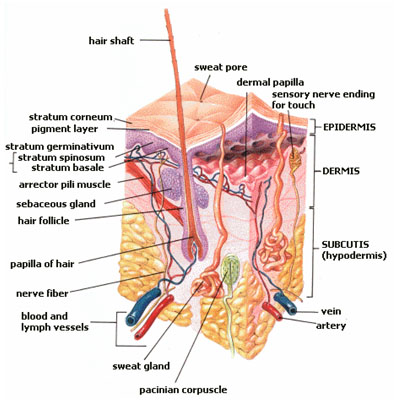 Skin
Skin


Editor-In-Chief: C. Michael Gibson, M.S., M.D. [1] Phone:617-632-7753