

Health Dictionary
Reliable, easy-to-read patient information on common medical conditions — written in plain language, free of jargon, and grounded in current evidence. Browse the most frequent diagnoses, understand what they mean for everyday life, and learn which steps and questions help you have a focused conversation with your doctor.
Vestibular nerve
Introduction
Overview
Overview
The vestibular nerve is one of the two branches of the Vestibulocochlear nerve (the cochlear nerve being the other). It goes to the semicircular canals via the vestibular ganglion. It receives positional information.
Axons of the vestibular nerve synapse in the vestibular nucleus on the lateral floor and wall of the fourth ventricle in the pons and medulla.
It arises from bipolar cells in the vestibular ganglion, ganglion of Scarpa, which is situated in the upper part of the outer end of the internal auditory meatus.
Branches
Branches
The peripheral fibers divide into three branches:
- the superior branch passes through the foramina in the area vestibularis superior and ends in the utricle and in the ampullae of the superior and lateral semicircular ducts;
- the fibers of the inferior branch traverse the foramina in the area vestibularis inferior and end in the saccule;
- the posterior branch runs through the foramen singulare and supplies the ampulla of the posterior semicircular duct.
Additional images
Additional images
-
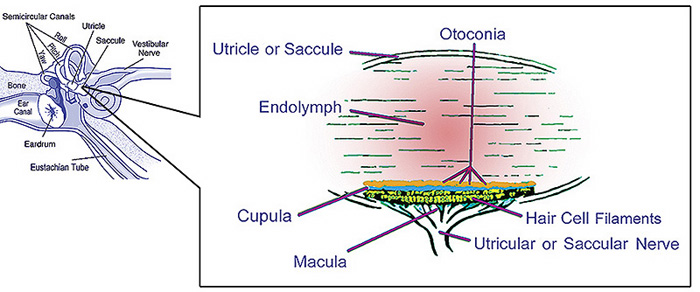 Illustration of otolith organs
 -
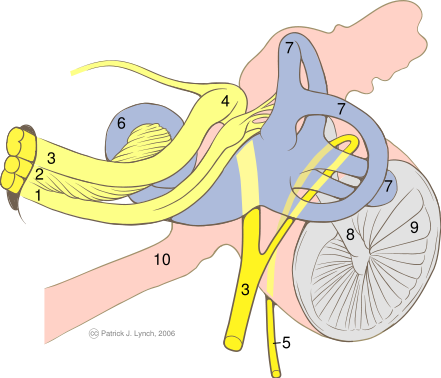 Ear internal anatomy


Editor-In-Chief: Template:Infobox Nerve C. Michael Gibson, M.S., M.D. [1]