

Health Dictionary
Reliable, easy-to-read patient information on common medical conditions — written in plain language, free of jargon, and grounded in current evidence. Browse the most frequent diagnoses, understand what they mean for everyday life, and learn which steps and questions help you have a focused conversation with your doctor.
Virchow's node
Introduction
Overview
Overview
Virchow’s node (or signal node) is an enlarged, hard, left supraclavicular lymph node which can contain metastasis of visceral (abdominal) malignancy.
Clinical significance
Clinical significance
Malignancies of the internal organs can reach an advanced stage before giving symptoms. Stomach cancer, for example, can remain symptomless while metastatizing. One of the first visible spots where these tumors metastatise is the left supraclavicular lymph node. The left supraclavicular node is the classical Virchow’s node because it is on the left side of the neck where the lymphatic drainage of most of the body (from the thoracic duct) enters the venous circulation via the left subclavian vein.
Differential diagnosis of an enlarged Virchow’s node includes lymphoma, various intra-abdominal malignancies, breast cancer, lung cancer, and infection (e.g. of the arm).
Eponym
Eponym
It is named after Rudolf Virchow (1821-1902), the German pathologist who first described the association. The presence of an enlarged Virchow’s node is also referred to as Troisier’s sign, named after Charles Emile Troisier, who also described this.
Because an enlarged Virchow’s node is often a harbinger of malignant disease, it is sometimes called the sentinel node. This needs to be contrasted with the technique of sentinel lymph node biopsy. It should also not be confused with the ‘sentinel gland’ of the greater omentum.[1]
Additional images
Additional images
-
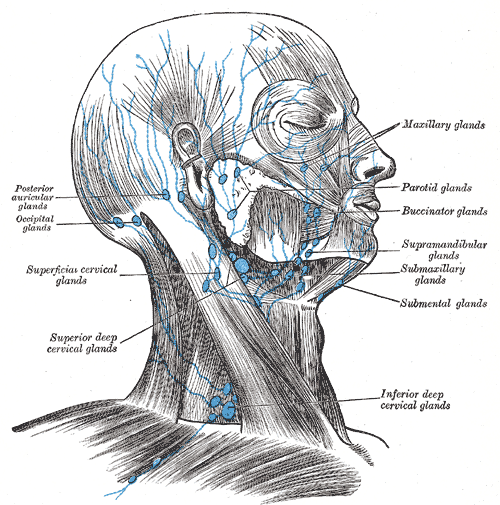 Superficial lymph glands and lymphatic vessels of head and neck.

External links
External links
- Template:WhoNamedIt
- Template:GPnotebook
- Template:FPnotebook
- Mizutani M, Nawata S, Hirai I, Murakami G, Kimura W (2005). “Anatomy and histology of Virchow’s node”. Anat Sci Int. 80 (4): 193–8. PMID 16333915.
Acknowledgements
Acknowledgements
The content on this page was first contributed by: C. Michael Gibson M.S., M.D.
Template:Lymphatics of head and neck
Template:Skin and subcutaneous tissue symptoms and signs Template:Nervous and musculoskeletal system symptoms and signs Template:Urinary system symptoms and signs Template:Cognition, perception, emotional state and behaviour symptoms and signs Template:Speech and voice symptoms and signs Template:General symptoms and signs
Editor-In-Chief: Template:Infobox Lymph Template:Search infobox C. Michael Gibson, M.S., M.D. [1]