

Health Dictionary
Reliable, easy-to-read patient information on common medical conditions — written in plain language, free of jargon, and grounded in current evidence. Browse the most frequent diagnoses, understand what they mean for everyday life, and learn which steps and questions help you have a focused conversation with your doctor.
Wolffian ducts
Introduction
Overview
Overview
The Wolffian duct (also known as archinephric duct, Leydig’s duct, mesonephric duct, or nephric duct) is a paired organ found in mammals including humans during embryogenesis.
It connects the primitive kidney Wolffian body (or mesonephros) to the cloaca and serves as the anlage for certain male reproductive organs.
Development
Development

In both the male and the female the Wolffian duct develops in to the trigone of urinary bladder, a part of the bladder wall. However, further development differentiates between the sexes in the development of the urinary and reproductive organs.
Male development
In a male, it develops into a system of connected organs between the testis and the prostate, namely the rete testis, the efferent ducts, the epididymis, the vas deferens, the seminal vesicle, and the prostate.
For this it is critical that the ducts are exposed to testosterone during embryogenesis. Testosterone binds to and activates androgen receptor, affecting intracellular signals and modifying the expression of numerous genes.[1]
In the mature male, the function of this system is to store and mature sperm, and provide accessory semen fluid.
Female development
In the female, in the absence of testosterone support, the Wolffian ducts regresses,and inclusions may persist . As a residual the epoophoron and Skene’s glands may be present. Also, lateral to the wall of the vagina a Gartner’s duct or cyst could develop as a remnant.
History
History
It is named after Caspar Friedrich Wolff who described the mesonephros and its ducts in his dissertation in 1759. [2]
Additional images
Additional images
-
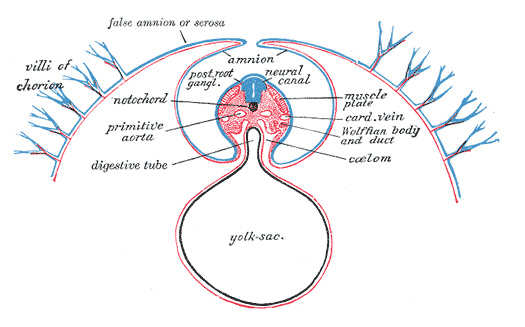 Diagram of a transverse section, showing the mode of formation of the amnion in the chick.
 -
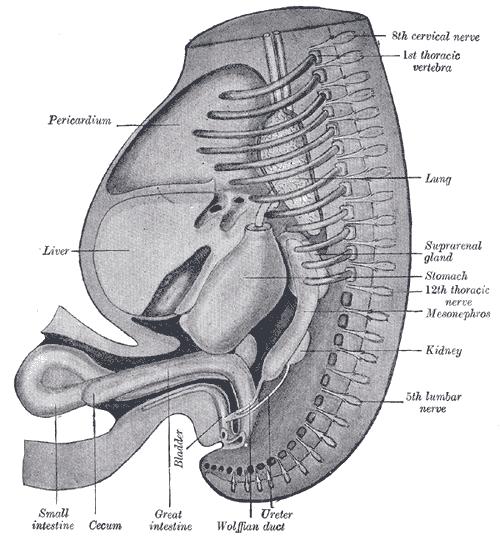 Reconstruction of a human embryo of 17 mm.
 -
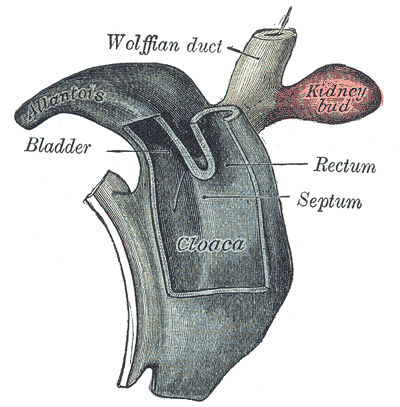 Cloaca of human embryo from twenty-five to twenty-seven days old.
 -
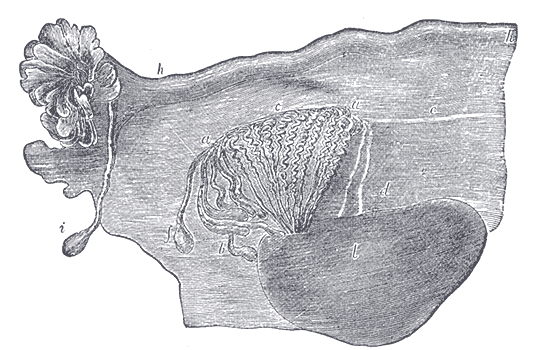 Broad ligament of adult, showing epoöphoron.
 -
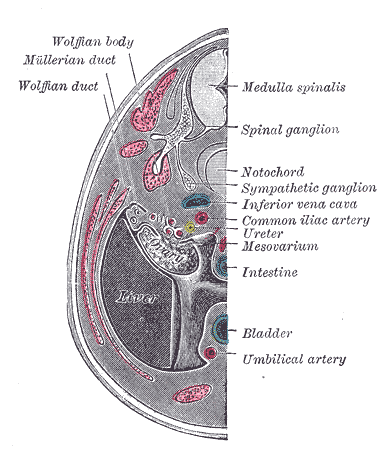 Transverse section of human embryo eight and a half to nine weeks old.
 -
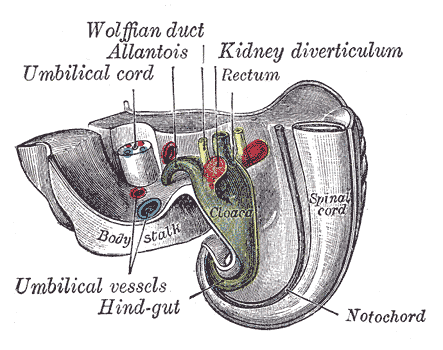 Tail end of human embryo twenty-five to twenty-nine days old.
 -
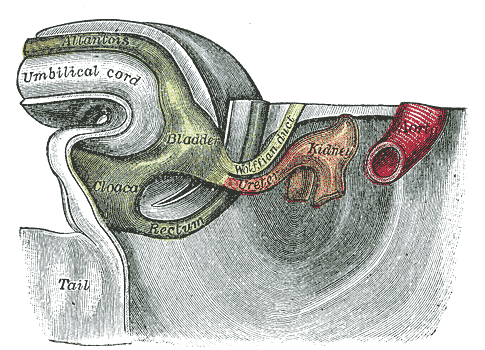 Tail end of human embryo thirty-two to thirty-three days old.
 -
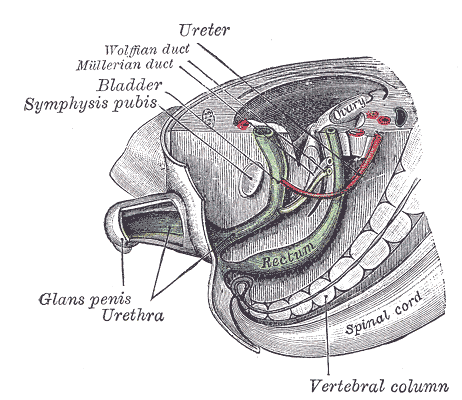 Tail end of human embryo; from eight and a half to nine weeks old.
 -
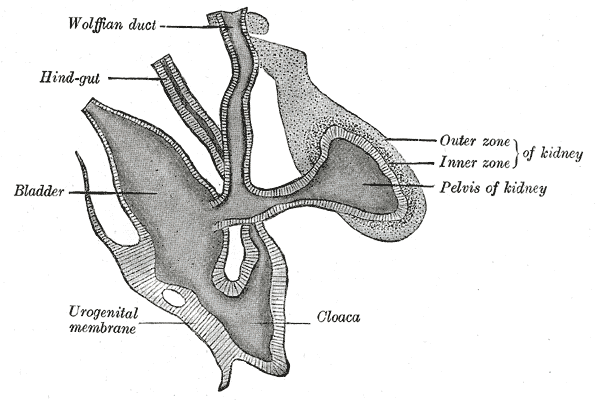 Primitive kidney and bladder, from a reconstruction.


See also
See also
References
References
- ↑ Hannema SE, Print CG, Charnock-Jones DS, Coleman N, Hughes IA (2006). “Changes in gene expression during Wolffian duct development”. Horm. Res. 65 (4): 200–9. doi:10.1159/000092408. PMID 16567946.
- ↑ Template:WhoNamedIt
Editor-In-Chief: C. Michael Gibson, M.S., M.D. [1]