Reliable, easy-to-read patient information on common medical conditions — written in plain language, free of jargon, and grounded in current evidence. Browse the most frequent diagnoses, understand what they mean for everyday life, and learn which steps and questions help you have a focused conversation with your doctor.
In 1970, Aarskog-Scott syndrome (AAS) was first described by Aarskog, a Norwegian pediatrician and human geneticist.
In 1971, Scott described the association between ligamentous laxity which results in hyperextensibility of the fingers, genu recurvatum, flat feet and Aarskog-Scott syndrome (AAS).[1]
In 1973, Sugarman et al described an Mexican-American family in which 2 half brothers and their 2 maternal uncles had Aarskog syndrome.
In 1984, Van den Bergh et al. mentioned a patient with Aarskog-Scott syndrome (AAS) development of syndrome of benign intracranial hypertension after minor headtrauma.[5]
In 1994, Fernandez et al. mentioned 10 Japanese patients who are positive with Aarskog syndrome.[6]
In 1998, Logie and Porteous concluded that in patients with Aarskog-Scott syndrome (AAS) have normal intelligence.[7]
In 2002, Lebel et al. is the one who found a missense mutation in the FGD1 gene.[8]
In 2005, Orrico et al. described attention deficit-hyperactivity disorder (ADHD) in patient with Aarskog-Scott syndrome (AAS).[9]
In 2010, Orrico et al. genetically confirmed 11 patients for Aarskog-Scott syndrome.[10]
Detection of FGD1 mutations. (A) Schematic representation of the domains of the FGD1 protein showing mutations (p.Glu380* and p.Gln664*) identified in patients with AAS. Arrows indicate the positions of the mutated nucleotides in FGD1. (B) sequencing results (p.Glu380* and p.Gln664*) detected in exon 5 and 12, respectively. The altered amino acids are shown in red. Case courtesy by Mariana Pérez-Coria et al[11]Classification
Classification
There is no established system for the classification of Aarskog-Scott syndrome (AAS).[12]
These abnormalities of FGD1/Cdc42 signaling pathway may produce an defective embryonic development and abnormal endochondral and intramembranous bone formation and leads to Aarskog-Scott syndrome (AAS).
Causes
Causes
Genetic Cause
Aarskog-Scott syndrome (AAS) is caused by a mutation in the FGD1 gene.
Differentiating Aarskog-Scott syndrome from other Diseases
Differentiating Aarskog-Scott syndrome from other Diseases
Patients with clinical features of Aarskog syndrome-(A) Patient 1; note distinctive facial characteristics and interdigital tracts in both hands. (B) Patient 2; discrete facial features and the shawl scrotum can be appreciated. (C) Patient 3 and his mother (patient 8); note prominent forehead, widow’s peak, hypertelorism, and fold under the lower lip. (D) Patient 4 with widow’s peak, midface hypoplasia, ptosis, clinodactyly, and brachydactyly. (E) Patient 5, brother of patient 4, with distinctive facial features, clinodactyly, and brachydactyly. Case courtesy by Mariana Pérez-Coria et al[46]History and Symptoms
History and Symptoms
Common Symptoms
Common symptoms of Aarskog-Scott syndrome (AAS) include:[25][47]
There are no diagnostic laboratory findings associated with Aarskog-Scott syndrome (AAS).
Electrocardiogram
Electrocardiogram
There are no ECG findings associated with Aarskog-Scott syndrome (AAS).
X-Ray Findings
X-Ray Findings
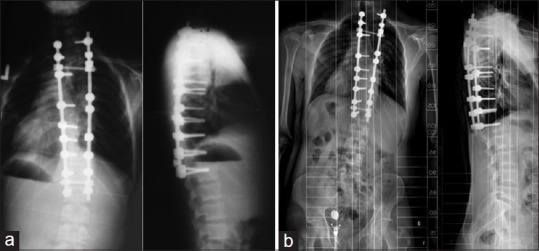
Scoliosis- a) Early postoperative X-ray (b) 10 years follow-up X-ray.Case courtesy Kerim Sariyilmaz[54]There are no x-ray findings associated with Aarskog-Scott syndrome (AAS). However, an x-ray may be helpful in the diagnosis of complications of Aarskog-Scott syndrome (AAS), which include:[55][56][57]
There are no MRI findings associated with Aarskog-Scott syndrome (AAS).
Medical Therapy
Medical Therapy
There is no treatment for Aarskog-Scott syndrome (AAS); the mainstay of therapy is symptomatic care.
Patients with short stature are treated with growth hormone, which shows promising results in increasing the height of the patients.[59][60]
Interventions
Interventions
There are some recommended therapeutic interventions for the management of Aarskog-Scott syndrome (AAS), which includes speech pathologists, audiologists and eye specialists who can improve the quality of the patient’s life.
↑Grier, Robert E.; Farrington, Frank H.; Kendig, Robert; Mamunes, Peter; Opitz, John M. (1983). “Autosomal dominant inheritance of the Aarskog syndrome”. American Journal of Medical Genetics. 15 (1): 39–46. doi:10.1002/ajmg.1320150105. ISSN0148-7299.
↑Bawle, E.; Tyrkus, M.; Lipman, S.; Bozimowski, D.; Opitz, John M. (1984). “Aarskog syndrome: Full male and female expression associated with an X-autosome translocation”. American Journal of Medical Genetics. 17 (3): 595–602. doi:10.1002/ajmg.1320170307. ISSN0148-7299.
↑Zou, Weiguo; Greenblatt, Matthew B.; Shim, Jae-Hyuck; Kant, Shashi; Zhai, Bo; Lotinun, Sutada; Brady, Nicholas; Hu, Dorothy Zhang; Gygi, Steven P.; Baron, Roland; Davis, Roger J.; Jones, Dallas; Glimcher, Laurie H. (2011). “MLK3 regulates bone development downstream of the faciogenital dysplasia protein FGD1 in mice”. Journal of Clinical Investigation. 121 (11): 4383–4392. doi:10.1172/JCI59041. ISSN0021-9738.
↑Weinstein, Lee S. (2016). “GNAS and McCune-Albright/Fibrous Dysplasia, Albright Hereditary Osteodystrophy, and Pseudohypoparathyroidism”: 1178–1181. doi:10.1093/med/9780199934522.003.0179.
↑Reza Jabalameli, M.; Briceno, Ignacio; Martinez, Julio; Briceno, Ignacio; J. Pengelly, Reuben; Ennis, Sarah; Collins, Andrew (2016). “Aarskog-Scott syndrome: phenotypic and genetic heterogeneity”. AIMS Genetics. 3 (1): 49–59. doi:10.3934/genet.2016.1.49. ISSN2377-1143.
↑Reza Jabalameli, M.; Briceno, Ignacio; Martinez, Julio; Briceno, Ignacio; J. Pengelly, Reuben; Ennis, Sarah; Collins, Andrew (2016). “Aarskog-Scott syndrome: phenotypic and genetic heterogeneity”. AIMS Genetics. 3 (1): 49–59. doi:10.3934/genet.2016.1.49. ISSN2377-1143.