
Böhler’s angle

Editor-In-Chief: C. Michael Gibson, M.S., M.D. [1]; Associate Editor(s)-in-Chief: Mohammadmain Rezazadehsaatlou[2].
Synonyms and Keywords: Heel Bone Fracture
Overview
The calcaneus bone known as the largest tarsal bone[1].
Historical Perspective
In early 1990s,Lorenz Böhler (1885-1973) introduced the Böhler’s angle[2].
Böhler’s angle
Böhler’s angle (Bohler angle, Boehler angle, calcaneal angle, or tuber joint angle)[3][4][5]: Is located through two lines tangent to the calcaneus: the anterior and posterior aspects of the superior calcaneus and in normal healthy non-fractured calcaneal bone is ranged from 20° to 40°. The lateral radiograph gives the best view of this angle. A value less than 20° can be seen in calcaneal fracture. In calcaneal fracture this angle decreases.
These two angles are useful for the calcaneal fracture severity evaluations and the related surgical managements.
-
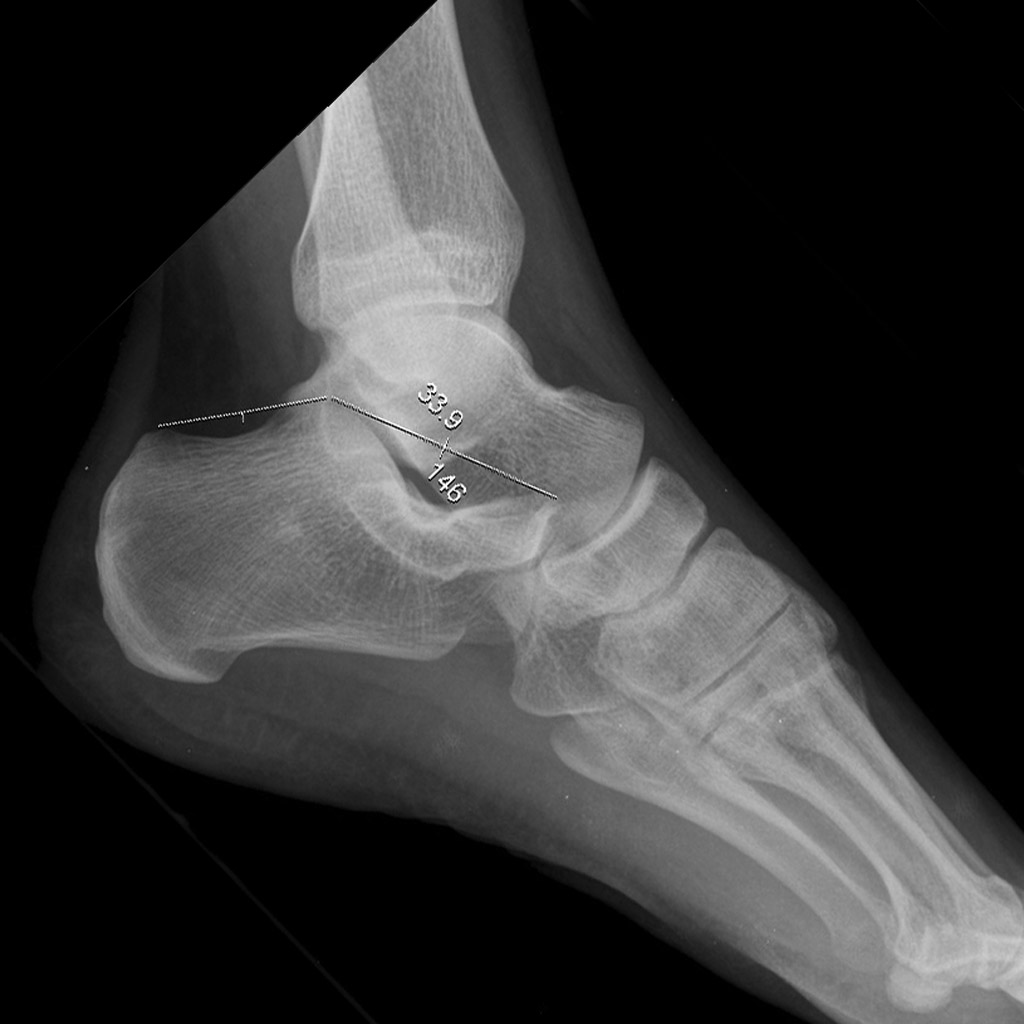 Normal Bohler’s angle.
 -
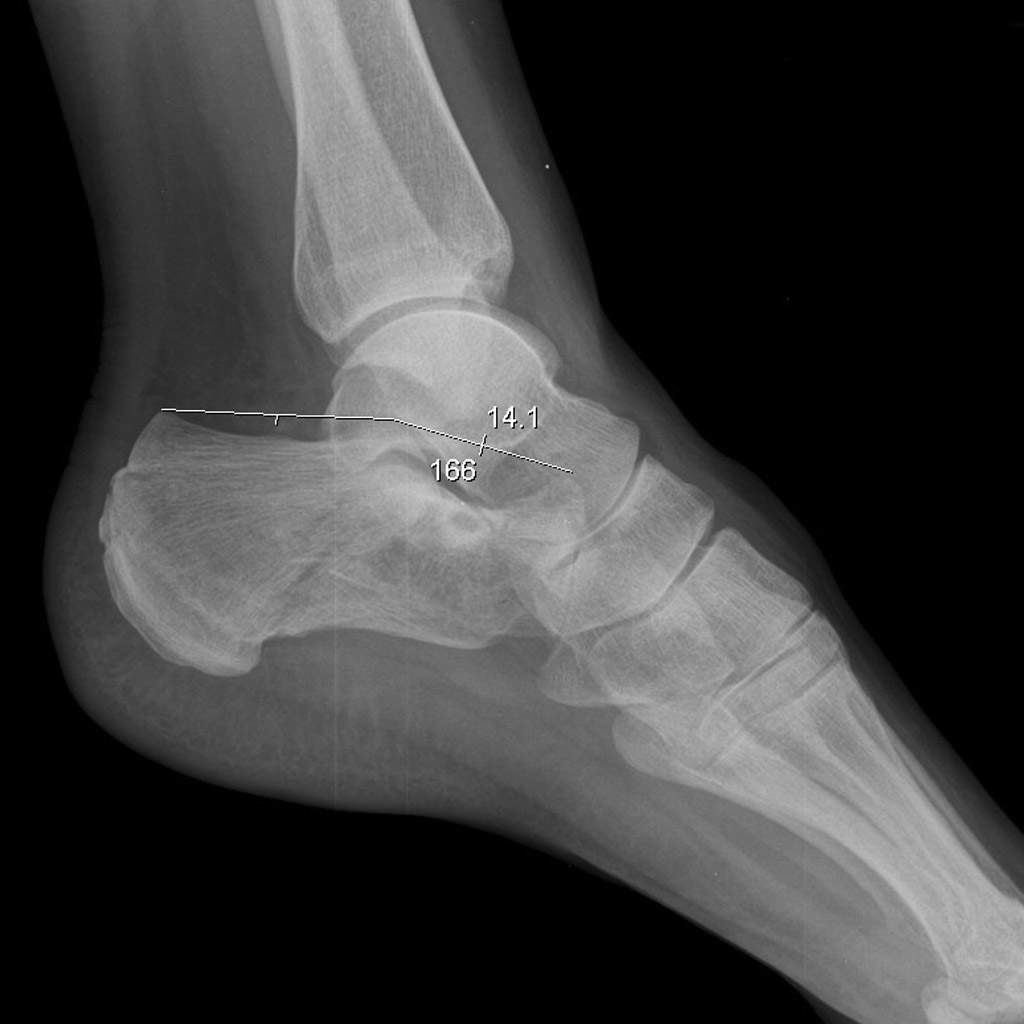 Calcaneal fracture with a decreased Bohler angle to 14 degrees.


Template:Fractures Template:WH Template:WS
References
- ↑ Sculier JP, Klastersky J (November 1981). “[Hypothermia: a new approach to the treatment of cancer (author’s transl)]”. Nouv Presse Med (in French). 10 (42): 3487–90. PMID 7031600.
- ↑ Pols J (January 1985). “[Involuntary commitment: therapy or confinement?]”. Tijdschr Ziekenverpl (in Dutch; Flemish). 38 (2): 47–52. PMID 3849198.
- ↑ Sonoda T, Masumoto T (October 1980). “[Innovation in nursing equipment. A bathroom for the orthopedic department]”. Kango Gijutsu (in Japanese). 26 (14): 1934–5. PMID 6904593.
- ↑ Tonsgard JH, Harwicke N, Levine SC (1987). “Kluver-Bucy syndrome in children”. Pediatr. Neurol. 3 (3): 162–5. doi:10.1016/0887-8994(87)90084-1. PMID 3508062.
- ↑ Travers PK (November 1986). “Application of toxicological concepts to the occupational history”. AAOHN J. 34 (11): 524–9. PMID 3022764.
See also
© 2026 MyEClinic – IFTM Institut für Telematik in der Medizin GmbH