
Patau syndrome
For patient information click here
Editor-In-Chief: C. Michael Gibson, M.S., M.D. [1];Associate Editor(s)-in-Chief: Kalsang Dolma, M.B.B.S.[2]
Synonyms and keywords: Bartholin-Patau syndrome; trisomy 13; trisomy D; Ullrich-Feichtiger syndrome
Overview
Patau syndrome is a chromosomal abnormality, a syndrome in which a patient has an additional chromosome 13 due to a non-disjunction of chromosomes during meiosis. The extra chromosome 13 disrupts the normal course of development, causing the characteristic features of Patau syndrome.
Historical Perspective
Trisomy 13 was first observed by Erasmus Bartholin in 1657,[1] but the chromosomal nature of the disease was ascertained by Dr.Klaus Patau in 1960.[2] The disease is named in his honor. Patau syndrome was also described in Pacific island tribes. These reports were thought to have been caused by radiation from atomic bomb tests. The tribes were temporarily moved before and during the test by an “x” amount of distance. They were then put back where they had been taken; all of this occurred before it was known how long, or even if, radiation still lingered on after a nuclear explosion.
Pathophysiology
Genetics
- Most cases of Patau’s syndrome result from trisomy 13, which means each cell in the body has three copies of chromosome 13 instead of the usual two copies. A small percentage of cases occur when only some of the body’s cells have an extra copy of chromosome 13, resulting in a mixed population of cells with a differing number of chromosomes, such cases are called mosaic Patau.
- Patau syndrome can also occur when part of chromosome 13 becomes attached to another chromosome (translocated) before or at conception. Affected people have two copies of chromosome 13, plus extra material from chromosome 13 attached to another chromosome. With a translocation, the person has a partial trisomy for chromosome 13 and often the physical signs of the syndrome differ from the typical Patau syndrome.
- Most cases of Patau syndrome are not inherited, but occur as random events during the formation of reproductive cells (eggs and sperm). An error in cell division called non-disjunction can result in reproductive cells with an abnormal number of chromosomes. For example, an egg or sperm cell may gain an extra copy of chromosome 13. If one of these atypical reproductive cells contributes to the genetic makeup of a child, the child will have an extra chromosome 13 in each of the body’s cells.
- Mosaic Patau syndrome is also not inherited. It occurs as a random error during cell division early in fetal development. As a result, some of the body’s cells have the usual two copies of chromosome 13, and other cells have three copies of the chromosome.
- Patau syndrome due to a translocation can be inherited. An unaffected person can carry a rearrangement of genetic material between chromosome 13 and another chromosome. This rearrangement is called a balanced translocation because there is no extra material from chromosome 13. Although they do not have signs of Patau syndrome, people who carry this type of balanced translocation are at an increased risk of having children with the condition.
Epidemiology and Demographics
Patau syndrome affects approximately 7 in 100,000 live births.
Risk Factors
- Like all non-disjunction diseases (Down syndrome, Edwards syndrome, etc…) the risk of disease in the offspring increases with maternal age at pregnancy.
- Unless one of the parents are carriers of a translocation the chances of a couple having another trisomy 13 affected child is less than 1% (less than that of Down Syndrome).
Screening
Laboratory Screening
- Maternal serum alpha-fetoprotein (AFP)
- Free or total beta-human chorionic gonadotropin (hCG)
- Unconjugated estriol
- Inhibin A
- Pregnancy-associated plasma protein A (PAPP-A)
Imaging
- Ultrasonography may show features of birth defects and growth restriction.
- Nuchal translucency measurement
Diagnostic Testing
- Amniocentesis: Done at 15 weeks of gestation
- Chorionic villus sampling (CVS): Done at 13 weeks of gestation.
Natural History, Complications and Prognosis
- Most embryos with trisomy 13 do not survive gestation and are spontaneously aborted.
- Of those surviving to term gestation, approximately 82-85% do not survive past 1 month of age, and 85% do not survive past 1 year of age.[3]
- Certain malformations, especially holoprosencephaly and other central nervous system malformations, yield a more grave prognosis.
- Of those infants that survive past 1 year, most have few major malformations, but the prognosis remains poor, owing to multiple factors including long term neurological disability, feeding difficulty, and frequent pneumonia and other respiratory infections. Currently there are over 66 survivors of some form or another of Trisomy 13. See [3].
Diagnosis
Symptoms
Physical Examination
Skin
- Cutis aplasia (missing portion of the skin/hair)
Head
Eyes
- Microphthalmia
- Cataract
- Iris and/or fundus (coloboma)
- Retinal detachment
- Nystagmus
- Optic nerve hypoplasia
- Hypertelorism
Ear
Throat
- Cleft lip or cleft palate
- Small lower jaw (micrognathia)
Abdomen
Extremities
-
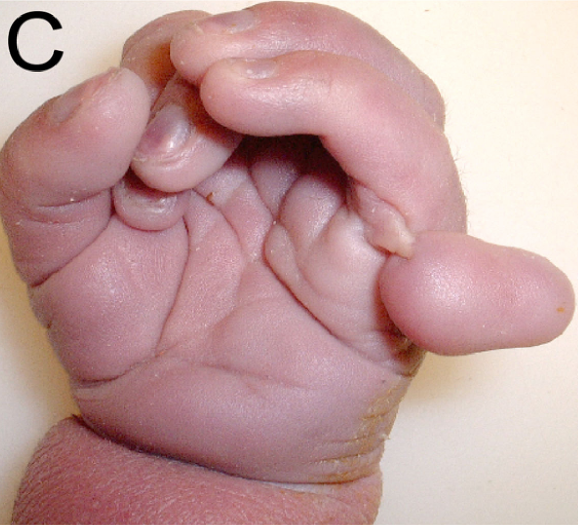 A 37 2/7 week gestational age male infant with Patau syndrome demonstrating polydactyly

- Polydactyly (extra digits)
- Deformed feet known as rocker-bottom feet
- Single palmar crease
- Overlapping of fingers over thumb
Neurologic
- Mental and motor challenged
- Meningomyelocele (a spinal defect)
- Muscle hypotonia
Other
Laboratory Findings
Electrolyte and Biomarker Studies
Echocardiography
Ultrasound
MRI
- Holoprosencephaly (failure of the forebrain to divide properly)
Primary Prevention
Parents of infants with trisomy 13 that is caused by a translocation should have genetic testing and counseling, which may help them avoid having another child with the condition.
References
- ↑ Template:WhoNamedIt
- ↑ Patau K, Smith DW, Therman E, Inhorn SL, Wagner HP (1960). “Multiple congenital anomaly caused by an extra autosome”. Lancet. 1: 790–3. PMID 14430807.
- ↑ Duarte AC, Menezes AI, Devens ES; et al. (2004). “Patau syndrome with a long survival. A case report”. Genet. Mol. Res. 3 (2): 288–92. PMID 15266400.
- ↑ H. Bruce Ostler (2004). Diseases of the eye and skin: a color atlas. Lippincott Williams & Wilkins. p. 72. ISBN 978-0-7817-4999-2. Retrieved 13 April 2010.
- ↑ “Trisomy 13: MedlinePlus Medical Encyclopedia”. Retrieved 2010-04-12.
Template:Chromosomal abnormalities
da:Pataus syndrom de:Pätau-Syndrom it:Sindrome di Patau nl:Syndroom van Patau no:Patau syndrom sr:Патауов синдром fi:Pataun oireyhtymä sv:Pataus syndrom uk:Синдром Патау
© 2026 MyEClinic – IFTM Institut für Telematik in der Medizin GmbH