
Sertoli cell
Editor-In-Chief: C. Michael Gibson, M.S., M.D. [1]
A Sertoli cell (a kind of sustentacular cell) is a ‘nurse’ cell of the testes which is part of a seminiferous tubule.
It is activated by follicle-stimulating hormone, and has FSH-receptor on its membranes.
Functions
Its main function is to nurture the developing sperm cells through the stages of spermatogenesis. Because of this, it has also been called the “mother cell.” It provides both secretory and structural support.
Secretory
Sertoli cells secrete the following substances:
- anti-Müllerian hormone (AMH) – secreted during the early stages of fetal life.
- androgen binding protein – facilitate spermatogenesis and sperm maturation
- glial cell line-derived neurotrophic factor (GDNF) – has been demonstrated to function in promoting undifferentiating spermatogonia, which ensures stem cell self-renewal during the perinatal period.
- the Ets related molecule (ERM transcription factor) – needed for maintenance of the spermatogonial stem cell in the adult testis.
Structural
The junctions of Sertoli cells form the blood-testis barrier, a structure that partitions the interstitial blood compartment of the testis from the adluminal compartment of the seminiferous tubules. Sertoli cells control the entry and exit of nutrients, hormones and other chemicals into the tubules of the testis as well as make the adluminal compartment an immune-privileged site.
The cell is also responsible for establishing and maintaining the spermatogonial stem cell niche, which ensures the renewal of stem cells and the differentiation of spermatogonia into mature germ cells that progress stepwise through the long process of spermatogenesis, ending in the release of spermatozoa.
Other functions
During the Maturation phase of spermiogenesis, the Sertoli cells consume the unneeded portions of the spermatazoa.
Production of Sertoli cells
Once fully differentiated, the Sertoli cell is unable to proliferate. Therefore, once spermatogenesis has begun, no more Sertoli cells are created.
Recently however, some scientists have found a way to grow these cells outside of the body. This gives rise to the possibility of repairing some defects that cause male infertility.
Nomenclature
Sertoli cells are called so because of their eponym Enrico Sertoli, an Italian physiologist who discovered them while studying medicine in the University of Pavia, Italy. [2]
He published a description of this cell in 1865. The cell was discovered by Sertoli with a Belthle microscope purchased in 1862, which he used while studying medicine.
In the 1865 publication, his first description used the terms “tree-like cell” or “stringy cell” and most importantly he referred to these “mother cells.” It was other scientists who used Enrico’s family name, Sertoli, to label these cell in publications, starting in 1888. As of 2006, two textbooks that are devoted specifically to the Sertoli cell have been published.
Histology
On slides, using standard staining, it can be easy to confuse the Sertoli cells with the other cells of the germinal epithelium. The most distinctive of the Sertoli cells is the dark nucleolus.[3]
Pathology
Sertoli-Leydig cell tumour are part of the sex cord-stromal tumour group of ovarian neoplasms.
Additional images
-
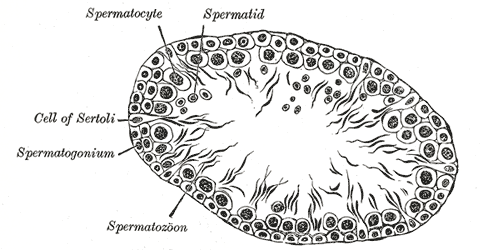 Transverse section of a tubule of the testis of a rat. X 250.

References
- ↑ Xiong X, Wang A, Liu G, Liu H, Wang C, Xia T, Chen X, Yang K (2006). “Effects of p,p’-dichlorodiphenyldichloroethylene on the expressions of transferrin and androgen-binding protein in rat Sertoli cells”. Environ Res. 101 (3): 334–9. PMID 16380112.
- ↑ Template:WhoNamedIt
- ↑ http://www.cvm.okstate.edu/instruction/mm_curr/histology/MR/HiMRP4.htm
External link
- Reproductive Physiology at ufp.pt
- Histology image: 17805loa – Histology Learning System at Boston University
- Histology image: 17806loa – Histology Learning System at Boston University
- Histology at University of Southern California rep/c_74
- Template:OklahomaHistology
Template:Male reproductive system
de:Sertoli-Zelle it:Cellula del Sertoli he:תא סרטולי nl:Sertolicel simple:Sertoli cell
© 2026 MyEClinic – IFTM Institut für Telematik in der Medizin GmbH