

Health Dictionary
Reliable, easy-to-read patient information on common medical conditions — written in plain language, free of jargon, and grounded in current evidence. Browse the most frequent diagnoses, understand what they mean for everyday life, and learn which steps and questions help you have a focused conversation with your doctor.
Aortic arch anomalies
Introduction
For patient information click here
Overview
Overview
The frequency of congenital aortic arch abnormalities is less than 1% of congenital cardiovascular defects.
References
Editor-In-Chief: C. Michael Gibson, M.S., M.D. [1] Cafer Zorkun, M.D., Ph.D. [2] Keri Shafer, M.D. [3] Priyamvada Singh, MBBS [[4]] Kristin Feeney, B.S. [[5]]
Pathophysiology
Overview
Pathophysiology
Vascular rings encircle the trachea and esophagus, which results in variable degrees of compression of both structures. Compression of the trachea causes upper airway obstruction that impairs airflow. The extent of airway compression is variable. Double aortic arch is more often associated airway compression and is also associated with more severe airway compression than other forms of vascular ring.
Gross Pathology
-
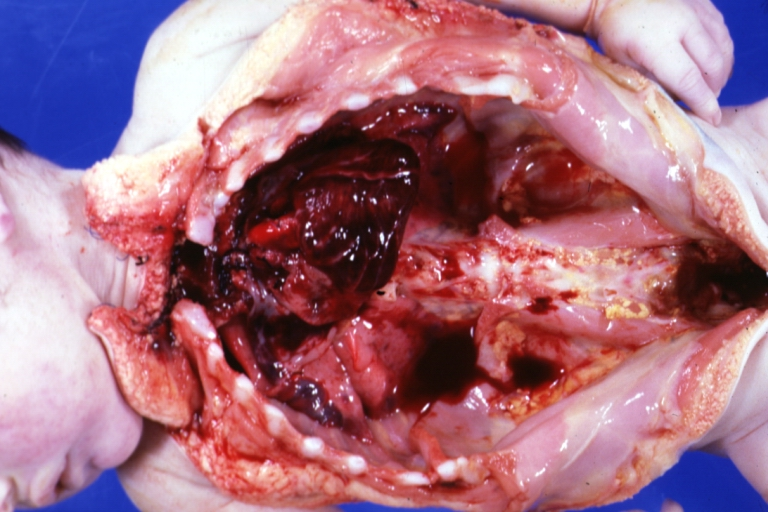 Hemorrhagic Necrosis; Massive, Postoperative: Gross; natural color, heart, in situ, a 2 day old infant, operative death, interrupted aortic arch and VSD (Image courtesy of Professor Peter Anderson DVM PhD and published with permission © PEIR, University of Alabama at Birmingham, Department of Pathology)

Genetics
Double Aortic Arch
Double aortic arch is associated with a chromosome band 22q11 deletion in approximately 20% of patients. Double aortic arch may be associated with band 22q11 deletion, which has various other possible manifestations. These include, but are not limited to, palatal abnormalities, laryngotracheal anomalies, speech and learning delay, characteristic facial features, hypocalcemia, abnormalities of T-cell–mediated immune function, and neurologic defects.
References
Editor-In-Chief: C. Michael Gibson, M.S., M.D. [1] Cafer Zorkun, M.D., Ph.D. [2] Keri Shafer, M.D. [3] Priyamvada Singh, MBBS [[4]] Kristin Feeney, B.S. [[5]]
Epidemiology and demographics
Please help WikiDoc by adding content here. It’s easy! Click here to learn about editing.
References
Natural history, Complications, and Prognosis
Please help WikiDoc by adding content here. It’s easy! Click here to learn about editing.
Natural History
Aortic arch anomalies may be associated with the following:
- Association with VACTERL: (vertebral, anal, cardiac, tracheal, esophageal, renal, and limb) or CHARGE (posterior coloboma, heart defect, choanal atresia, retardation, genital, and ear) associations.
- Esophageal atresia
- Congenital laryngeal web
Complications
Prognosis
References
Editor-In-Chief: C. Michael Gibson, M.S., M.D. [1] Cafer Zorkun, M.D., Ph.D. [2] Keri Shafer, M.D. [3] Priyamvada Singh, MBBS [[4]] Kristin Feeney, B.S. [[5]]
Causes
Please help WikiDoc by adding content here. It’s easy! Click here to learn about editing.
References
Classifications of Aortic arch anomalies
Overview
Classifications
There are three common classifications to the branching pattern: [1]
- Normal (as below) – seen in ~ 70% of patients.
- Bovine arch – common origin of brachiocephalic and left common carotid artery – seen in approximately 15% of patients (more common in blacks)
- Left common carotid has its origin from the brachiocephalic artery proper, rather than from a common trunk – – seen in approximately 10% of patients (also more common in blacks)
There may be additional branches that arise directly from the arch. These include:
- Thyroidea ima artery, usually between the brachiocephalic and left common carotid
- Left vertebral artery, usually between the left common carotid and the left subclavian arteries.
- Rarely the right subclavian and right common carotid arise independently.
Other major classifications:
References
- ↑ K.F. Layton “Bovine Aortic Arch Variant in Humans: Clarification of a Common Misnomer” AJNR 27: August 2006, 1541-42
Editor-In-Chief: C. Michael Gibson, M.S., M.D. [1] Cafer Zorkun, M.D., Ph.D. [2] Keri Shafer, M.D. [3] Priyamvada Singh, MBBS [[4]] Kristin Feeney, B.S. [[5]]
Differentiating Aortic arch anomalies from other Disorders
Please help WikiDoc by adding content here. It’s easy! Click here to learn about editing.
References
Diagnosis
Diagnosis
History and Symptoms | Physical Examination | Laboratory Tests | Electrocardiogram | Chest X Ray | MRI | CT | Echocardiography | Other Imaging Findings | Other Diagnostic Studies
Treatment
Treatment
Medical: Medical Therapy
Surgical: Surgery
Primary Prevention | Secondary Prevention | Cost-Effectiveness of Therapy | Future or Investigational Therapies
Editor-In-Chief: C. Michael Gibson, M.S., M.D. [1]; Priyamvada Singh, MBBS [[2]], Cafer Zorkun, M.D., Ph.D. [3], Keri Shafer, M.D. [4]; Kristin Feeney, B.S. [[5]]