

Health Dictionary
Reliable, easy-to-read patient information on common medical conditions — written in plain language, free of jargon, and grounded in current evidence. Browse the most frequent diagnoses, understand what they mean for everyday life, and learn which steps and questions help you have a focused conversation with your doctor.
Chvostek sign
Introduction
Overview
Overview
The Chvostek’s sign (also Weiss sign) is one of the signs of tetany seen in hypocalcemia. It refers to an abnormal reaction to the stimulation of the facial nerve. When the facial nerve is tapped at the angle of the jaw, the facial muscles on the same side of the face will contract momentarily (typically a twitch of the nose or lips) because of hypocalcaemia (ie from hypoparathyroidism, pseudohypoparathyroidism, hypovitaminosis D) with resultant hyperexcitability of nerves. Though classically described in hypocalcemia, this sign may also be encountered in respiratory alkalosis, such as that seen in hyperventilation, which actually causes decreased serum Ca++ with a normal calcium level due to a shift of Ca++ from the blood to albumin which has become more negative in the alkalotic state.
It was first described by František Chvostek, an Austrian physician in 1876, and later independently by Nathan Weiss in 1883.
The Trousseau sign of latent tetany is also often used to detect early tetany.
Chvostek’s Sign seen in tetany and sometimes in anxiety states.
In modern medical era, the utility of Chvostek’s sign has diminished with the development of serum calcium level assessments. However, the sign may still be helpful as crude determinations of the neuromuscular excitability that occurs in patients with hypocalcemia.
Differential Diagnosis
Differential Diagnosis
Physical Examination and Appearance of the Patient
Physical Examination and Appearance of the Patient
-
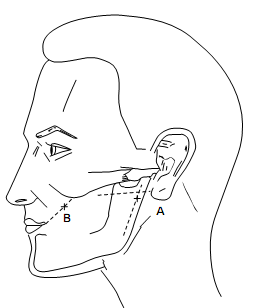 Evaluation of Chvostek’ Sign: A= The Chvostek I phenomenon and B= The Chvostek II phenomenon
 -
 Appearance of a patient with Chvostek’s Sign


References
References
- ↑ McKennis A, Waddington C, Nursing Interventions for Potential Complications After Thyroidectomy, Continuing Education Featured Article.
- ↑ Urbano F.L. Signs of Hypocalcemia: Chvostek’ and Trousseau’ Signs. Hospital Physician. March 2000.
- ↑ Sailer, Christian, Wasner, Susanne. Differential Diagnosis Pocket. Hermosa Beach, CA: Borm Bruckmeir Publishing LLC, 2002:77.
Editor-In-Chief: C. Michael Gibson, M.S., M.D. [1]