

Health Dictionary
Reliable, easy-to-read patient information on common medical conditions — written in plain language, free of jargon, and grounded in current evidence. Browse the most frequent diagnoses, understand what they mean for everyday life, and learn which steps and questions help you have a focused conversation with your doctor.
Cystic duct
Introduction
Overview
Overview
The cystic duct is the short duct that joins the gall bladder to the common bile duct. It usually lies next to the cystic artery. It is of variable length. It contains a ‘spiral valve’, which does not provide much resistance to the flow of bile.
Function
Function
Bile can flow in both directions between the gallbladder and the common hepatic duct and the (common) bile duct.
In this way, bile is stored in the gallbladder in between meal times and released after a fatty meal.
Clinical significance
Clinical significance
During a cholecystectomy, the cystic duct is clipped two or three times and a cut is made between the clips, freeing the gallbladder to be taken out.
Additional images
Additional images
-
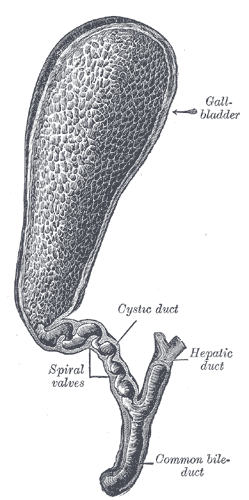 The gall-bladder and bile ducts laid open.
 -
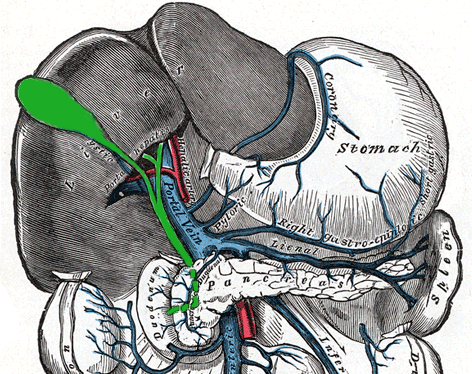 The portal vein and its tributaries.


External links
External links
- Template:EMedicineDictionary
- Template:SUNYAnatomyFigs – “The gallbladder and extrahepatic bile ducts.”
- Template:SUNYAnatomyLabs – “Stomach, Spleen and Liver: The Gallbladder and the Bile System”
- Template:NormanAnatomy (Template:NormanAnatomyFig, Template:NormanAnatomyFig)