

Health Dictionary
Reliable, easy-to-read patient information on common medical conditions — written in plain language, free of jargon, and grounded in current evidence. Browse the most frequent diagnoses, understand what they mean for everyday life, and learn which steps and questions help you have a focused conversation with your doctor.
Duct
Introduction
Overview
Overview
In anatomy and physiology, a duct is a circumscribed channel leading from an exocrine gland or organ.
Types of ducts
Types of ducts
Examples include:
Duct system
Duct system
As ducts travel from the acinus which generates the fluid to the target, the ducts become larger and the epithelium becomes thicker. The parts of the system are classified as follows:
| Type of duct | Epithelium | Surroundings |
| intralobular duct | simple cuboidal | parenchyma |
| interlobular duct | simple columnar | connective tissue |
| interlobar duct | stratified columnar | connective tissue |
Some sources consider “lobar” ducts to be the same as “interlobar ducts”, while others consider lobar ducts to be larger and more distal from the acinus. For sources that make the distinction, the interlobar ducts are more likely to classified with simple columnar epithelium (or pseudostratified epithelium), reserving the stratified columnar for the lobar ducts.
Additional images
Additional images
-
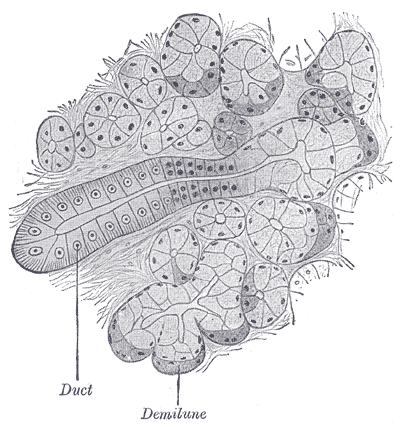 Section of submaxillary gland of kitten. Duct semidiagrammatic. X 200.
 -
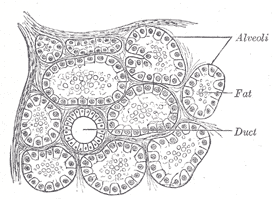 Section of portion of mamma.


External links
External links
- Template:EMedicineDictionary
- Template:Dorlands
- Template:UCDavisOrganology – “Exocrine gland (LM, Low)”
- Overview at uwa.edu.au
- Overview at siumed.edu
Editor-In-Chief: C. Michael Gibson, M.S., M.D. [1] Phone:617-632-7753