

Health Dictionary
Reliable, easy-to-read patient information on common medical conditions — written in plain language, free of jargon, and grounded in current evidence. Browse the most frequent diagnoses, understand what they mean for everyday life, and learn which steps and questions help you have a focused conversation with your doctor.
Geniculate ganglion
Introduction
The geniculate ganglion (from Latin genu, for “knee”) is an L-shaped collection of fibers and sensory neurons of the facial nerve located in the facial canal of the head. It receives fibers from both the motor, sensory, and parasympathetic components of the facial nerve and sends fibers that will innervate the lacrimal glands, submandibular glands, sublingual glands, tongue, palate, pharynx, external auditory meatus, stapedius, posterior belly of the digastric muscle, stylohyoid muscle, and muscles of facial expression.
Sensory and parasympathetic inputs are carried into the geniculate ganglion via the nervus intermedius. Motor fibers are carried via the facial nerve proper. The greater petrosal nerve, which carries sensory fibers as well as preganglionic parasympathetic fibers, emerges from the anterior aspect of the ganglion.
The geniculate ganglion is one of several ganglia of the head and neck. Like the others, it is a bilaterally distributed structure, with each side of the face having a geniculate ganglion.
Additional images
Additional images
-
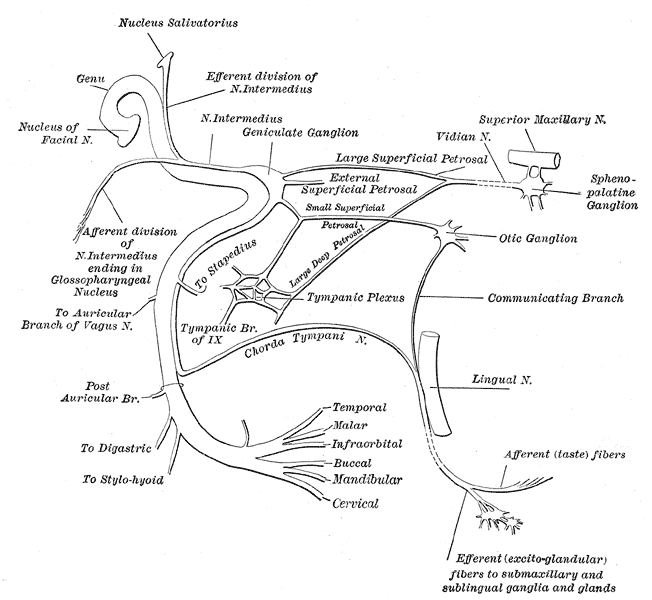 Plan of the facial and intermediate nerves and their communication with other nerves.

Editor-In-Chief: Template:Infobox Nerve C. Michael Gibson, M.S., M.D. [1]