

Health Dictionary
Reliable, easy-to-read patient information on common medical conditions — written in plain language, free of jargon, and grounded in current evidence. Browse the most frequent diagnoses, understand what they mean for everyday life, and learn which steps and questions help you have a focused conversation with your doctor.
Hindbrain
Introduction
Overview
Overview
The rhombencephalon (or hindbrain) is a developmental categorization of portions of the central nervous system in vertebrates.
The rhombencephalon can be subdivided in a variable number of transversal swellings called rhombomeres. In the human embryo we can distinguish eight rhombomeres, from caudal to rostral: Rh7-Rh1 and the isthmus (the most rostral rhombomere).
A rare disease of the rhomencephalon, “rhombencephalosynapsis” is characterized by a missing vermis resulting in a fused cerebellum. Patients generally present with cerebellar ataxia.
Myelencephalon
Myelencephalon
Rhombomeres Rh7-Rh4 form the myelencephalon.
The myelencephalon forms the medulla oblongata in the adult brain; it contains:
- a portion of the fourth ventricle,
- the glossopharyngeal nerve (CN IX),
- vagus nerve (CN X),
- accessory nerve (CN XI),
- hypoglossal nerve (CN XII),
- and a portion of the vestibulocochlear nerve (CN VIII).
Metencephalon
Metencephalon
Rhombomeres Rh3-Rh1 form the metencephalon.
The metencephalon is composed of the pons and the cerebellum; it contains:
- a portion of the fourth ventricle,
- the trigeminal nerve (CN V),
- abducens nerve (CN VI),
- facial nerve (CN VII),
- and a portion of the vestibulocochlear nerve (CN VIII).
Additional images
Additional images
-
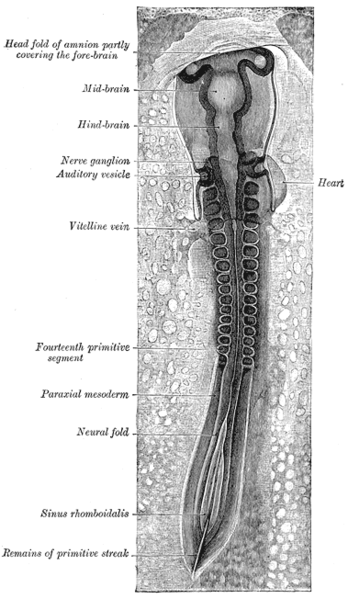 Chick embryo of thirty-three hours’ incubation, viewed from the dorsal aspect. X 30.
 -
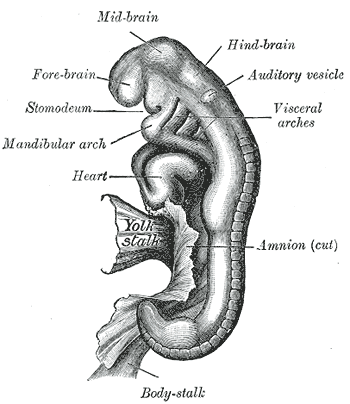 Embryo between eighteen and twenty-one days.


| File:Wiktionary-logo-en-v2.svg | Look up rhombencephalon in Wiktionary, the free dictionary. |