

Health Dictionary
Reliable, easy-to-read patient information on common medical conditions — written in plain language, free of jargon, and grounded in current evidence. Browse the most frequent diagnoses, understand what they mean for everyday life, and learn which steps and questions help you have a focused conversation with your doctor.
Hindgut
Introduction
Overview
Overview
The hindgut (or epigaster) is the posterior (caudal) part of the alimentary canal. It includes the distal third of the transverse colon and the splenic flexure, the descending colon, sigmoid colon, rectum and upper part of the anal canal.
Blood flow
Blood flow
Arterial supply is by the Inferior mesenteric artery, and venous drainage is to the portal venous system. Lymphatic drainage is to the chyle cistern.
Autonomic innervation
Autonomic innervation
The hindgut is innervated via the inferior mesenteric plexus. Sympathetic innervation is from the Lumbar splanchnic nerves (L1-L2), parasympathetic innervation is from S2-S4.
Additional images
Additional images
-
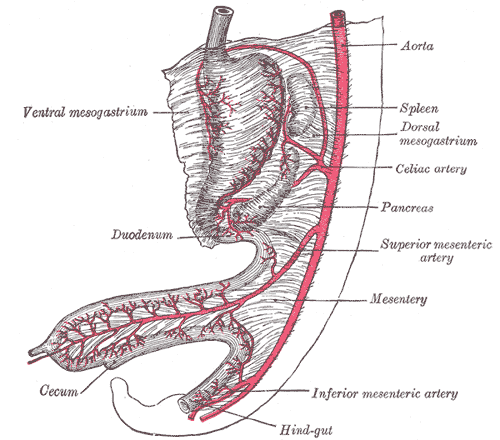 Abdominal part of digestive tube and its attachment to the primitive or common mesentery. Human embryo of six weeks.
 -
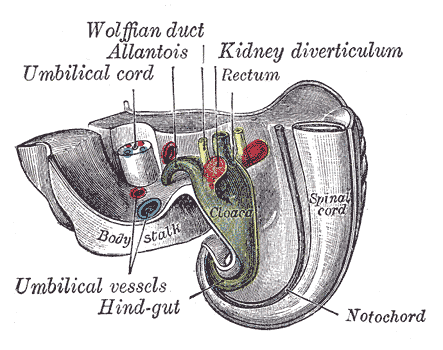 Tail end of human embryo twenty-five to twenty-nine days old.

