

Health Dictionary
Reliable, easy-to-read patient information on common medical conditions — written in plain language, free of jargon, and grounded in current evidence. Browse the most frequent diagnoses, understand what they mean for everyday life, and learn which steps and questions help you have a focused conversation with your doctor.
Morula
Introduction
Template:Infobox Embryology A morula (Latin “morus”, mulberry) is an embryo at an early stage of embryonic development, consisting of approximately 12-32 cells (called blastomeres) in a solid ball contained within the zona pellucida.
Production
Production
The morula is produced by embryonic cleavage, the rapid division of the zygote. After reaching the 16-cell stage, the cells of the morula differentiate. The inner blastomeres will become the inner cell mass and the blastomeres on the surface will later flatten to form the trophoblast. As this process begins, the blastomeres change their shape and tightly align themselves against each other to form a compact ball of cells. This is called compaction and is likely mediated by cell surface adhesion glycoproteins.
Development
Development
In mammals the morula travels to the uterus around 3-4 days after fertilization, and at about 4 days after fertilization a fluid-filled space called the blastocoel cavity appears and the morula becomes a blastocyst.
Additional images
Additional images
-
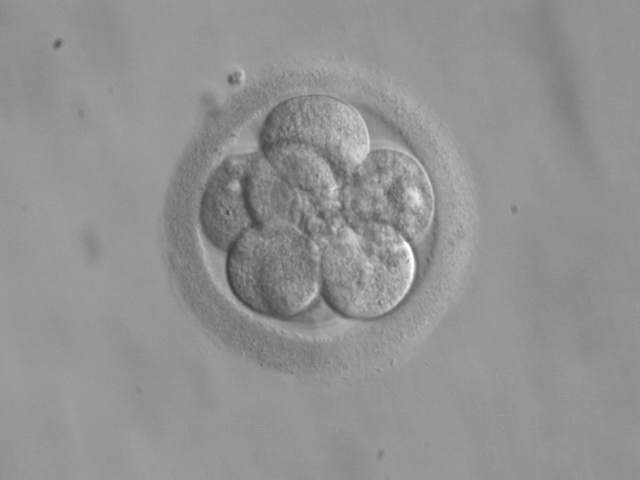 Morula, 8 cell stage

Template:Developmental-biology-stub Template:Embryology
bg:Морула cs:Morula de:Morula it:Morula lt:Morulė sk:Morula sv:Morula