

Health Dictionary
Reliable, easy-to-read patient information on common medical conditions — written in plain language, free of jargon, and grounded in current evidence. Browse the most frequent diagnoses, understand what they mean for everyday life, and learn which steps and questions help you have a focused conversation with your doctor.
Occipital vein
Introduction
The occipital vein begins in a plexus at the back part of the vertex of the skull.
From the plexus emerges a single vessel, which pierces the cranial attachment of the Trapezius and, dipping into the suboccipital triangle, joins the deep cervical and vertebral veins.
Occasionally it follows the course of the occipital artery and ends in the internal jugular; in other instances, it joins the posterior auricular vein and through it opens into the external jugular.
The parietal emissary vein connects it with the superior sagittal sinus; and as it passes across the mastoid portion of the temporal bone, it receives the mastoid emissary vein which connects it with the transverse sinus.
The occipital diploic vein sometimes joins it.
Additional images
Additional images
-
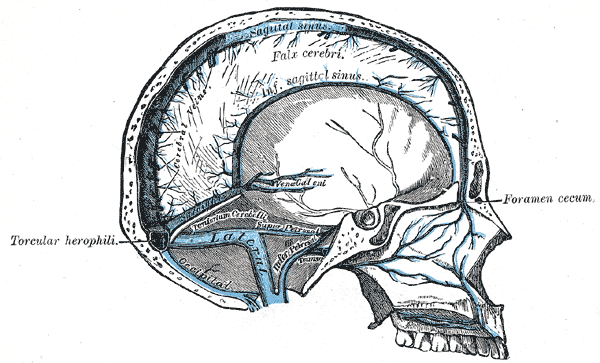 Sagittal section of the skull, showing the sinuses of the dura.

External links
External links
Editor-In-Chief: C. Michael Gibson, M.S., M.D. [1]