

Health Dictionary
Reliable, easy-to-read patient information on common medical conditions — written in plain language, free of jargon, and grounded in current evidence. Browse the most frequent diagnoses, understand what they mean for everyday life, and learn which steps and questions help you have a focused conversation with your doctor.
Short ciliary nerves
Introduction
The branches of the ciliary ganglion are the short ciliary nerves.
These are delicate filaments, from six to ten in number, which arise from the forepart of the ganglion in two bundles connected with its superior and inferior angles; the lower bundle is the larger.
They run forward with the ciliary arteries in a wavy course, one set above and the other below the optic nerve, and are accompanied by the long ciliary nerves from the nasociliary.
They pierce the sclera at the back part of the bulb of the eye, pass forward in delicate grooves on the inner surface of the sclera, and are distributed to the Ciliaris muscle, iris, and cornea.
The short ciliary nerve contains parasympathetic and sympathetic nerve fibers. The parasympathetics arise from the Edinger-Westphal nucleus and synapse in the ciliary ganglion via the oculomotor nerve, the postganglionic parasympathetics leave the ciliary ganglion in the short ciliary nerve and supply the ciliary body and iris. Sympathetics are provided by the superior cervical ganglion.
Damage to the short ciliary nerve may result in loss of the pupillary light reflex, or mydriasis.
Additional images
Additional images
-
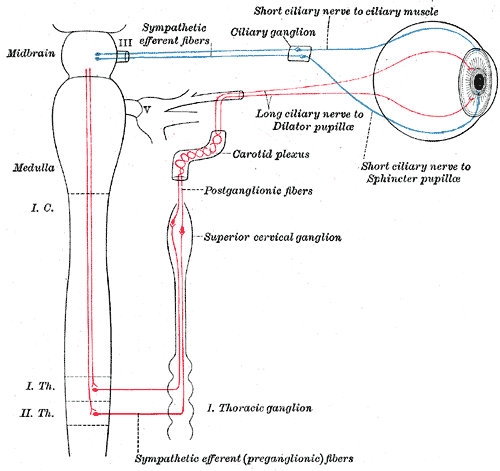 Sympathetic connections of the ciliary and superior cervical ganglia.
 -
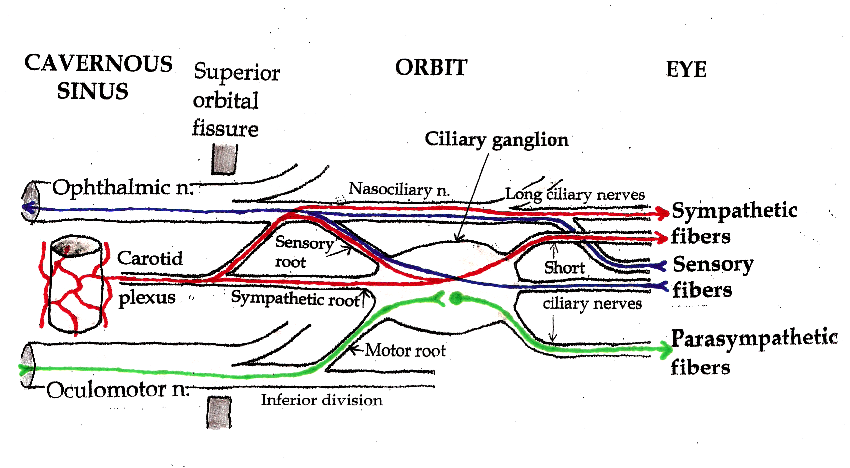 Pathways in the Ciliary Ganglion.


Editor-In-Chief: Template:Infobox Nerve C. Michael Gibson, M.S., M.D. [1]