

Health Dictionary
Reliable, easy-to-read patient information on common medical conditions — written in plain language, free of jargon, and grounded in current evidence. Browse the most frequent diagnoses, understand what they mean for everyday life, and learn which steps and questions help you have a focused conversation with your doctor.
Stomodeum
Introduction
Overview
Overview
The stomodeum, also called stomatodeum, is a depression between the brain and the pericardium in an embryo, and is the precursor of the mouth and the anterior lobe of the pituitary gland.
Structure
Structure
The stomodeum is lined by ectoderm, and is separated from the anterior end of the fore-gut by the buccopharyngeal membrane.
This membrane is devoid of mesoderm, being formed by the apposition of the stomodeal ectoderm with the fore-gut endoderm; at the end of the third week it disappears, and thus a communication is established between the mouth and the future pharynx.
Development
Development
The mouth is developed partly from the stomodeum, and partly from the floor of the anterior portion of the fore-gut.
By the growth of the head end of the embryo, and the formation of the cephalic flexure, the pericardial area and the buccopharyngeal membrane come to lie on the ventral surface of the embryo.
With the further expansion of the brain, and the forward bulging of the pericardium, the buccopharyngeal membrane is depressed between these two prominences. This depression constitutes the stomodeum.
No trace of the membrane is found in the adult; and the communication just mentioned must not be confused with the permanent isthmus faucium.
The lips, teeth, and gums are formed from the walls of the stomodeum, but the tongue is developed in the floor of the pharynx.
Additional images
Additional images
-
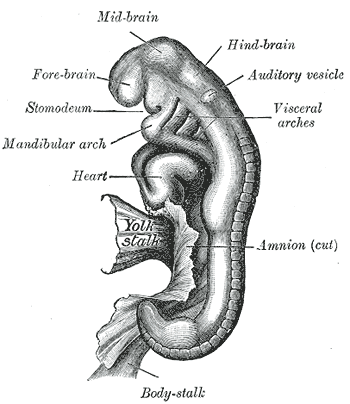 Embryo between eighteen and twenty-one days.
 -
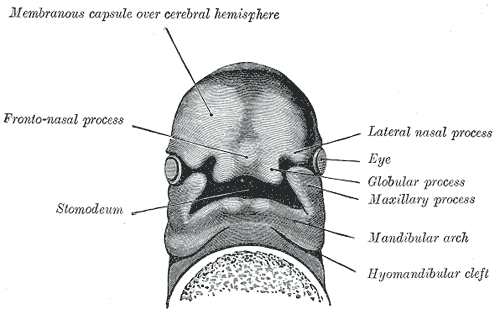 Under surface of the head of a human embryo about twenty-nine days old.
 -
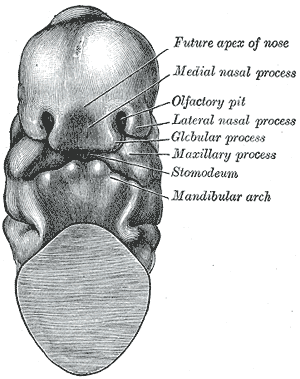 Head end of human embryo of about thirty to thirty-one days.


