

Health Dictionary
Reliable, easy-to-read patient information on common medical conditions — written in plain language, free of jargon, and grounded in current evidence. Browse the most frequent diagnoses, understand what they mean for everyday life, and learn which steps and questions help you have a focused conversation with your doctor.
Superficial cervical artery
Introduction
The transverse cervical artery (transverse artery of neck, transversalis colli artery) is a branch of the thyrocervical trunk, running at a higher level than the suprascapular artery; it passes transversely above the inferior belly of the omohyoid muscle to the anterior margin of the trapezius, beneath which it divides into an ascending and a descending branch.
It crosses in front of the phrenic nerve and the scalene muscles, and in front of or between the divisions of the brachial plexus, and is covered by the platysma and sternocleidomastoid muscles, and crossed by the omohyoid and trapezius.
Branches
Branches
The transverse cervical artery splits into two branches, a superficial one and a deep one:
- Superficial branch (also known as the superficial cervical artery)
- Deep branch (also called the dorsal scapular artery)
Superficial branch
The superficial cervical artery is another name for the superficial branch of transverse cervical artery. It ascends beneath the anterior margin of the trapezius, distributing branches to it, and to the neighboring muscles and lymph glands in the neck, and anastomosing with the superficial branch of the descending branch of the occipital artery.
Deep branch
Additional images
Additional images
-
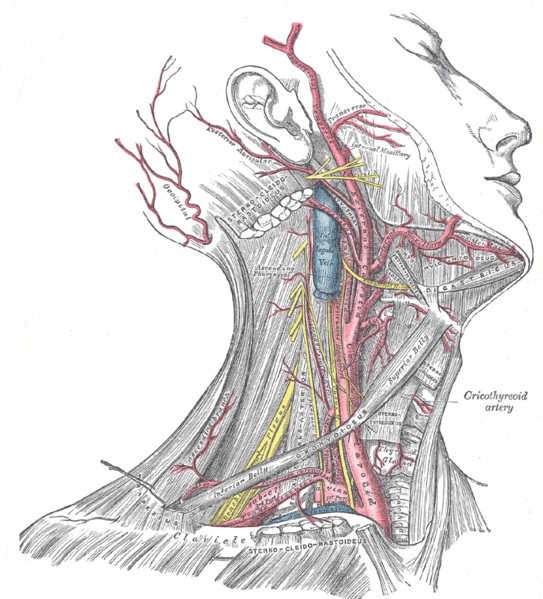 Superficial dissection of the right side of the neck, showing the carotid and subclavian arteries.

External links
External links
- Template:SUNYAnatomyLabs – “Muscles of the Back: Spinal Accessory Nerve (CN XI) and Transverse Cervical Vessels”
- Template:SUNYAnatomyFigs – “Branches of the first part of the subclavian artery.”
Editor-In-Chief: C. Michael Gibson, M.S., M.D. [1]