

Health Dictionary
Reliable, easy-to-read patient information on common medical conditions — written in plain language, free of jargon, and grounded in current evidence. Browse the most frequent diagnoses, understand what they mean for everyday life, and learn which steps and questions help you have a focused conversation with your doctor.
Triglyceride
Introduction
Overview
Please help WikiDoc by adding content here. It’s easy! Click here to learn about editing.
Historical Perspective
Please help WikiDoc by adding content here. It’s easy! Click here to learn about editing.
Classification
Please help WikiDoc by adding content here. It’s easy! Click here to learn about editing.
Biochemistry
Overview
Triglyceride (more properly known as triacylglycerol, TAG or triacylglyceride) is glyceride in which the glycerol is esterified with three fatty acids.[1] It is the main constituent of vegetable oil and animal fats.
Biochemistry
Structure
The chemical formula is RCOO-CH2CH(-OOCR’)CH2-OOCR”, where R, R’, and R” are longer alkyl chains. The three fatty acids RCOOH, R’COOH and R”COOH can be all different, all the same, or only two the same.
Chain lengths of the fatty acids in naturally occurring triglycerides can be of varying lengths but 16, 18 and 20 carbons are the most common. Natural fatty acids found in plants and animals are typically composed only of even numbers of carbon atoms due to the way they are bio-synthesised from acetyl CoA. Bacteria, however, possess the ability to synthesise odd- and branched-chain fatty acids. Consequently, ruminant animal fat contains odd numbered fatty acids, such as 15, due to the action of bacteria in the rumen.
Most natural fats contain a complex mixture of individual triglycerides; because of this, they melt over a broad range of temperatures. Cocoa butter is unusual in that it is composed of only a few triglycerides, one of which contains palmitic, oleic and stearic acids in that order. This gives rise to a fairly sharp melting point, causing chocolate to melt in the mouth without feeling greasy.
-
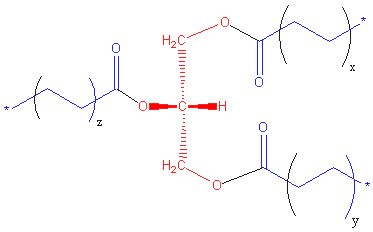 General structure of a triglyceride
 -
 Example of an unsaturated fat triglyceride. Left part: glycerol, right part from top to bottom: palmitic acid, oleic acid, alpha-linolenic acid, chemical formula: C55H98O6


Industrial Uses
Triglycerides are also split into their components via transesterification during the manufacture of biodiesel. The fatty acid monoalkyl ester can be used as fuel in diesel engines. The glycerin has many uses, such as in the manufacture of food and in the production of pharmaceuticals.
Other examples are the Triglyceride process in the decaffeination of coffee beans.
Staining
Staining for fatty acids, triglycerides, lipoproteins, and other lipids is done through the use of lysochromes (fat-soluble dyes). These dyes can allow the qualification of a certain fat of interest by staining the material a specific color. Some examples: Sudan IV, Oil Red O, and Sudan Black B.
References
- ↑ “Nomenclature of Lipids”. IUPAC-IUB Commission on Biochemical Nomenclature (CBN). Retrieved 2007-03-08.
Editor-In-Chief: C. Michael Gibson, M.S., M.D. [1]
Physiology
Overview
Physiology
Metabolism
- See also fatty acid metabolism
| Function | Cardiac risk increase? | Apolipoprotein B on the surface[1]? | |
|---|---|---|---|
| Chylomicron | Transport dietary fatty acids and cholesterol from the intestine to liver | No, chylomicrons,are too large to enter the arterial wall | Yes |
| Very low density lipoprotein | Transport triglycerides from the liver | Yes | Yes |
|
Notes: Apolipoprotein B may best relate to cardiac risk reduction[1] | |||
Triglycerides, as major components of very low density lipoprotein (VLDL) and chylomicrons, play an important role in metabolism as energy sources and transporters of dietary fat. They contain more than twice as much energy (9 kcal/g) as carbohydrates and proteins. In the intestine, triglycerides are split into glycerol and fatty acids (this process is called lipolysis) (with the help of lipases and bile secretions), which are then moved into the cells lining the intestines (absorptive enterocytes). The triglycerides are rebuilt in the enterocytes from their fragments and packaged together with cholesterol and proteins to form chylomicrons. These are excreted from the cells and collected by the lymph system and transported to the large vessels near the heart before being mixed into the blood. Various tissues can capture the chylomicrons, releasing the triglycerides to be used as a source of energy. Fat and liver cells can synthesize and store triglycerides. When the body requires fatty acids as an energy source, the hormone glucagon signals the breakdown of the triglycerides by hormone-sensitive lipase to release free fatty acids. As the brain can not utilize fatty acids as an energy source, the glycerol component of triglycerides can be converted into glucose, via gluconeogenesis, for brain fuel when it is broken down. Fat cells may also be broken down for that reason, if the brain’s needs ever outweigh the body’s.
Triglycerides cannot pass through cell membranes freely. Special enzymes on the walls of blood vessels called lipoprotein lipases must breakdown triglycerides into fatty acids and glycerol. Fatty acids can then be taken up by cells via the fatty acid transporter (FAT).
-
General structure of a triglyceride
References
- ↑ 1.0 1.1 Thanassoulis G, Williams K, Ye K, Brook R, Couture P, Lawler PR; et al. (2014). “Relations of change in plasma levels of LDL-C, non-HDL-C and apoB with risk reduction from statin therapy: a meta-analysis of randomized trials”. J Am Heart Assoc. 3 (2): e000759. doi:10.1161/JAHA.113.000759. PMC 4187506. PMID 24732920.
Editor-In-Chief: C. Michael Gibson, M.S., M.D. [1]
Clinical Correlation
Clinical Correlation
Epidemiology and Demographics | Pathophysiology | Causes | Prognosis and Complications | History and Symptoms | Physical Examination
Epidemiology and Demographics | Pathophysiology | Causes | Diseases | Prognosis and Complications
Editor-In-Chief: C. Michael Gibson, M.S., M.D. [1]; Associate Editor(s)-in-Chief: Priyamvada Singh, M.B.B.S. [2]; Rim Halaby, M.D. [3]