

Health Dictionary
Reliable, easy-to-read patient information on common medical conditions — written in plain language, free of jargon, and grounded in current evidence. Browse the most frequent diagnoses, understand what they mean for everyday life, and learn which steps and questions help you have a focused conversation with your doctor.
Campylobacteriosis
Introduction
For patient information click here
Template:DiseaseDisorder infobox
Overview
Overview
Campylobacteriosis is among the most common bacterial infections of humans. It produces an inflammatory, sometimes bloody, diarrhea or dysentery syndrome. It is responsible for proctocolitis in participants of anoreceptive intercourse, bacteremia in AIDS patients and other immunocompromised patients, and travelers’ diarrhea. Helicobacter pylori is closely related to Campylobacter and causes peptic ulcer disease. The campylobacter organisms can cause a variety of infections manifesting as systemic, abortion, stillbirth, and oral (periodontitis) and intestinal.
References
Editor-In-Chief: C. Michael Gibson, M.S., M.D. [1]
Historical Perspective
Please help WikiDoc by adding content here. It’s easy! Click here to learn about editing.
References
Pathophysiology
Overview
Campylobacter organisms are curved or spiral, motile, non–spore-forming, gram-negative rods. The known routes of transmission are fecal-oral, person-to-person sexual contact, raw milk and poultry ingestion, and waterborne (ie, through contaminated water supplies). Exposure to sick pets, especially puppies, has also been associated with outbreaks.
Pathophysiology
- Campylobacter organisms are curved or spiral, motile, non–spore-forming, gram-negative rods.
- C jejuni appears to invade and destroy epithelial cells. Some strains of C jejuni produce a cholera-like enterotoxin, which is important in the watery diarrhea observed in infections.
- The organism produces diffuse, bloody, edematous, and exudative enteritis. In a small number of cases, the infection may be associated with hemolytic uremic syndrome and thrombotic thrombocytopenic purpura through a poorly understood mechanism.
- In patients with HIV, infections may be more frequent, may cause prolonged or recurrent diarrhea, and may be more commonly associated with bacteremia and antibiotic resistance. T
- The severity and persistence of infection in patients with AIDS and hypogammaglobulinemia indicates that both cell-mediated and humoral immunity are important in preventing and terminating infection.
- The exact pathogenesis by which it causes colitis after transmission is not fully understood. However, it is hypothesized that requirement for C. jejuni virulence include (1) motility, (2) drug resistance, (3) host cell adherence, (4) host cell invasion, (5) alteration of the host cell signaling pathways, (6) induction of host cell death, (7) evasion of the host immune system defenses, and (9) acquisition of iron which serves as a micronutrient for growth and works as a catalyst for hydroxyl radical formation.[1]
- C. jejuni also secretes proteins that may contribute to the ability of the bacterium to invade the host epithelial cells.[1]
References
Editor-In-Chief: C. Michael Gibson, M.S., M.D. [1]
Causes
Overview
Campylobacter jejuni is a species of curved,long rod-shaped, Gram-negative microaerophilic, bacteria commonly found in animal feces.[1] It is one of the most common causes of human gastroenteritis in the world. Food poisoning caused by Campylobacter species can be severely debilitating but is rarely life-threatening. It has been linked with subsequent development of Guillain-Barré syndrome (GBS), which usually develops two to three weeks after the initial illness.
Organism
C. jejuni is commonly associated with poultry and naturally colonises the GI tract of many bird species. It has also been isolated from wombat and kangaroo feces, being a cause of bushwalkers’ diarrhea. Contaminated drinking water and unpasteurized milk provide an efficient means for distribution. Contaminated food is a major source of isolated infections, with incorrectly prepared meat and raw poultry normally the source of the bacteria.
Infection with C. jejuni usually results in enteritis, which is characterised by abdominal pain, diarrhea, fever, and malaise. The symptoms usually persist for between 24 hours and a week, but may be longer. Diarrhea can vary in severity from loose stools to bloody stools. No antibiotics are usually given as the disease is self-limiting, however, severe or prolonged cases may require ciprofloxacin, erythromycin or norfloxacin. Fluid and electrolyte replacement may be required for serious cases.
Laboratory characteristics
| Characteristic | Result |
|---|---|
| Growth at 25 °C | – |
| Growth at 35-37 °C | – |
| Growth at 42 °C | + |
| Nitrate reduction | + |
| Catalase test | + |
| Oxidase test | + |
| Growth on MacConkey agar | + |
| Motility (wet mount) | + |
| Glucose utilization | – |
| Hippurate hydrolysis | + |
| Resistance to naladixic acid | – |
| Resistance to cephalothin | + |
Campylobacter is grown on specially selective “CAMP” agar plates at 42 °C, the normal avian body temperature, rather than at 37 °C, the temperature at which most other pathogenic bacteria are grown. Since the colonies are oxidase positive, they will usually only grow in scanty amounts on the plates. Microaerophilic conditions are required for luxurious growth. The selective medium known as Skirrow’s medium is used. Skirrow’s medium is blood agar infused with a cocktail of antibiotics: vancomycin, polymixin-B and trimethoprim under microaerophilic conditions at 42 degrees.
Gallery
-
![Campylobacter fetus (C. fetus ss. jejuni) cultures were grown on Skirrow's and Butzler's medium. From Public Health Image Library (PHIL). [2]](https://www.wikidoc.org/images/1/19/Campylobacter12.jpeg) Campylobacter fetus (C. fetus ss. jejuni) cultures were grown on Skirrow’s and Butzler’s medium. From Public Health Image Library (PHIL). [2]
Campylobacter fetus (C. fetus ss. jejuni) cultures were grown on Skirrow’s and Butzler’s medium. From Public Health Image Library (PHIL). [2] -
![Campylobacter jejunii, formerly known as C. fetus subsp. jejuni, culture was grown on Skirrow's and Butzler's medium. From Public Health Image Library (PHIL). [2]](https://www.wikidoc.org/images/e/ee/Campylobacter11.jpeg) Campylobacter jejunii, formerly known as C. fetus subsp. jejuni, culture was grown on Skirrow’s and Butzler’s medium. From Public Health Image Library (PHIL). [2]
Campylobacter jejunii, formerly known as C. fetus subsp. jejuni, culture was grown on Skirrow’s and Butzler’s medium. From Public Health Image Library (PHIL). [2] -
![Scanning electron micrograph depicts a number of Gram-negative Campylobacter jejuni bacteria (11,734x mag). From Public Health Image Library (PHIL). [2]](https://www.wikidoc.org/images/f/f4/Campylobacter09.jpeg) Scanning electron micrograph depicts a number of Gram-negative Campylobacter jejuni bacteria (11,734x mag). From Public Health Image Library (PHIL). [2]
Scanning electron micrograph depicts a number of Gram-negative Campylobacter jejuni bacteria (11,734x mag). From Public Health Image Library (PHIL). [2] -
![Scanning electron micrograph depicts a number of Gram-negative Campylobacter jejuni bacteria (9,951x mag). From Public Health Image Library (PHIL). [2]](https://www.wikidoc.org/images/7/7f/Campylobacter07.jpeg) Scanning electron micrograph depicts a number of Gram-negative Campylobacter jejuni bacteria (9,951x mag). From Public Health Image Library (PHIL). [2]
Scanning electron micrograph depicts a number of Gram-negative Campylobacter jejuni bacteria (9,951x mag). From Public Health Image Library (PHIL). [2] -
![Micrograph depicts a 0.1µm polycarbonate membrane filter, which is coated with a C. jejuni bacterial film. From Public Health Image Library (PHIL). [2]](https://www.wikidoc.org/images/1/1c/Campylobacter06.jpeg) Micrograph depicts a 0.1µm polycarbonate membrane filter, which is coated with a C. jejuni bacterial film. From Public Health Image Library (PHIL). [2]
Micrograph depicts a 0.1µm polycarbonate membrane filter, which is coated with a C. jejuni bacterial film. From Public Health Image Library (PHIL). [2] -
![Campylobacter jejuni bacteria revealing characteristic “thin”, “comma-“, “S-“ or “gull winged-shaped” forms. From Public Health Image Library (PHIL). [2]](https://www.wikidoc.org/images/8/89/Campylobacter04.jpeg) Campylobacter jejuni bacteria revealing characteristic “thin”, “comma-“, “S-“ or “gull winged-shaped” forms. From Public Health Image Library (PHIL). [2]
Campylobacter jejuni bacteria revealing characteristic “thin”, “comma-“, “S-“ or “gull winged-shaped” forms. From Public Health Image Library (PHIL). [2] -
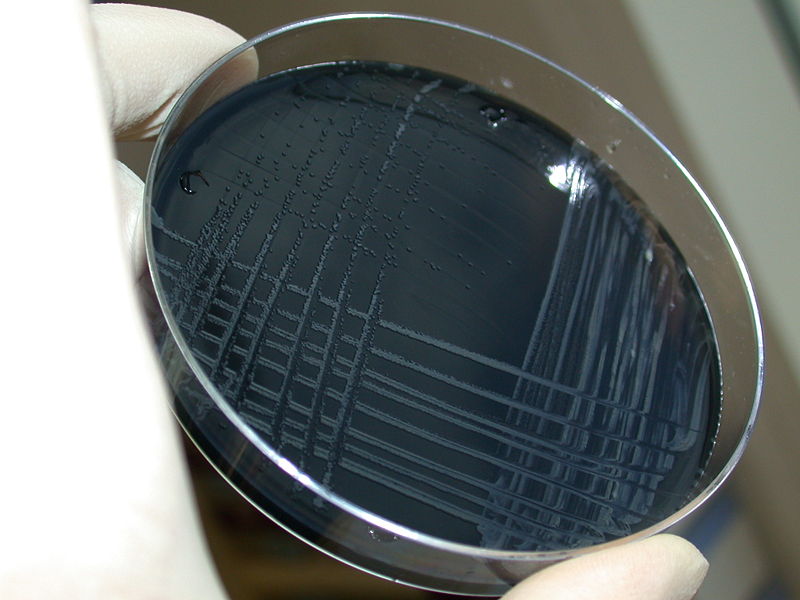 Blood-free, charcoal-based selective medium agar (CSM) for isolation of Campylobacter jejuni.
 -
Scanning electron micrograph depicting a number of Campylobacter jejuni bacteria.
![Campylobacter fetus (C. fetus ss. jejuni) cultures were grown on Skirrow's and Butzler's medium. From Public Health Image Library (PHIL). [2]](https://www.wikidoc.org/index.php/File%3ACampylobacter12.jpeg)
![Campylobacter jejunii, formerly known as C. fetus subsp. jejuni, culture was grown on Skirrow's and Butzler's medium. From Public Health Image Library (PHIL). [2]](https://www.wikidoc.org/index.php/File%3ACampylobacter11.jpeg)
![Scanning electron micrograph depicts a number of Gram-negative Campylobacter jejuni bacteria (11,734x mag). From Public Health Image Library (PHIL). [2]](https://www.wikidoc.org/index.php/File%3ACampylobacter09.jpeg)
![Scanning electron micrograph depicts a number of Gram-negative Campylobacter jejuni bacteria (9,951x mag). From Public Health Image Library (PHIL). [2]](https://www.wikidoc.org/index.php/File%3ACampylobacter07.jpeg)
![Micrograph depicts a 0.1µm polycarbonate membrane filter, which is coated with a C. jejuni bacterial film. From Public Health Image Library (PHIL). [2]](https://www.wikidoc.org/index.php/File%3ACampylobacter06.jpeg)
![Campylobacter jejuni bacteria revealing characteristic “thin”, “comma-“, “S-“ or “gull winged-shaped” forms. From Public Health Image Library (PHIL). [2]](https://www.wikidoc.org/index.php/File%3ACampylobacter04.jpeg)

See also
References
- ↑ Ryan KJ, Ray CG (editors) (2004). Sherris Medical Microbiology (4th ed. ed.). McGraw Hill. ISBN 0-8385-8529-9.
- ↑ 2.0 2.1 2.2 2.3 2.4 2.5 “Public Health Image Library (PHIL)”.
- “Multiple Campylobacter Genomes Sequenced”. 2005-01-04. Retrieved 2007-07-27.
- Gorbach, Sherwood L., Falagas, Matthew (editors) (2001). The 5 minute infectious diseases consult (1st ed. ed.). Lippincott Williams & Wilkins. ISBN 0-683-30736-3.
- Online Bacteriological Analytical Manual, Chapter 7: Campylobacter – US Center for Food Safety & Applied Nutrition (accessed 13 October 2006)
Editor-In-Chief: C. Michael Gibson, M.S., M.D. [1]
Differentiating Campylobacteriosis from other Diseases
Overview
Differential diagnosis of campylobacteriosis include other pathogens causing inflammatory diarrhea such as salmonella, shigella, E. coli (EHEC or EIEC), clostridium difficile, yersinia, aeromonas, plesiomonas
Campylobacteriosis Differential Diagnosis
The table below lists the underlying pathogens known to cause acute inflammatory diarrhea:[1][2]
| Pathogen | Transmission | Clinical Manifestations | |||
|---|---|---|---|---|---|
| Fever | Nausea/Vomiting | Abdominal Pain | Bloody Stool | ||
| Salmonella | Foodborne transmission, community-acquired | ++ | + | ++ | + |
| Shigella | Community-acquired, person-to-person | ++ | ++ | ++ | + |
| Campylobacter | Community-acquired, ingestion of undercooked poultry | ++ | + | ++ | + |
| E. coli (EHEC or EIEC) | Foodborne transmission, ingestion of undercooked hamburger meat | ± | + | ++ | ++ |
| Clostridium difficile | Nosocomial spread, antibiotic use | + | ± | + | + |
| Yersinia | Community-aquired, foodborne transmission | ++ | + | ++ | + |
| Entamoeba histolytica | Travel to or emigration from tropical regions | + | ± | + | ± |
| Aeromonas | Ingestion of contaminated water | ++ | + | ++ | + |
| Plesiomonas | Ingestion of contaminated water or undercooked shellfish, travel to tropical regions | ± | ++ | + | + |
References
- ↑ Thielman NM, Guerrant RL (2004). “Clinical practice. Acute infectious diarrhea”. N Engl J Med. 350 (1): 38–47. doi:10.1056/NEJMcp031534. PMID 14702426.
- ↑ Khan AM, Faruque AS, Hossain MS, Sattar S, Fuchs GJ, Salam MA (2004). “Plesiomonas shigelloides-associated diarrhoea in Bangladeshi children: a hospital-based surveillance study”. J Trop Pediatr. 50 (6): 354–6. doi:10.1093/tropej/50.6.354. PMID 15537721.
Editor-In-Chief: C. Michael Gibson, M.S., M.D. [1]
Epidemiology and Demographics
Overview
Campylobacter is the most common bacterial cause of diarrheal illness. In 2012, the Foodborne Diseases Active Surveillance Network (FoodNet) estimated the incidence to be 14.3 cases per 100,000 population. An estimated 1.3 million persons are affected each year.
Epidemiology and Demographics
An estimated 2 million cases of Campylobacter enteritis occur annually in the U.S., accounting for 5-7% of cases of gastroenteritis. A large animal reservoir is present, with up to 100% of poultry, including chickens, turkeys, and waterfowl, having asymptomatic infections in their intestinal tracts. An infected chicken may contain up to 109 bacteria per 25 grams, and due to the installations, the bacteria is rapidly spread to other chicken. Ten to five hundred bacteria are enough to infect humans. Campylobacter enteritis has a classical seasonal pattern characterized by a peak incidence in early summer, and then a steady decline in winter.
References
Editor-In-Chief: C. Michael Gibson, M.S., M.D. [1]
Risk Factors
Overview
The most common risk factor for development of campylobacteriosis is ingestion of uncooked or poorly cooked poultry. Ingestion of poorly cooked meat, vegetables, unpasteurized milk and contaminated water are also risk factors for development of campylobacteriosis.[1][2]
Risk factors
Risk factors in the development of campylobacterioisis include the following:[1][2]
- Ingestion of uncooked or poorly handled poultry
- Ingestion of uncooked or poorly cooked meat, raw milk, vegetables, or poorly stored foods that require refrigeration (e.g. mayonnaise)
- Drinking from untreated water (e.g. stream or well)
- Recent travel to developing countries
- Infection is more common among males than females. The exact reason for this is unknown
- Exposure to pets especially pets with diarrhea
- Severe form of the infection can occur in little children ( < 1 year of age) and immunocompromised people
- The cause remain unknown in some cases
References
- ↑ 1.0 1.1 Friedman CR, Hoekstra RM, Samuel M, Marcus R, Bender J, Shiferaw B; et al. (2004). “Risk factors for sporadic Campylobacter infection in the United States: A case-control study in FoodNet sites”. Clin Infect Dis. 38 Suppl 3: S285–96. doi:10.1086/381598. PMID 15095201.
- ↑ 2.0 2.1 Tenkate TD, Stafford RJ (2001). “Risk factors for campylobacter infection in infants and young children: a matched case-control study”. Epidemiol Infect. 127 (3): 399–404. PMC 2869763. PMID 11811871.
.
Editor-In-Chief: C. Michael Gibson, M.S., M.D. [1]
Natural History, Complications and Prognosis
Overview
It is usually self-limited without any mortality. Occasional deaths occur in young, previously healthy individuals because of volume depletion and in persons who are elderly or immunocompromised.
Natural History, Complications and Prognosis
Most people who get campylobacteriosis recover completely within two to five days, although sometimes recovery can take up to 10 days. Rarely, Campylobacter infection results in long-term consequences. Some people develop arthritis. Others may develop a rare disease called Guillain-Barré syndrome that affects the nerves of the body beginning several weeks after the diarrheal illness. This occurs when a person’s immune system is “triggered” to attack the body’s own nerves resulting in paralysis. The paralysis usually lasts several weeks and requires intensive medical care. It is estimated that approximately one in every 1,000 reported Campylobacter illnesses leads to Guillain-Barré syndrome. As many as 40% of Guillain-Barré syndrome cases in this country may be triggered by campylobacteriosis.
References
Editor-In-Chief: C. Michael Gibson, M.S., M.D. [1]
Diagnosis
Diagnosis
History and Symptoms | Physical Examination | Laboratory Findings | Other Diagnostic Studies
Editor-In-Chief: C. Michael Gibson, M.S., M.D. [1]; Cafer Zorkun, M.D., Ph.D. [2], Fizza Zulfiqar, MD[3]