

Health Dictionary
Reliable, easy-to-read patient information on common medical conditions — written in plain language, free of jargon, and grounded in current evidence. Browse the most frequent diagnoses, understand what they mean for everyday life, and learn which steps and questions help you have a focused conversation with your doctor.
Janeway lesion
Introduction
Janeway lesions are non-tender, small erythematous or haemorrhagic macular or nodular lesions on the palms or soles only a few millimeters in diameter that are pathognomonic of infective endocarditis.[1] Pathologically, the lesion is described to be a microabscess of the dermis with marked necrosis and inflammatory infiltrate not involving the epidermis, which is due to the deposition of circulating immune complexes in small blood vessels.[1]
Overview
Overview
- Janeway lesions are irregular, flat, painless, erythematous macules found on the palms, soles, thenar and hypothenar eminences of the fingertips, hands and plantar surfaces of the toes.
- Stigmata of infectious endocarditis
- Considered a criterion (albeit minor) of vascular phenomena
Etymology
Etymology
They are named after Edward G. Janeway (1841–1911), a professor of medicine with interests in cardiology and infectious disease.[2]
Diagnosis
Diagnosis
(Images courtesy of Charlie Goldberg, M.D., UCSD School of Medicine and VA Medical Center, San Diego, CA)
-
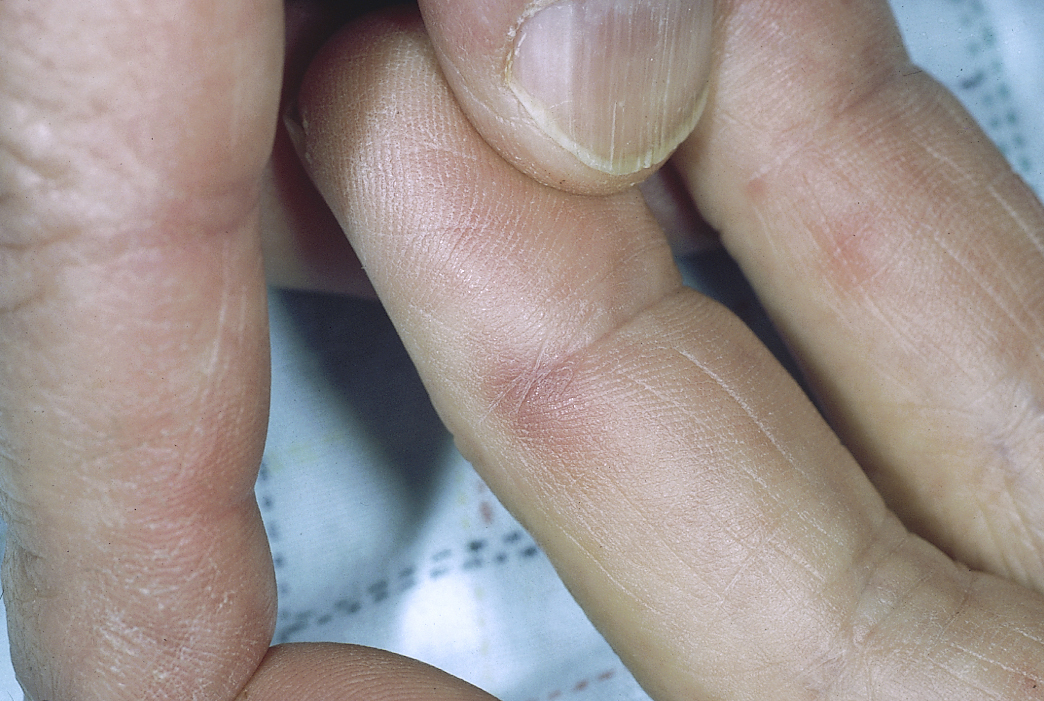 Janeway Lesions: Flat, painless, erythematous lesions seen on the palm of this patient’s hand. Frequently associated with bacterial endocarditis.
 -
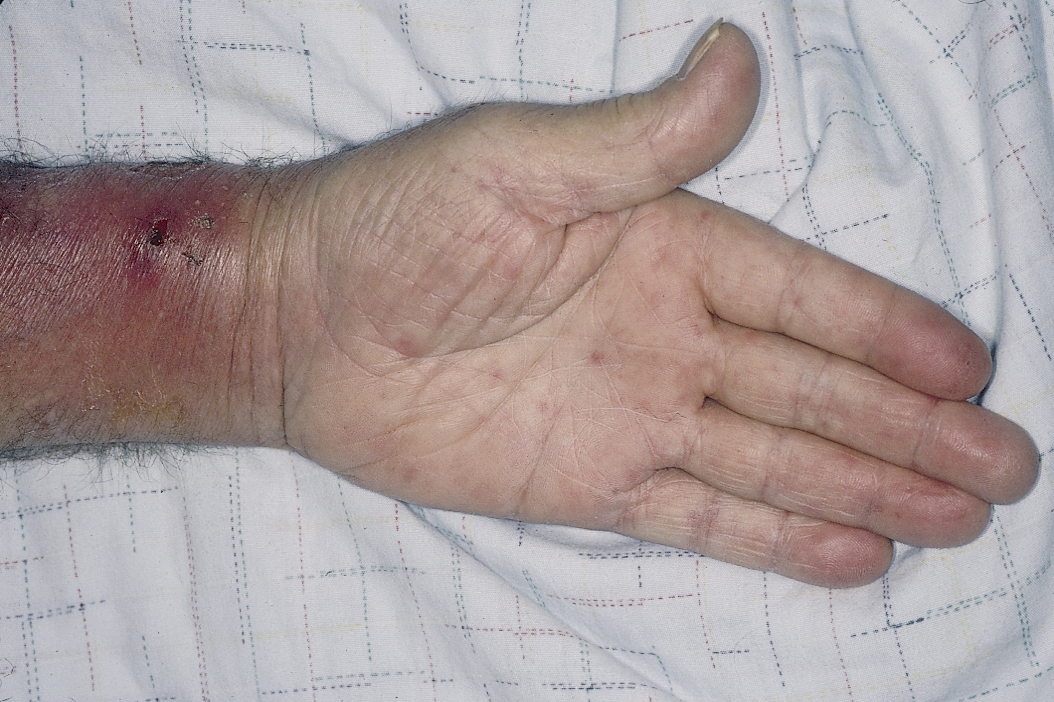 Janeway Lesion: Flat, painless, erythematous lesions seen on the palm of this patient’s hand. While frequently associated with bacterial endocarditis, in this case, they are the result of an infected radial artery aneurysm (inflamed area proximal to thumb).
 -
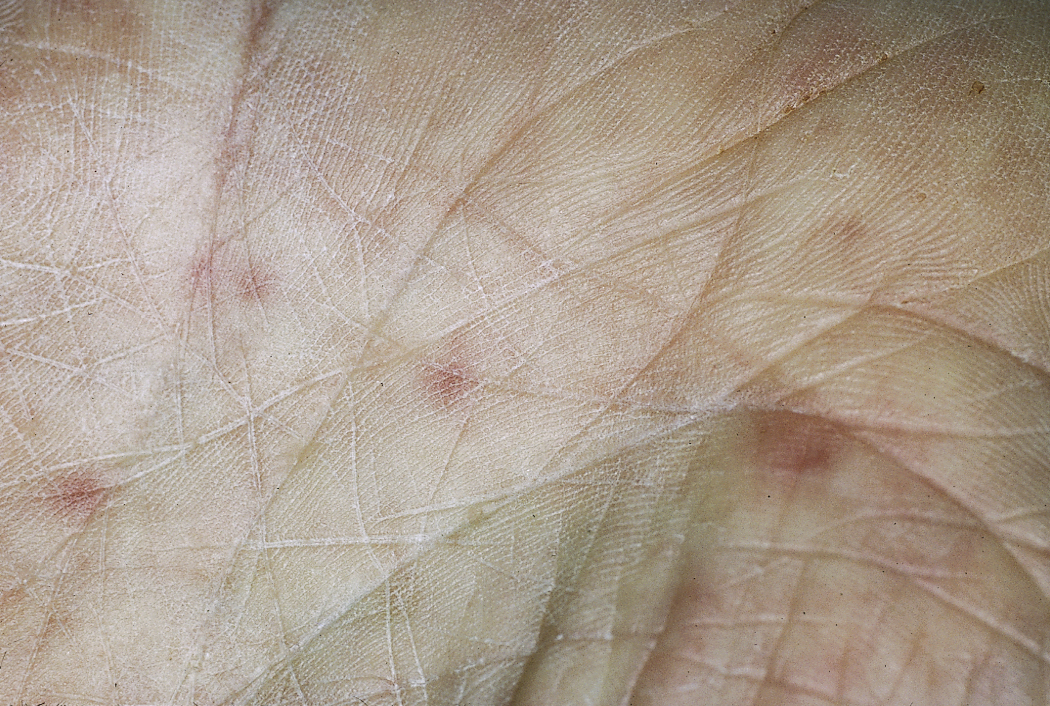 Janeway Lesions: Flat, painless, erythematous lesions seen on the palm of this patient’s hand. Frequently associated with bacterial endocarditis.
 -
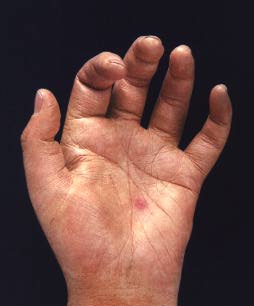 Janeway Lesions: Flat, painless, erythematous lesions seen on the palm of this patient’s hand. Frequently associated with bacterial endocarditis.


History and Symptoms
- IV drug abuse
- Infective endocarditis
- Structural heart disease
- Heart valve injury/replacement
- Family history of autoimmune disorders
- HIV status
- Mucosal bleeding
- Head/neck or lung infection
- Tick exposure
- Constitutional symptoms
Laboratory Findings
- Blood cultures
- Complete blood count (CBC) with peripheral smear
- Antinuclear antibody (ANA)
- Rapid plasma reagin (RPR)
- Erythrocyte sedimentation rate (ESR)
- Antistreptolysin O antibodies (ASO)
- Urinalysis
- Coagulation studies
- Anti-SM antibodies
- Anti-dsDNA antbodies
Chest X Ray
Echocardiography or Ultrasound
Other Diagnostic Studies
- Possible biopsy
Differential Diagnosis
Differential Diagnosis
In alphabetical order. [3] [4]
- Acute bacterial endocarditis
- Coxsackievirus
- Cutaneous vasculitis
- Disseminated Intravascular Coagulation (DIC)
- Echovirus
- Erythema multiforme
- Idiopathic thrombocytopenia purpura
- Meningococcemia
- Polyarteritis Nodosa
- Rocky Mountain Spotted Fever
- Secondary syphilis
- Subacute bacterial endocarditis
- Systemic Lupus Erythematosus
- Thrombotic thrombocytopenic purpura
- Typhoid Fever
Acute Pharmacotherapies
- IV antibiotics
- Antibiotic prophylaxis
- Treat all underlying etiologies
Chronic Pharmacotherapies
- Antibiotic therapy for bacterial endocarditis
Surgery and Device Based Therapy
Surgery and Device Based Therapy
- Valve replacement for bacterial endocarditis
Indications for Surgery
- If all other medical therapy fails (bacterial endocarditis)
References
References
- ↑ 1.0 1.1 Farrior, J.B. (1976). “A consideration of the differences between a Janeway’s lesion and an Osler’s node in infectious endocarditis”. Chest. 70 (2): 239–43. doi:10.1378/chest.70.2.239. PMID 947688. Unknown parameter
|coauthors=ignored (help) - ↑ Janeway C. (1998). “Presidential Address to The American Association of Immunologists. The road less traveled by: the role of innate immunity in the adaptive immune response”. J. Immunol. 161 (2): 539–44. PMID 9670925.
- ↑ Sailer, Christian, Wasner, Susanne. Differential Diagnosis Pocket. Hermosa Beach, CA: Borm Bruckmeir Publishing LLC, 2002:77 ISBN 1591032016
- ↑ Kahan, Scott, Smith, Ellen G. In A Page: Signs and Symptoms. Malden, Massachusetts: Blackwell Publishing, 2004:68 ISBN 140510368X
Editor-In-Chief: C. Michael Gibson, M.S., M.D. [1]