

Health Dictionary
Reliable, easy-to-read patient information on common medical conditions — written in plain language, free of jargon, and grounded in current evidence. Browse the most frequent diagnoses, understand what they mean for everyday life, and learn which steps and questions help you have a focused conversation with your doctor.
Petechial
Introduction
For patient information, click here
Overview
Please help WikiDoc by adding more content here. It’s easy! Click here to learn about editing.
Overview
A petechia (Template:Pronounced), plural petechiae (Template:IPA) is a small red or purple spot on the body, caused by a minor hemorrhage (broken capillary blood vessels).
References
Editor-In-Chief: C. Michael Gibson, M.S., M.D. [1]
Historical Perspective
Please help WikiDoc by adding content here. It’s easy! Click here to learn about editing.
References
Pathophysiology
Pathophysiology
Petechiae may be a sign of thrombocytopenia (low platelet counts). They also occur in circumstances when platelet function is inhibited (e.g., as a side effect of medications or during certain infections) or when excessive pressure is applied to tissue (e.g., when a tourniquet is applied to an extremity or with excessive coughing).
Petechiae should always be quickly investigated. They can be interpreted as vasculitis, an inflammation of the blood vessels, which requires immediate treatment to prevent permanent damage. Some malignancies can also cause petechiae to appear. Petechiae should be investigated by a physician immediately to rule out the more dangerous conditions. Dermatologists can be the most helpful specialists in these conditions because they can more easily identify if the condition is petechiae or some similar looking but less worrisome rash.
The significance of petechiae in children depends on the clinical context in which they arise. Petechiae in children can occur with viral infections. In this setting they do not necessarily signify serious illness. They are the hallmark of some possibly serious illnesses, however, such as meningococcemia, various causes of thrombocytopenia, and leukemia. Therefore, their presence should not be ignored.
Gross Pathology
-
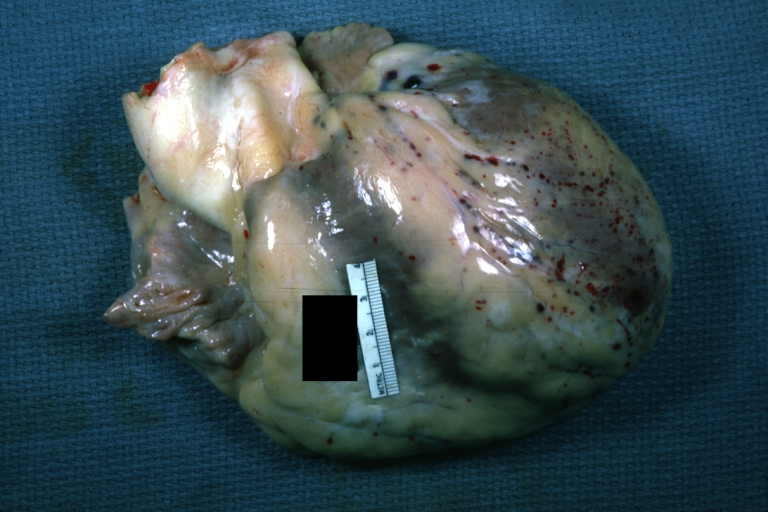 Epicardial petechiae: Gross, an excellent example of infarct heart with petechiae.
Image courtesy of Professor Peter Anderson DVM PhD and published with permission © PEIR, University of Alabama at Birmingham, Department of Pathology

Forensics
Petechiae on the face and conjunctiva (eyes) are a sign of a death by asphyxiation. They are thought to result from an increase of pressure in the veins of the head and hypoxic damage to endothelial of blood vessels.[1]
References
- ↑ Ely, Susan F. (2000). “Ashpyxial deaths and petechiae: a review” (PDF). Journal of Forensic Science. 45 (6): 1274–1277. Retrieved 2007-09-22. Unknown parameter
|coauthors=ignored (help)
Editor-In-Chief: C. Michael Gibson, M.S., M.D. [1]
Causes
Causes
Common causes in adults
- Prolonged straining- crying, coughing, vomiting, childbirth.
- Medications- atropine, carbamazepine, heparin, indomethacin, penicillin, quinine, warfarin.
- Infections- Cytomegalovirus, endocarditis, Hantavirus pulmonary syndrome, meningococcemia, mononucleosis, rocky Mountain spotted fever, scarlet fever, sepsis, viral hemorrhagic fevers.
- Injuries and sunburn.
Causes in adults by Organ System
Causes of petechia in adults in Alphabetical Order
- Acquired aplastic anemia
- Acroangiodermatitis
- Acute biphenotypic leukemia
- Acute infantile hemorrhagic oedema
- Acute lymphoblastic leukemia
- Acute lymphocytic leukemia
- Alemtuzumab
- Altamira syndrome
- Amyloidosis
- Anorexia nervosa
- Argentinean hemorrhagic fever
- Asphyxiation
- Atrus syndrome
- Autoimmune thrombocytopenia
- Autoimmune vasculitis
- Bacterial endocarditis
- Bolivian hemorrhagic fever
- Calcaneal petechiae
- Chronic idiopathic myelofibrosis
- Chronic myeloproliferative disorders
- Cilostazol
- Clotting factor defect
- Congenital cytomegalovirus infection
- Corticosteroid use
- Cryoglobulinaemia
- Dengue
- Disseminated intravascular coagulation
- Endocarditis
- Eosinophilic granulomatosis with polyangiitis
- Ethylmalonic aciduria
- Ethylmalonic encephalopathy
- Familial atrial myxoma
- Fat embolism
- Fetal and neonatal alloimmune thrombocytopenia
- Gardner-diamond syndrome
- Gaucher disease perinatal lethal form
- Granulomatosis with polyangiitis
- Grey Turner’s sign
- Hantavirosis
- Heat stroke
- Hemorragic fever with renal syndrome
- Henoch-schönlein purpura
- Human monocytotropic ehrlichiosis
- Hypersensitivity vasculitis
- Idiopathic thrombocytopenic purpura
- Immune thrombocytopenia purpura
- Infective endocarditis
- Leptospirosis
- Leukocyte adhesion deficiency type iii
- Lymphoblastic lymphoma
- Machupo virus
- Microscopic polyangiitis
- Myelodysplastic syndromes
- Myeloid leukemia philadelphia-negative
- Myeloid leukemia philadelphia-positive
- Myeloproliferative disease
- Neisseria gonorrhoea
- Neisseria meningiditis
- Nodular vasculitis
- Pancytopenia
- Polyarteritis nodosa
- Relapsing fever
- Rickettsiae
- Scurvy
- Secondary vasculitis
- Senile purpura
- Spondylometaphyseal dysplasia with combined immunodeficiency
- T-cell acute lymphoblastic leukemia
- Thrombocytopenia
- Thrombotic thrombocytopenic purpura
- Topical glucocorticoids
- Trauma
- Typhus fever
- Tyrosinaemia type 1
- Urticarial vasculitis
- Vasculitis hypersensitivity
- Vibrio vulnificus
- Vitamin k deficiency
- Warfarin necrosis
- X-linked dyserythropoietic anaemia and thrombocytopenia
Causes
Causes in children by Organ System
Causes of petechia in children in Alphabetical Order
- Acquired platelet function abnormalities
- Aplastic anemia
- B12 deficiency
- Bernard-Soulier syndrome
- Bolivian hemorrhagic fever
- Bone marrow failure
- Bone marrow infiltration
- Boutonneuse fever
- Cavernous hemangioma
- Cerebral malaria
- Child abuse
- Congenital syphilis
- Crimean-Congo hemorrhagic fever
- Dengue fever
- Disseminated intravascular coagulation
- Drug induced thrombocytopenia
- Duke’s fever
- Ebola
- Ehlers–Danlos syndrome
- Fanconi anemia
- Folate deficiency
- Forceful vomiting causing petechiae on face
- Glanzmann’s thrombasthenia
- Hemolytic uremic syndrome
- Hemophilia
- Henoch-schönlein purpura
- Hypersplenism
- Idiopathic thrombocytopenic purpura
- Immune thrombocytopenia purpura
- Inherited thrombocytopenias
- Kawasaki fever
- Leukaemia
- Liver disease
- May Hegglin anomaly
- Meningococcal disease
- Metabolic disorders
- Necrotizing enterocolitis
- Neonatal alloimmune thrombocytopenia
- Neonatal purpura fulminans
- Osteopetrosis
- Sepsis
- Sequestration
- Thrombocytopenia
- Thrombotic thrombocytopenic purpura
- Trauma
- Vasculitis
- Vitamin C deficiency
- Vitamin K deficiency
- Von Willebrand Disease
- Wiskott-Aldrich syndrome
Life-Threatening Causes
Common Causes
Causes in pregnant women by Organ System
| Cardiovascular | No underlying causes |
| Chemical/Poisoning | No underlying causes |
| Dental | No underlying causes |
| Dermatologic | No underlying causes |
| Drug Side Effect | Steroid use |
| Ear Nose Throat | No underlying causes |
| Endocrine | No underlying causes |
| Environmental | No underlying causes |
| Gastroenterologic | No underlying causes |
| Genetic | No underlying causes |
| Hematologic | Idiopathic thrombocytopenic purpura, isoimmune thrombocytopenia, placental abruption causing DIC |
| Iatrogenic | No underlying causes |
| Infectious Disease | Meningococcal disease, rickettsia lillness, viral illness |
| Musculoskeletal/Orthopedic | No underlying causes |
| Neurologic | Meningococcal disease |
| Nutritional/Metabolic | No underlying causes |
| Obstetric/Gynecologic | Hyperemesis gravidarum (on face) |
| Oncologic | No underlying causes |
| Ophthalmologic | No underlying causes |
| Overdose/Toxicity | No underlying causes |
| Psychiatric | No underlying causes |
| Pulmonary | No underlying causes |
| Renal/Electrolyte | No underlying causes |
| Rheumatology/Immunology/Allergy | No underlying causes |
| Sexual | No underlying causes |
| Trauma | Trauma |
| Urologic | No underlying causes |
| Miscellaneous | No underlying causes |
Causes of petechia in pregnant women in Alphabetical Order
- Hyperemesis gravidarum
- Idiopathic thrombocytopenic purpura
- Isoimmune thrombocytopenia
- Meningococcal disease
- Placental abruption causing DIC
- Rickettsia lillness
- Steroid use
- Trauma
- Viral illness
References
- ↑ Grayson MD, Charlotte (2006-09-26). “Typhus”. MedlinePlus Medical Encyclopedia. National Institutes of Health. Retrieved 2007-11-05.
Editor-In-Chief: C. Michael Gibson, M.S., M.D. [1]
Differentiating Petechia from other Diseases
Please help WikiDoc by adding content here. It’s easy! Click here to learn about editing.
References
Epidemiology and Demographics
Please help WikiDoc by adding content here. It’s easy! Click here to learn about editing.
References
Risk Factors
Please help WikiDoc by adding content here. It’s easy! Click here to learn about editing.
References
Natural History, Complications and Prognosis
Please help WikiDoc by adding content here. It’s easy! Click here to learn about editing.
References
Diagnosis
Diagnosis
History and Symptoms | Physical Examination | Laboratory Findings | Other Diagnostic Studies
Treatment
Treatment
Medical Therapy | Primary Prevention | Secondary Prevention | Cost-Effectiveness of Therapy | Future or Investigational Therapies
Editor-In-Chief: C. Michael Gibson, M.S., M.D. [1]