

Health Dictionary
Reliable, easy-to-read patient information on common medical conditions — written in plain language, free of jargon, and grounded in current evidence. Browse the most frequent diagnoses, understand what they mean for everyday life, and learn which steps and questions help you have a focused conversation with your doctor.
Pediculosis capitis
Introduction
For patient information click here Synonyms and keywords: Head lice infestation; Nits
Overview
Overview

The head louse (Pediculus humanus capitis) is one of the many varieties of sucking lice specialized to live on different areas of various animals.
As the name implies, head lice are specialized to live among the hair present on the human head and are exquisitely adapted to living mainly on the scalp and neck hairs of their human host. Lice present on other body parts covered by hair are not head lice but are either pubic lice (Pthirus pubis) or body lice (Pediculus humanus humanus).
Pathophysiology
The main mode of transmission is contact with a person who is already infested (i.e., head-to-head contact). Contact is common during play (sports activities, playgrounds, at camp, and slumber parties) at school and at home.
Causes
Pediculus humanus capitis, the head louse, is an insect of the order Anoplura and is an ectoparasite whose only host are humans. The louse feeds on blood several times daily and resides close to the scalp to maintain its body temperature.
Epidemiology and Demographics
In the United States, infestation with head lice (Pediculus humanus capitis) is most common among preschool- and elementary school-age children and their household members and caretakers. Head lice are not known to transmit disease; however, secondary bacterial infection of the skin resulting from scratching can occur with any lice infestation.
Diagnosis
History and Symptoms
Pediculosis capitiss can be asymptomatic, particularly with a first infestation or when an infestation is light. Itching (“pruritus”) is the most common symptom of Pediculosis capitis and is caused by an allergic reaction to louse bites. It may take 4-6 weeks for itching to appear the first time a person has head lice.
Physical Examination
An infestation is diagnosed by looking closely through the hair and scalp for nits, nymphs, or adults. Finding a nymph or adult may be difficult; there are usually few of them and they can move quickly from searching fingers. If crawling lice are not seen, finding nits within a 1/4 inch of the scalp confirms that a person is infested and should be treated.
Other Diagnostic Studies
The condition is diagnosed by the presence of lice or eggs in the hair, which is facilitated by using a magnifying glass or running a comb through the child’s hair. In questionable cases, a child can be referred to a health professional. However, the condition is overdiagnosed, with extinct infestations being mistaken for active ones. As a result, lice-killing treatments are more often used on noninfested than infested children.[1] The use of a louse comb is the most effective way to detect living lice.[2]
Treatment
Secondary Prevention
Examination of the child’s head at regular intervals using a louse comb allows the diagnosis of louse infestation at an early stage.
References
- ↑ Pollack RJ, Kiszewski AE, Spielman A (2000). “Overdiagnosis and consequent mismanagement of head louse infestations in North America”. The Pediatric Infectious Diseases Journal. 19 (8): 689–93. doi:10.1097/00006454-200008000-00003. PMID 10959734.
- ↑ Mumcuoglu KY, Friger M, Ioffe-Uspensky I, Ben-Ishai F, Miller J (2001). “Louse comb versus direct visual examination for the diagnosis of head louse infestations”. Pediatric dermatology. 18 (1): 9–12. doi:10.1046/j.1525-1470.2001.018001009.x. PMID 11207962.
Editor-In-Chief: C. Michael Gibson, M.S., M.D. [1]
Historical Perspective
Template:Rquote The number of cases of human louse infestations (or pediculosis) has increased worldwide since the mid-1960s, reaching hundreds of millions annually.[1]
Despite improvements in medical treatment and prevention of human diseases during the 20th century, head louse infestation remains stubbornly prevalent. In 1997, 80% of American elementary schools reported at least one outbreak of lice.[2] Lice infestation during that same period was more prevalent than chicken pox.[2]
About 6–12 million children between the ages of 3 and 11 are treated annually for head lice in the United States alone.[3] High levels of louse infestations have also been reported from all over the world including Israel, Denmark, Sweden, U.K., France and Australia.[4][5]
The number of children per family, the sharing of beds and closets, hair washing habits, local customs and social contacts, healthcare in a particular area (e.g. school) and socioeconomic status were found to be significant factors in head louse infestation. Girls are 2–4 times more frequently infested than boys. Children between 4 and 13 years of age are the most frequently infested group.[6] In the U.S., African-American children have lower rates of infestation.[3]
The United Kingdom’s National Health Service and many American health agencies [1][2][3] report that lice “prefer” clean hair because it’s easier to attach eggs and to cling to the strands; however, this is often contested.
Head lice (Pediculus humanus capitis) infestation is most frequent on children aged 3–10 and their families.[7] Females get head lice twice as often as males,[7] and infestation in persons of Afro-Caribbean or other black descent is rare because of hair consistency.[7] But these children may have nits that hatch and the live lice could be transferred by head contact to other children.[8]
References
- ↑ Norman G. Gratz (1998). “Human lice: Their prevalence, control and resistance to insecticides. A review 1985–1997” (PDF). Geneva, Switzerland: World Health Organization. Retrieved 2008-01-02.
- ↑ 2.0 2.1 “A modern scourge: Parents scratch their heads over lice”. Consumer Reports. February 1998. pp. 62–63. Retrieved 2008-10-10.
- ↑ 3.0 3.1 Invalid
<ref>tag; no text was provided for refs namedcdc - ↑ Mumcuoglu, Kosta Y.; Barker CS; Burgess IF; Combescot-Lang C; Dagleish RC; Larsen KS; Miller J; Roberts RJ; Taylan-Ozkan A. (2007). “International Guidelines for Effective Control of Head Louse Infestations”. Journal of Drugs in Dermatology. 6 (4): 409–14. PMID 17668538.
- ↑ Ian Burgess (2004). “Human Lice and their Control”. Annual Review of Entomology. Annual Reviews. 49: 457–481. doi:10.1146/annurev.ento.49.061802.123253. PMID 14651472.
- ↑ Mumcuoglu KY, Miller J, Gofin R; et al. (September 1990). “Epidemiological studies on Pediculosis capitis in Israel. I. Parasitological examination of children”. International Journal of Dermatology. 29 (7): 502–6. doi:10.1111/j.1365-4362.1990.tb04845.x. PMID 2228380.
- ↑ 7.0 7.1 7.2 Nutanson I.; et al. (2008). “Pediculus humanus capitis: an update” (PDF). Acta Dermatoven. 17 (4): 147–59.
- ↑ James GH Dinulos (September 2008). “Lice (Pediculosis)”. The Merck Manual. Merck & Co., Inc. Retrieved 2008-12-27.
Classification
Please help WikiDoc by adding content here. It’s easy! Click here to learn about editing.
References
Pathophysiology
Overview
The main mode of transmission is contact with a person who is already infested (i.e., head-to-head contact). Contact is common during play (sports activities, playgrounds, at camp, and slumber parties) at school and at home.
Pathophysiology
Life cycle:

The life cycle of the head louse has three stages: egg, nymph, and adult.
- Eggs: Nits are head lice eggs. They are hard to see and are often confused for dandruff or hair spray droplets. Nits are laid by the adult female and are cemented at the base of the hair shaft nearest the scalp 1. They are 0.8 mm by 0.3 mm, oval and usually yellow to white. Nits take about 1 week to hatch (range 6 to 9 days). Viable eggs are usually located within 6 mm of the scalp.
- Nymphs: The egg hatches to release a nymph 2. The nit shell then becomes a more visible dull yellow and remains attached to the hair shaft. The nymph looks like an adult head louse, but is about the size of a pinhead. Nymphs mature after three molts (3, 4) and become adults about 7 days after hatching.
- Adults: The adult louse is about the size of a sesame seed, has 6 legs (each with claws), and is tan to grayish-white 5. In persons with dark hair, the adult louse will appear darker. Females are usually larger than males and can lay up to 8 nits per day. Adult lice can live up to 30 days on a person’s head. To live, adult lice need to feed on blood several times daily. Without blood meals, the louse will die within 1 to 2 days off the host.
-
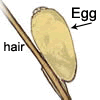 Egg on a hair shaft
 -
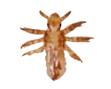 Nymph form
 -
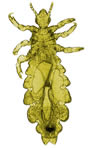 Adult louse


Transmission
Personal hygiene or cleanliness in the home or school has nothing to do with getting head lice. Getting head lice is not related to cleanliness of the person or his or her environment. Head lice are mainly spread by direct contact with the hair of an infested person. The most common way to get head lice is by head-to-head contact with a person who already has head lice. Such contact can be common among children during play at:
- School,
- Home, and
- Elsewhere (e.g., sports activities, playgrounds, camp, and slumber parties).
Less commonly,
- Wearing clothing, such as hats, scarves, coats, sports uniforms, or hair ribbons, recently worn by an infested person.
- Using infested combs, brushes, or towels.
- Lying on a bed, couch, pillow, carpet, or stuffed animal that has recently been in contact with an infested person.
References
Editor-In-Chief: C. Michael Gibson, M.S., M.D. [1]
Causes
Overview
The head louse (Pediculus humanus capitis) is an obligate, ectoparasitic, wingless insect spending its entire life on human scalp and feeding exclusively on human blood. Humans are the only known host of this parasite. Humans can also be infested with the pubic or crab louse (Pthirus pubis) and/or with the body louse (Pediculus humanus humanus).Head lice infect hair on the head. Tiny eggs on the hair look like flakes of dandruff. However, instead of flaking off the scalp, they stay put. Head lice can live up to 30 days on a human. Their eggs can live for more than 2 weeks. Head lice spread easily, particularly among school children. Head lice are more common in close, overcrowded living conditions. Pediculus humanus capitis is most commonly found on the scalp, behind the ears and near the neckline at the back of the neck. Head lice hold on to hair with hook-like claws found at the end of each of their six legs. Head lice are rarely found on the body, eyelashes, or eyebrows.
Morphology
The dorso-ventrally flattened body of the louse is divided into head, thorax and abdomen. On the head, one pair of eyes and one pair of antennae are clearly visible. The mouthparts are adapted to piercing the skin and sucking blood. The legs, with their terminal claws, are adapted to holding the hair-shaft. They cannot jump from head to head and being wingless insects they also cannot fly. In males (Fig.1), the first pair of legs are slightly larger and also used for holding the female during copulation. Males are slightly smaller than females and are characterized by the pointed end of the abdomen and the well-developed genital apparatus visible inside the abdomen. Females are characterized by two gonopods in the shape of a W at the end of their abdomen (see figure above). The eggs (Fig.3) are oval-shaped and ca. 0.8 mm in length. Immediately after oviposition they are shiny, round, and transparent. Head lice are 1-3 mm in size, varying according to their stage of development. They are usually grayish in color but depending on the time since their previous blood-meal they can be also reddish-brown.
-
Fig. 1. Male of head louse
-
Fig.3.Louse egg
Biology
During its lifespan of 4 weeks a female louse lays 50-150 eggs (nits). The egg hatches to the first nymphal stage, which after three moltings develop to nymph 2, nymph 3 and eventually to either a male or female louse. Adult lice copulate frequently and the females lay an average of 3-4 eggs daily. A generation lasts for about 1 month. All stages are blood-feeders and they bite the skin 4-5 times daily to feed. During oviposition the female excretes a glue-like substance from a gland located at the posterior end of the body and attaches the eggs on the hair of the host. Although any part of the scalp may be colonized, lice favor the nape of the neck and the area behind the ears, where the eggs are usually laid.
Template:Head louse pediculosis
See also
References
External links
Editor-In-Chief: C. Michael Gibson, M.S., M.D. [1]
Differentiating Pediculosis capitis from other Diseases
- Seborrheic dermatitis
- Dermatophyte infection
- Dried hairspray/gel
- Piedra (black piedra from Piedraia hortae, white piedra from Trichosporon asahii and other species of Trichosporon)
- Monilethrix or trichorrhexis nodosa
References
Editor-In-Chief: C. Michael Gibson, M.S., M.D. [1]; Associate Editor(s)-In-Chief: Varun Kumar, M.B.B.S. [2]
Epidemiology and Demographics
Overview
In the United States, infestation with head lice (Pediculus humanus capitis) is most common among preschool- and elementary school-age children and their household members and caretakers. Head lice are not known to transmit disease; however, secondary bacterial infection of the skin resulting from scratching can occur with any lice infestation.
Epidemiology and Demographics
Having head lice is very common. However, there are no reliable data on how many people get head lice in the United States each year. Occasionally, head lice may be acquired from contact with clothing (such as hats, scarves, coats) or other personal items (such as brushes or towels) that belong to an infested person.
Age
Preschool and elementary-age children, 3-11, and their families are infested most often.
Gender
Girls get head lice more often than boys, women more than men.
Developed Countries
In the United States, African-Americans rarely get head lice. Reliable data on how many people get head lice each year in the United States are not available; however, an estimated 6 million to 12 million infestations occur each year in the United States among children 3 to 11 years of age. Some studies suggest that girls get head lice more often than boys, probably due to more frequent head-to-head contact. In the United States, infestation with head lice is much less common among African-Americans than among persons of other races. The head louse found most frequently in the United States may have claws that are better adapted for grasping the shape and width of some types of hair but not others.
References
Editor-In-Chief: C. Michael Gibson, M.S., M.D. [1]
Risk Factors
Risk Factors
Anyone who comes in close contact (especially head-to-head contact) with someone who already has head lice is at greatest risk.
- Coming in close contact with a person who has lice
- Touching the clothing or bedding of someone who has lice
- Sharing hats, towels, brushes, or combs of someone who has had lice
Having head lice does not mean the person has poor hygiene or low social status. Having head lice causes intense itching, but does not lead to serious medical problems. Unlike body lice, head lice never carry or spread diseases.
References
Editor-In-Chief: C. Michael Gibson, M.S., M.D. [1]
Natural History, Complications and Prognosis
Complications
Some people will develop a secondary skin infection from scratching. Antihistamines can help relieve the itching.
Prognosis
Lice are usually killed with proper treatment. However, lice may come back, especially if the source is not corrected. For example, a classroom with many infected children can cause kids to repeatedly get lice. When one case is detected in a family or a school or child-care center, every child at that location should be examined for head lice. This can help prevent further spreading.
References
Editor-In-Chief: Please help WikiDoc by adding more content here. It’s easy! Click here to learn about editing. C. Michael Gibson, M.S., M.D. [1]
Diagnosis
Diagnosis
History and Symptoms | Physical Examination | Laboratory Findings | Other Diagnostic Studies
Treatment
Treatment
Medical Therapy | Primary Prevention | Secondary Prevention | Future or Investigational Therapies
Editor-In-Chief: C. Michael Gibson, M.S., M.D. [1]