

Health Dictionary
Reliable, easy-to-read patient information on common medical conditions — written in plain language, free of jargon, and grounded in current evidence. Browse the most frequent diagnoses, understand what they mean for everyday life, and learn which steps and questions help you have a focused conversation with your doctor.
NSVT
Introduction
For patient information, click here
Synonyms and keywords: V tach; tachycardia – ventricular; VT
Ventricular tachycardia (VT) is a cardiac arrhythmia of three or more consecutive complexes originating in the ventricles at a rate greater than 100 beats per minute.[1] VT is a potentially life-threatening arrhythmia that may cause hemodynamic compromise, syncope, or degenerate into ventricular fibrillation and sudden cardiac death.
Overview
Ventricular tachycardia is one of the most clinically significant cardiac arrhythmias. It arises from abnormal electrical activity within the ventricular myocardium and is usually manifested as a tachyarrhythmia with a wide QRS complex (≥120 ms) on electrocardiography.[2] Management requires assessment of the risk of sudden cardiac death, evaluation for underlying heart disease, and consideration of the risks and benefits of available treatments.[2]
Historical Perspective
Overview
In 1906 Gallavardin discovered the reasons behind the cardiac instability which leads to ventricular tachycardia, and put forth the idea that VT could convert into ventricular fibrillation. Thomas Lewis gave the first electrocardiographic description of ventricular tachycardia in 1909. It was first suggested in 1921 that coronary occlusion could the main cause of ventricular tachycardia. Many advancements have been made in the diagnosis and management protocols of ventricular tachycardia (VT) since that time.
Historical Perspective
Discovery
Early Clinical and Experimental Observations
- The first electrocardiographic description and evidence of ventricular tachycardia (VT) was given by Thomas Lewis in 1909.[1]
- He described a patient with shortness of breath, precordial pain, and dropsy in whom he observed from three to eleven successive extrasystoles.
- He deduced from the electrocardiogram, venous pulse recording, and clinical evidence that the rhythm was of ventricular origin.
- In 1906, Einthoven had recorded ventricular premature beats and ventricular bigeminy using his string galvanometer.[2]
- In 1906 Gallavardin did landmark work in France in which he found the reasons for instability in VT and its ability to convert in ventricular fibrillation.[3][4]
- He challenged the fact that ventricular tachycardia was no more than a succession of extrasystoles suggesting that although the two phenomena were intimately related, the same mechanism might not be responsible for both.
- Lewis and Smith did experimentation with dogs by simulating VT by ligating coronary arteries and were able to find characteristics of VT as we have described in the other sections.[5][6]
Electrocardiographic Features
- Robinson and Herrmann, in 1921, suggested that coronary occlusion was a frequent cause of ventricular tachycardia and the prognosis in these cases appeared to be poor.[7]
- They also suggested the most initial criteria for VT classification.
- That was modified later by Rosenberg as well as Dressler and Roesler who pointed out the occasional occurrence of fusion beats in tracings showing the arrhythmia.[8][9]
- Since then we have come a long way in making of the diagnostic criteria better with advent of esophageal and venous leads and invasive electrophysiologic studies.[10][11][12]
- Holter and colleagues devised radio signal technique for obtaining a longer period of observation of the patient’s rhythm.[13]
- Later in development portable battery-operated electromagnetic tape recording with high-speed analyzing equipment was described by Holter and has been called Holter monitor ever since.[13]
- This technique has led to discovery, classification and research for treatment of various forms of VT.
- Direct intracavitary recordings from the human ventricle were reported by Lenegre and Maurice in 1945.
- Hiss bundle electrocardiograms were described by Ciraud, Latour, and Puech in 1960.[14][15]
- It was only in 1969, however, that a safe, percutaneous method of recording the His bundle electrocardiogram in man was reported.[16]
- Intracardiac recordings have allowed more precise diagnosis of ventricular tachycardia and have modified the electrocardiographic criteria for diagnosing this arrhythmia.[10]
- In 1972, Wellens et al. reported the initiation and termination of ventricular tachycardia in patients with priorventricular tachycardia using critically timed extrastimuli.[17]
- This ability to initiate and terminate arrhythmias under controlled circumstances, as well as the ability to record from multiple sites within the heart, has allowed rapid advancement in our understanding of cardiac arrhythmias.
- Initially phlebography was very popular amongst scientists for features of VT.
- Prinzmetal and Kellogg in 1934 concluded that slower, independent A waves might be encountered in two-thirds of cases of VT.[18]
- Schrire and Vogelpoel discovered that the so-called cannon A is encountered in presence of atrioventricular dissociation, but could occur in regular fashion at the same rate in nodal tachycardias.[19]
- The AV dissociation and its reflection was demonstrated by Wilson et al. in 1964. [20]
- Levine was the first who noted slight irregularity in cycle length in patients with ventricular tachycardia which was audible with the stethoscope.[21] In 1927, he mentioned variation in intensity of the first heart sound, due to atrioventricular dissociation, and extended these observations in conjunction with Harvey in 1948.[22][23]
- Harvey and Corrado demonstrated multiple low-frequency sounds audible in ventricular tachycardia as a differential point.[24]
- In 1930, Strauss[25] correlated prognosis with the presence or absence of organic heart disease. It was noted that 60% of the cases occurred during the fifth and sixth decade of life, with a male preponderance.
- Congestive heart failure was present in two-thirds of the patient population and digitalis had been administered before the onset of the tachycardia in half of the patients.
- Quinidine sulfate was acutely successful in controlling paroxysms in all cases in which it was employed. There were many other case series which had similar findings.[26][27][28][29][30][31][32][33]
- Most investigators classified ventricular tachycardia into two forms on the basis of pattern and duration of the arrhythmia.
- Intermittent ventricular tachycardia was defined as runs of ventricular tachycardia separated by periods of normal rhythm, the latter often showing ventricular extrasystoles or short paroxysms of tachycardia lasting seconds or minutes which ceased spontaneously or were controlled readily in most cases by therapy. Persistent ventricular tachycardia was thereby defined as being of longer duration and without periods of interruption.[34]
- In all these series, the prognosis in patients with no identified organic heart disease was better than in those patients with abnormal hearts.
- Paroxysmal ventricular tachycardia in young patients with otherwise apparently healthy hearts was thought by several investigators to run a benign clinical course.[30][36]
- With the advent of more refined investigations such as cardiac catheterization, echocardiography, and endomyocardial biopsy, anatomic and histologic details were found about the primary electrical disease.
- Various investigators attempted to ascribe prognostic significance to morphologic characteristics of ventricular tachycardia. Lundy and McLellan categorized ventricular tachycardia by bundle branch pattern and assumed incorrectly the ventricular origin of the tachycardia from these morphologies.[26]
- A distinctive form of ventricular tachycardia with beat-to-beat alteration of QRS axis in a single lead has been called bidirectional tachycardia and was first described by Schwensen in 1922.[37]
- He observed its occurrence during atrial fibrillation and linked it to digitalis intoxication.
- Palmer and White reported its poor prognosis.[38]
- The studies which followed showed the same finding of poor prognosis with digitalis.[39][33]
Landmark Events in the Development of Treatment Strategies
- Scott in 1922 described a patient in whom quinidine could both terminate and prevent episodes of ventricular tachycardia.[40]
- He also noticed that on discontinuing quinidine ventricular tachycardia recurred. He also hypothesized that quinidine abolished ventricular tachycardia by lengthening the refractory period of the ventricle, thereby preventing early premature ventricular beats.
- Drury and others demonstrated that quinidine prolonged the refractory period of ventricular muscle in dogs.[41]
- Levine and Fulton noted that treatment with quinidine could either terminate episodes of ventricular tachycardia or it could cause them.[42]
- By 1950, Armbrust and Levine had followed a large population of patients and strongly advocated quinidine administration in the acute setting despite the difficulties associated with its use.[32]
- Procainamide was used to treat ventricular tachycardia in man in 1950 and rapidly achieved widespread use.[43][44]
- The first steps toward the development of procainamide had taken place many years earlier.
- In 1937, Beck and Mantz demonstrated that the topical application of procaine to the epicardium during surgical procedures reduced the occurrence of ventricular extrasystoles.[45]
- Procaine was limited to use under anesthesia because of its central nervous system toxicity.
- With further development of newer congeners, procainamide and lidocaine achieved wide clinical use.
- Lidocaine was synthesized in 1946 and was first used clinically by Southworth and colleagues to prevent ventricular arrhythmias during cardiac catheterization.[46]
- Other antiarrhythmic drugs quickly followed procainamide and lidocaine. Phenytoin was first used to treat ventricular tachycardia in 1958.[47]
- In the 1960s a number of other drugs including beta-adrenergic blocking agents, disopyramide, bretylium, mexiletine and amiodarone were reported to be effective in treating ventricular arrhythmias in selected patients.[48]
- Once ventricular tachycardia had accelerated and become less organized, the likelihood of successful termination of the arrhythmia by drugs became more remote. Considerable experimental work had demonstrated the feasibility of using electric shocks to terminate ventricular fibrillation in a variety of experimental situations.[49][50]
- Several chance events and experimental procedure had demonstrated the use of this procedure.[51][52]
- In 1961, Alexander et al. used alternating current electively for the first time to terminate ventricular tachycardia that could not be stopped by giving antiarrhythmic drugs.[53]
- Over the subsequent few years, Lown and his colleagues greatly refined and popularized techniques for terminating tachyarrhythmias by electric discharges.[54][55][56][57]
- Direct current (DC) or capacitor discharge was shown to be safer and more effective than alternating current.
- Synchronization of the direct current discharge to the R-wave resulted in safer termination of arrhythmias and was called cardioversion and was used for different kinds of arrhythmias.
- Ventricular tachycardia could occasionally be terminated by thumping the chest in some patients.[58]
- Defibrillation even using DC discharge required much higher energies, however. These techniques were quickly accepted around the world and truly revolutionized the treatment of cardiac tachyarrhythmias.
- Implantable devices capable of sensing and terminating ventricular tachycardia automatically by either defibrillation or cardioversion have come into clinical use.[59]
Overdrive Pacing
- In 1960, Zoll and associates reported that increasing the heart rate by closed-chest cardiac stimulation had prevented recurrent ventricular tachyarrhythmias.[60]
- They demonstrated that runs of ventricular fibrillation could be prevented by pacing the heart above a certain critical heart rate.
- In the same year, Schwedel, Escber. and Furman demonstrated similar short-term benefit from transvenous right ventricular endocardial pacing. [61]
- Both the above experiments were in patients with heart block. Subsequently, Sowton and colleagues applied a similar technique in patients with ventricular tachycardia and fibrillation but without evidence of heart block.[62]
- Apparently, pacing prevented episodes of tachyarrhythmia and extrasystoles in these patients. Furthermore, these authors suggested that the combined use of antiarrhythmic drugs and overdrive pacing might be better than the use of either modality alone in some patients.
- There were many case series and reports of the use of overdrive pacing after this.
- These series are small with a limited follow-up period. Not all reports were favorable and long-term outcomes were rarely available.
- Acute treatment of ventricular arrhythmias by overdrive pacing became accepted as effective in some patients.
Landmark Events in the Development of Surgical Treatment
- In 1959 Couch reported on a patient in whom ventricular aneurysmectomy was successfully performed to prevent recurrent ventricular tachycardia.[63][64]
- But the procedure has been associated with poor success rates and surgical mortality of 20-50%.[65][66]
- Newer techniques include incising the margins of an aneurysm and excising these, and extensive endocardial scar excision combined with aneurysmectomy.[67][68][69][70]
- Sympathectomy, myocardial revascularization, and mitral valve replacement have also been tried for VT repair.[71]
Choronology of Events
| Year | Event |
| 1909 | First electrocardiographic demonstration of ventricular tachycardia. |
| 1921 | Relationship of coronary artery disease and ventricular tachycardia described. |
| 1921 | Electrocardiographic criteria for ventricular tachycardia were defined. |
| 1922 | Quinidine used to treat ventricular tachycardia. |
| 1946 | Lidocaine synthesized. |
| 1950 | Procainamide introduced into clinical practice. |
| 1956 | Alternating current used to terminate ventricular tachycardia. |
| 1959 | Aneurysmectomy performed to treat ventricular tachycardia. |
| 1960 | Use of cardiac pacing to prevent ventricular tachycardia in patients with complete heart block. |
| 1960 | Elective alternating current termination of ventricular tachycardia. |
| 1962 | Synchronized cardioversion of ventricular tachycardia. |
| 1966 | Torsades de pointes described. |
| 1971 | Ventricular tachycardia initiated and terminated by critically-timed premature ventricular beats. |
References
- ↑ Lewis T(1909). Single and successive extrasystoles. Lancet 1:382.
- ↑ Einthoven W(1906). Le telecardiogramme. Arch Int Physiol 4:132.
- ↑ Gallavardin L(1922). Extrasystolie ventriculaire a paroxysmes tachycardiques prolonges. Arch Mal Coeur 15:298.
- ↑ Gallavardin, L(1926). Tachycardie ventriculaire terminale: complexes alternants ou multiformes: ses rapports avec une forme severe d’extra-systolie ventriculaire. Arch Mal Coeur 19:153.
- ↑ Lewis T(1909). The experimental production of paroxysmal tachycardia and the effects of ligation of the coronary arteries. Heart 1:98.
- ↑ Smith FM(1918). The ligation of coronary arteries with electrocardiographic study. Arch Intern Med, 22:8.
- ↑ Robinson, GC, Herrmann CR(1921). Paroxysmal tachycardia of ventricular origin and its relation to coronary occlusion. Heart 8:59.
- ↑ Rosenberg DH(1940). Fusion beats. J Lab Clin Med 25:919.
- ↑ DRESSLER W, ROESLER H (1952). “The occurrence in paroxysmal ventricular tachycardia of ventricular complexes transitional in shape to sinoauricular beats; a diagnostic aid”. Am Heart J. 44 (4): 485–93. PMID 12976333.
- ↑ 10.0 10.1 Wellens HJ, Bär FW, Lie KI (1978). “The value of the electrocardiogram in the differential diagnosis of a tachycardia with a widened QRS complex”. Am J Med. 64 (1): 27–33. PMID 623134.
- ↑ BUTTERWORTH S, POINDEXTER CA (1946). “The esophageal electrocardiogram in arrhythmias and tachycardias”. Am Heart J. 32 (6): 681–8. PMID 20278231.
- ↑ VOGEL JH, TABARI K, AVERILL KH, BLOUNT SG (1964). “A SIMPLE TECHNIQUE FOR IDENTIFYING P WAVES IN COMPLEX ARRHYTHMIAS”. Am Heart J. 67: 158–61. PMID 14118481.
- ↑ 13.0 13.1 HOLTER NJ (1961). “New method for heart studies”. Science. 134: 1214–20. PMID 13908591.
- ↑ Lenegre I, Maurice P(1945): De quelques resultats obtenus par la derivation dired intracavitaire des courants electriques de l’oreillette et du ventricule droile. Arch Mal Coeur 38:298
- ↑ Giraud C, Latour H, Peuch P(1960). L’activite du noeud de Tawara et du faisceau de His en electrocardiographie chez l’homme. Malattie Cardiovascolari 1:321.
- ↑ Scherlag BJ, Lau SH, Helfant RH, Berkowitz WD, Stein E, Damato AN (1969). “Catheter technique for recording His bundle activity in man”. Circulation. 39 (1): 13–8. PMID 5782803.
- ↑ Wellens HJ, Schuilenburg RM, Durrer D (1972). “Electrical stimulation of the heart in patients with ventricular tachycardia”. Circulation. 46 (2): 216–26. PMID 4114692.
- ↑ Prinzmetal M, Kellogg F(1934): On the significance of the jugular pulse in the clinical diagnosis of ventricular tachycardia. Am Heart J 9:370.
- ↑ SCHRIRE V, VOGELPOEL L (1955). “The clinical and electrocardiographic differentiation of supraventricular and ventricular tachycardias with regular rhythm”. Am Heart J. 49 (2): 162–87. PMID 13228352.
- ↑ WILSON WS, JUDGE RD, SIEGEL JH (1964). “A SIMPLE DIAGNOSTIC SIGN IN VENTRICULAR TACHYCARDIA”. N Engl J Med. 270: 446–8. doi:10.1056/NEJM196402272700905. PMID 14163224.
- ↑ Strong CF, Levine SA(1923): The irregularity of the ventricular rate in paroxysmal ventricular tachycardia. Heart 10:125.
- ↑ Levine SA(1927). The clinical recognition of paroxysmal ventricular tachycardia. Am Heart J 3: 177.
- ↑ Harvey WP, Levine SA(1948) The changing intensity of the first sound in auricular flutter, an aid to the diagnosis by auscultation. Am Heart J 35:924.
- ↑ HARVEY WP, CORRADO MA (1957). “Multiple sounds in paroxysmal ventricular tachycardia; an aid in diagnosis by auscultation”. N Engl J Med. 257 (7): 325–9. doi:10.1056/NEJM195708152570708. PMID 13464935.
- ↑ Strauss MB(1930). Paroxysmal ventricular tachycardia . Am J Med Sci 179:337.
- ↑ 26.0 26.1 Lundy CJ, McLellan LL(1934) Paroxysmal ventricular tachycardia: an etiological study with special reference to the type. Ann Intern Med 7:812.
- ↑ Riseman JEF, Linenthal H(1941).
- Paroxysmal ventricular tachycardia. Its favorable prognosis in the absence of acute cardiac damage and its treatment with parenterally administered quinine dihydrochloride. Am Heart J 22:219.
- ↑ :Ventricular tachycardia: an analysis of 36 cases. Arch Intern Med 71:137.
- ↑ Cooke WT, White PD(1943). Paroxysmal ventricular tachycardia. Br Heart J 5:33.
- ↑ 30.0 30.1 Parkinson J, Papp C(1947). Repetitive paroxysmal tachycardia. Br Heart J 9:241.
- ↑ Herrmann CR, Hejtmancik, MR(1948). A clinical and electrocardiographic study of paroxysmal ventricular tachycardia and its management. Ann Intern Med 28:989.
- ↑ 32.0 32.1 ARMBRUST CA, LEVINE SA (1950). “Paroxysmal ventricular tachycardia; a study of 107 cases”. Circulation. 1 (1): 28–40. PMID 15401194.
- ↑ 33.0 33.1 33.2 HERRMANN GR, PARK HM, HEJTMANCIK MR (1959). “Paroxysmal ventricular tachycardia; a clinical and electrocardiographic study”. Am Heart J. 57 (2): 166–76. PMID 13617190.
- ↑ 34.0 34.1 Williams. C. Ellis. L.B.: Ventricular tachycardia: an analysis of 36 cases. Arch Intern Med 71:137.
- ↑ MACKENZIE GJ, PASCUAL S (1964). “PAROXYSMAL VENTRICULAR TACHYCARDIA”. Br Heart J. 26: 441–51. PMC 1018162. PMID 14196126.
- ↑ FROMENT R, GALLAVARDIN L, CAHEN P (1953). “Paroxysmal ventricular tachycardia; a clinical classification”. Br Heart J. 15 (2): 172–8. PMC 479483. PMID 13041996.
- ↑ Schwensen, C: Ventricular tachycardia as a result of tho administration of digitalis. Heart. 9:199, 1922.
- ↑ Palmer RS, White PD(1928): Paroxysmal ventricular tachycardia with rhythmic alternation in direction of the ventricular complexes in the electrocardiogram. Am Heart J 3:454.
- ↑ Herrmann CR, Hejtmancik, MR(1948). A clinical and electrocardiographic study of paroxysmal ventricular tachycardia and its management. Ann Intern Med 28:989.
- ↑ Scott RW(1922). Observations on a case of ventricular tachycardia with retrograde conduction. Heart 9:297.
- ↑ Lewis T, Drury AN, Iliescu CC et al(1921). Observations relating to the action of quinidine upon the dog’s heart, with special reference to its action on clinical fibrillation of the auricles. Heart, 9:55.
- ↑ Levine SA, Fulton MN(1929). The effects of quinidine sulphate on ventricular tachycardia. JAMA 92:1162.
- ↑ Mark LC, Berlin I, Kayden HJ et al(1950): The action of procaine amide (N-2-diethylaminoethyl p-aminobenzamide) on ventricular arrhythmias. J Pharmacol Exper Therap 98:21.
- ↑ BRODIE BB, KAYDEN HJ, STEELE JM (1957). “Procaine amide; a review”. Circulation. 15 (1): 118–26. PMID 13396938.
- ↑ Beck CS, Mautz FR(1937). The control of the heart beat by the surgeon with special reference to ventricular fibrillation occurring during operation. Ann Surg 106:525.
- ↑ SOUTHWORTH JL, McKUSICK VA, PIERCE EC, RAWSON FL (1950). “Ventricular fibrillation precipitated by cardiac catheterization; complete recovery of the patient after 45 minutes”. J Am Med Assoc. 143 (8): 717–20. PMID 15421803.
- ↑ LEONARD WA (1958). “The use of diphenylhydantoin (dilantin) sodium in the treatment of ventricular tachycardia”. AMA Arch Intern Med. 101 (4): 714–7. PMID 13519913.
- ↑ Boyden PA, Wit AL(1983). Pharmacology of the antiarrhythmic drugs: In: MR Rosen, BF Hoffman(Eds). Cardiac Therapy Boston, Martinus Nijhoff Publishers.
- ↑ Hooker DR, Kouwenhoven WB, Langworthy OR(1933). The effect of alternating electrical currents on the heart. Am J Physiol 103:444.
- ↑ Wiggers C](1940) The physiologic basis for cardiac resuscitation from ventricular fibrillation—method for serial defibrillation. Am Heart J 20: 413.
- ↑ Beck CS, Pritchard WH, Feil HS(1947): Ventricular fibrillatiun of long duration abolished by electric shock. JAMA 135:985.
- ↑ ZOLL PM, LINENTHAL AJ, GIBSON W, PAUL MH, NORMAN LR (1956). “Termination of ventricular fibrillation in man by externally applied electric countershock”. N Engl J Med. 254 (16): 727–32. doi:10.1056/NEJM195604192541601. PMID 13309666.
- ↑ ALEXANDER S, KLEIGER R, LOWN B (1961). “Use of external electric countershock in the treatment of ventricular tachycardia“. JAMA. 177: 916–8. PMID 13682369.
- ↑ LOWN B, AMARASINGHAM R, NEUMAN J (1962). “New method for terminating cardiac arrhythmias. Use of synchronized capacitor discharge”. JAMA. 182: 548–55. PMID 13931298.
- ↑ LOWN B, NEUMAN J, AMARASINGHAM R, BERKOVITS BV (1962). “Comparison of alternating current with direct electroshock across the closed chest”. Am J Cardiol. 10: 223–33. PMID 14466975.
- ↑ Lown B (1967). “Electrical reversion of cardiac arrhythmias”. Br Heart J. 29 (4): 469–89. PMC 487824. PMID 6029120.
- ↑ DeSilva RA, Graboys TB, Podrid PJ, Lown B (1980). “Cardioversion and defibrillation”. Am Heart J. 100 (6 Pt 1): 881–95. PMID 7004155.
- ↑ Pennington JE, Taylor J, Lown B (1970). “Chest thump for reverting ventricular tachycardia”. N Engl J Med. 283 (22): 1192–5. doi:10.1056/NEJM197011262832204. PMID 5472940.
- ↑ Mirowski M, Reid PR, Mower MM, Watkins L, Gott VL, Schauble JF; et al. (1980). “Termination of malignant ventricular arrhythmias with an implanted automatic defibrillator in human beings”. N Engl J Med. 303 (6): 322–4. doi:10.1056/NEJM198008073030607. PMID 6991948.
- ↑ ZOLI PM, LINENTHAL AJ, ZARSKY LR (1960). “Ventricular fibrillation: treatment and prevention by external electric currents”. N Engl J Med. 262: 105–12. doi:10.1056/NEJM196001212620301. PMID 13847723.
- ↑ SCHWEDEL JB, FURMAN S, ESCHER DJ (1960). “Use of an intracardiac pacemaker in the treatment of Stokes-Adams seizures”. Prog Cardiovasc Dis. 3: 170–7. PMID 14444092.
- ↑ SOWTON E, LEATHAM A, CARSON P (1964). “THE SUPPRESSION OF ARRHYTHMIAS BY ARTIFICIAL PACEMAKING”. Lancet. 2 (7369): 1098–100. PMID 14207900.
- ↑ COUCH OA (1959). “Cardiac aneurysm with ventricular tachycardia and subsequent excision of aneurysm; case report”. Circulation. 20 (2): 251–3. PMID 13671713.
- ↑ http://www.ncbi.nlm.nih.gov/pmc/articles/PMC1243228/pdf/annsurg00064-0137.pdf
- ↑ Sami M, Chaitman BR, Bourassa MG, Charpin D, Chabot M (1978). “Long term follow-up of aneurysmectomy for recurrent ventricular tachycardia or fibrillation”. Am Heart J. 96 (3): 303–8. PMID 308302.
- ↑ Harken AH, Horowitz LN, Josephson ME (1980). “Comparison of standard aneurysmectomy and aneurysmectomy with directed endocardial resection for the treatment of recurrent sustained ventricular tachycardia”. J Thorac Cardiovasc Surg. 80 (4): 527–34. PMID 7421287.
- ↑ Guiraudon G, Fontaine G, Frank R, Escande G, Etievent P, Cabrol C (1978). “Encircling endocardial ventriculotomy: a new surgical treatment for life-threatening ventricular tachycardias resistant to medical treatment following myocardial infarction”. Ann Thorac Surg. 26 (5): 438–44. PMID 753158.
- ↑ Wittig JH, Boineau JP (1975). “Surgical treatment of ventricular arrhythmias using epicardial, transmural, and endocardial mapping”. Ann Thorac Surg. 20 (2): 117–26. PMID 51609.
- ↑ Josephson ME, Harken AH, Horowitz LN (1979). “Endocardial excision: a new surgical technique for the treatment of recurrent ventricular tachycardia”. Circulation. 60 (7): 1430–9. PMID 498470.
- ↑ Moran JM, Kehoe RF, Loeb JM, Lichtenthal PR, Sanders JH, Michaelis LL (1982). “Extended endocardial resection for the treatment of ventricular tachycardia and ventricular fibrillation”. Ann Thorac Surg. 34 (5): 538–52. PMID 7138122.
- ↑ McGovern B, DiMarco JP, Garan H(1983). New concepts in the management of ventricular arrhythmias and sudden death. Curr Probl Cardiol 7:1.
Editor-In-Chief: C. Michael Gibson, M.S., M.D. [1]; Associate Editor-in Chief: Avirup Guha, M.B.B.S.[2]
Classification
VT is classified based on duration, morphology, and clinical context:
| Classification | Definition |
|---|---|
| Sustained VT | VT lasting >30 seconds or requiring termination due to hemodynamic compromise in 30 seconds[1] |
| Nonsustained VT (NSVT) | ≥3 beats of VT, terminating spontaneously in 30 seconds[1] |
| Monomorphic VT | Stable single QRS morphology from beat to beat; typically due to a fixed substrate such as myocardial scar[1] |
| Polymorphic VT | Changing or multiform QRS morphology from beat to beat; suggests acute myocardial ischemia, channelopathy, or metabolic derangement[1] |
| Bidirectional VT | Beat-to-beat alternation in the QRS frontal plane axis; often associated with digitalis toxicity or catecholaminergic polymorphic ventricular tachycardia[1] |
| Torsades de pointes | Polymorphic VT occurring in the setting of a prolonged QT interval, characterized by waxing and waning QRS amplitude[1] |
| Electrical storm | ≥3 episodes of sustained VT or ventricular fibrillation within 24 hours[3] |
| Idiopathic VT | Monomorphic VT occurring in the absence of structural heart disease; often due to an automatic focus in a characteristic location (e.g., right ventricular outflow tract)[1] |
Overview
Ventricular tachycardia refers to a rhythm with a heart rate in excess of 100 (and in some definitions 120) beats per minute that arises distal to the bundle of His. Ventricular tachycardia can be classified based on morphology and duration of tachyarrhythmia. The morphology of the QRS complexes on the ECG maybe (monomorphic ventricular tachycardiaor polymorphic ventricular tachycardia). In sustained VT duration of VT lasts > 30 sec or VT< 30 sec that needs to termination due to compromised hemodynamic. Nonsustained, or unsustained VT is more than 3 consecutive premature ventricular complexes with spontaneously termination. Bidirectional VT is a type of VT with beat to beat changing QRS frontal plane axis indicating of digoxin toxicity or catecholaminergic polymorphic VT.Torsades de pointed is a type of polymorphic VT in the setting of long QT interval which is characterized by twisting of the points, waxing and waning QRS amplitude, Long-short sequence with long-coupling interval to the first VT beat, maybe initiated after bradycardia such as high grade AV block.Ventricular flutter is explained as a regular ventricular arrhythmia with rate about 300 beat per minute (bpm), or cycle length 200 ms, sinusoidal monophorphic QRS complexes, Without any isoelecterical interval between successive QRS complexes. Ventricular fibrillation is a rapid, grossly irregular electrical activity with variation in morphologic waveforms by ventricular rate >300bpm, cycle length <200 ms. VT/ VF storm is an electerical storm or cardiac instability due to ≥ 3 episodes of sustained VT, VF or shock delivery from ICD within 24 hours.
Classification Based Upon Morphology of the QRS Complexes
Classification of ventriculat arrhythmia:
| Term | Definition | Feature | |
|---|---|---|---|
| Ventricular tachycardia[1] | Presence of ≥ 3 consecutive premature ventricular complexes with the rate of >100 beats per minute or cycle length< 600 ms |  |
|
| Sustained VT |
|
||
| Nonsustained, or unsustained VT |
|
||
| Monomorphic VT |
|
||
| Polymorphic VT | |||
| Bidirectional VT |
|
||
| Torsades de pointes |
|
 |
|
| Ventricular flutter |
|
 |
|
| Ventricular fibrillation |
|
 |
|
| VT, VF storm |


References
- ↑ “ACC/AHA/HRS 2006 Key Data Elements and Definitions for Electrophysiological Studies and Procedures”. Circulation. 114 (23): 2534–2570. 2006. doi:10.1161/CIRCULATIONAHA.106.180199. ISSN 0009-7322.
- ↑ ECG found in of https://en.ecgpedia.org/index.php?title=Main_Page
- ↑ ECG found in https://en.ecgpedia.org/index.php?title=Main_Page
- ↑ ECG found in https://en.ecgpedia.org/index.php?title=Main_Page
- ↑ ECG found in https://en.ecgpedia.org/index.php?title=Main_Page
Editor-In-Chief: C. Michael Gibson, M.S., M.D. [1]; Sara Zand, M.D.[2] Cafer Zorkun, M.D., Ph.D. [3]
Pathophysiology
The mechanisms of VT vary depending on the presence or absence of structural heart disease:
Structural Heart Disease
In the presence of structural heart disease, VT is typically monomorphic and usually due to a reentrant mechanism resulting from the formation of an abnormal electrical circuit in the myocardium.[2] Myocardial scars from previous myocardial infarction or surgical procedures create regions of discontinuous electrical propagation, which results in reentry.[2] Additional pathophysiological factors contributing to arrhythmogenesis include activation of the autonomic nervous system, stretching of the cardiac chambers, molecular changes associated with hypertrophy, and heart failure.[2]
Any disease process that predisposes to myocardial scar may cause reentrant VT, including dilated cardiomyopathy, arrhythmogenic right ventricular cardiomyopathy (ARVC), hypertrophic cardiomyopathy, cardiac sarcoidosis, Chagas disease, and surgically repaired congenital heart disease.[4] Unlike post-MI scar, which has a predilection for the subendocardium, scar in nonischemic disease states may occur in midmyocardial and epicardial locations.[4]
Focal VT originating from the Purkinje system in the setting of acute ischemia has been attributed to triggered activity and delayed afterdepolarizations.[4]
Structurally Normal Heart
In the absence of structural heart disease, monomorphic VT (idiopathic VT) is often due to an automatic focus along the pulmonic, aortic, mitral, or tricuspid valve annulus, or less often, reentry in or near the fascicles of the left bundle branch.[3] The risk of sudden cardiac death in these patients is generally low.[2]
Polymorphic VT and ventricular fibrillation occurring in the absence of structural heart disease are rare and may be due to a cardiac channelopathy (e.g., long QT syndrome, Brugada syndrome, catecholaminergic polymorphic ventricular tachycardia), medication-induced QT prolongation, or may be idiopathic.[1]
Causes
The causes of VT can be broadly categorized as follows:
| Category | Examples |
|---|---|
| Ischemic heart disease | Acute coronary syndrome, prior myocardial infarction with scar-related reentry |
| Nonischemic cardiomyopathy | Dilated cardiomyopathy, hypertrophic cardiomyopathy, arrhythmogenic right ventricular cardiomyopathy |
| Infiltrative/inflammatory | Cardiac sarcoidosis, cardiac amyloidosis, myocarditis, Chagas disease |
| Channelopathies | Long QT syndrome, short QT syndrome, Brugada syndrome, catecholaminergic polymorphic ventricular tachycardia |
| Congenital/surgical | Repaired tetralogy of Fallot, other surgically repaired congenital heart disease |
| Idiopathic | Right ventricular outflow tract VT, fascicular VT (left posterior or anterior) |
| Drug-induced | Digitalis toxicity, QT-prolonging medications, sympathomimetic agents |
| Metabolic/electrolyte | Hypokalemia, hypomagnesemia, hypoxia, acidosis |
Overview
Ischemic heart disease is a common cause of ventricular tachycardia. Other causes of ventricular tachycardia include congenital heart disease, valvular heart disease, dilated non-ischemic cardiomyopathy, sarcoidosis, infiltrative cardiomyopathy, inflammatory cardiomyopathy, and inherited channelopathies. In addition, illicit drug use with sympathetic activity such as cocaine and methamphetamine, and drugs with QT interval prolongation effect and also electrolyte disturbances such as hypokalemia, hypomagnesemia, and hypocalcemia may cause ventricular tachycardia.
Causes
Life Threatening Causes
Life-threatening causes include conditions which may result in death or permanent disability within 24 hours if left untreated. They are mainly due to acute conditions that promote rapid dysfunction of automaticity and include:[1][2][3][4]
Common Causes
- Acid-base disturbances
- Antiarrhythmics
- Azithromycin
- Cardioversion
- Clarithromycin
- Claritin
- Cocaine
- Congestive heart failure
- Dilated cardiomyopathy
- Erythromycin
- Hypokalemia
- Hypomagnesemia
- Myocarditis
- Obstructive sleep apnea
- Pulmonary artery catheter
- STEMI
- Tricyclic antidepressants
Causes by Organ System
Causes in Alphabetical Order
- Acid-base disturbances
- Acidosis
- Aconitine toxin
- Acute coronary syndrome
- Acute starvation
- Acute stroke
- Addisonian crisis
- Alcoholism
- Alimemazine
- Almokalant
- Amiodarone
- Amitriptyline
- Amphetamines
- Amyloidosis
- Andersen cardiodysrhythmic periodic paralysis
- Anorexia nervosa
- Antiarrhythmics
- Arrhythmogenic right ventricular dysplasia
- Arsenic trioxide
- Arsenicals
- Asenapine
- Astemizole
- AV block
- Azimilide
- Azithromycin
- Bepridil
- Blunt chest trauma
- Bretylium
- Brugada syndrome
- Budipine
- Caffeine
- Cardiac sarcoidosis
- Cardiac transplantation
- Cardiomyopathy
- Cardioversion
- Catecholaminergic polymorphic ventricular tachycardia
- Chagas heart disease
- Channelopathies
- Chloroquine
- Chronic pulmonary artery hypertension
- Cibenzoline
- Cisapride
- Citalopram
- Claritin
- Clomipramine
- Clozapine
- Cocaine
- Congenital Heart Disease
- Congestive heart failure
- COPD
- Crizotinib
- Cushing’s syndrome
- Defibrillation
- Desipramine
- Diabetic ketoacidosis
- Dilated cardiomyopathy
- Digitalis
- Diphenhydramine
- Disopyramide
- Dofetilide
- Dolasetron
- Doxepin
- Dronedarone
- Droperidol
- Electrolyte imbalance
- Eribulin mesylate
- Erythromycin
- Fabry disease
- Fluconazole
- Fosphenytoin
- Giant cell myocarditis
- Grepafloxacin
- Halofantrine
- Haloperidol
- Heart surgery
- Heat stroke
- Hyperkalaemia
- Hypertensive heart disease
- Hypertrophic cardiomyopathy
- Hypocalcemia
- Hypoglycaemia
- Hypokalemia
- Hypomagnesemia
- Hypothermia
- Hypothyroidism
- Hypoxia
- Ibutilide
- Idiopathic
- Imipramine
- Indapamide
- Inotropes
- Ischemic heart disease
- Jervell and Lange-Nielsen syndrome
- Ketanserin
- Ketoconazole
- Lidoflazine
- Long QT Syndrome
- Lubeluzole
- Lyme disease
- Major depression
- Methadone
- Methadyl acetate
- Methamphetamine
- Midodrine
- Mitral valve prolapse
- Mizolastine
- Moxifloxacin
- Myocardial Infarction
- Myocarditis
- Myotonic dystrophy
- Myxedema
- Naratriptan
- Nicardipine
- Nilotinib
- Noncompaction cardiomyopathy
- NSTEMI
- Obstructive sleep apnea
- Ondansetron
- Pasireotide
- Pazopanib
- Pentamidine
- Pergolide
- Phenothiazines
- Pimozide
- Piperaquine
- Post-anesthesia
- Prenylamine
- Probucol
- Procainamide
- Propoxyphene
- Pulmonary artery catheter
- QT lengthening
- Quinidine
- Quinine
- Renal failure
- Ranolazine
- Retigabine
- Rheumatoid arthritis
- Right heart catheterisation
- Right ventricular outflow tract tachycardia
- Ritodrine
- Ritonavir
- Romano-Ward syndrome
- Runaway pacemaker syndrome
- Saquinavir
- Sertindole
- Short QT syndrome
- Short QT syndrome type 1
- Short QT syndrome type 2
- Short QT syndrome type 3
- Short QT syndrome type 4
- Short QT syndrome type 5
- Sleep apnea
- Sotalol
- Sparfloxacin
- STEMI
- Sumatriptan
- Sympathomimetic agents
- Systemic lupus erythematosus
- Takotsubo cardiomyopathy
- Tedisamil
- Telithromycin
- Terfenadine
- Terodiline
- Tetrabenazine
- Thioridazine
- Timothy syndrome
- Torsade de pointes
- Unstable angina
- Uremia
- Valvular heart disease
- Vandetanib
- Vemurafenib
- Venlafaxine
- Ventricular aneurysm
- Vernakalant
- Voriconazole
- Vorinostat
- Wolff-Parkinson-White syndrome
- Zero gravity
- Ziprasidone
- Zotepine
- Zuclopenthixol
References
- ↑ Ajijola, Olujimi A.; Tung, Roderick; Shivkumar, Kalyanam (2014). “Ventricular tachycardia in ischemic heart disease substrates”. Indian Heart Journal. 66: S24–S34. doi:10.1016/j.ihj.2013.12.039. ISSN 0019-4832.
- ↑ Meja Lopez, Eliany; Malhotra, Rohit (2019). “Ventricular Tachycardia in Structural Heart Disease”. Journal of Innovations in Cardiac Rhythm Management. 10 (8): 3762–3773. doi:10.19102/icrm.2019.100801. ISSN 2156-3977.
- ↑ Coughtrie, Abigail L; Behr, Elijah R; Layton, Deborah; Marshall, Vanessa; Camm, A John; Shakir, Saad A W (2017). “Drugs and life-threatening ventricular arrhythmia risk: results from the DARE study cohort”. BMJ Open. 7 (10): e016627. doi:10.1136/bmjopen-2017-016627. ISSN 2044-6055.
- ↑ El-Sherif, Nabil (2001). “Mechanism of Ventricular Arrhythmias in the Long QT Syndrome: On Hermeneutics”. Journal of Cardiovascular Electrophysiology. 12 (8): 973–976. doi:10.1046/j.1540-8167.2001.00973.x. ISSN 1045-3873.
Editor-In-Chief: C. Michael Gibson, M.S., M.D. [1]; Associate Editor(s)-in-Chief: Avirup Guha, M.B.B.S.[2]; Mugilan Poongkunran M.B.B.S [3]
Differentiating Ventricular Tachycardia from other Disorders
Overview
When wide QRS tachycardia is present on the [[electrocardiogram] ECG, it is necessary to rapidly differentiate whether it is caused by ventricular tachycardia (VT) or a supraventricular tachycardia (SVT) with aberrant conduction. While the ECG provides the most reliable data to distinguish VT from SVT with aberrant conduction, the clinical history and the age of the patient may also provide additional discriminatory information regarding the cause of the wide QRS tachycardia. While older patients with a prior history of myocardial infarction are more likely to have VT, young hemodynamically stable patients presenting with paroxysmal tachycardia are more likely to have SVT with aberrant conduction. Nevertheless, the primary tool to differentiate VT from SVT with aberrant conduction is the ECG. There are several findings that are more common in ventricular tachycardia, and there are also more sophisticated electrophysiologic algorithms such as the Brugada and Vereckei algorithms that can be used to distinguish VT from SVT with aberrant conduction. The diagnosis of VT is more likely if: There is a history of myocardial infarction or structural heart disease, the electrical axis is -90 to -180 degrees (a “northwest” or “superior” axis), the QRS is > 140 msec, there is AV dissociation, there are positive or negative QRS complexes in all the precordial leads, and the morphology of the QRS complexes resembles that of a previous premature ventricular contraction (PVC).
History of Ischemic Heart Disease
- Risk factors for the ventricular tachycardia as a cause of wide complex tachycardia include a history of prior myocardial infarction, a history of congestive heart failure, and a history of recent angina pectoris.[1]
- Wide complex tachycardia will be due to VT in 98% of cases if there’s a history of structural heart disease.
Hemodynamic Stability
- Hemodynamic stability does not reliably differentiate VT from SVT.
- Patients with ventricular tachycardia can often be hemodynamically stable, and stable vital signs do not rule out ventricular tachycardia.
- This is often a major mistake on the part of clinicians and can lead to inappropriate treatment of VT as SVT with poor outcomes. [2]
EKG Findings Suggestive of VT
The Presence of AV Dissociation
Although AV dissociation is highly suggestive of VT, it may also be seen in junctional tachycardias with retrograde block.
Example: Shown below is a wide complex tachycardia. AV dissociation is present as shown by the varying morphology highlighted by the red arrows. LBBB configuration. The absence of RS in the chest leads. The diagnosis is VT.

Example: Shown below is a wide complex tachycardia. AV dissociation is present as shown by the varying morphology highlighted by the red arrows. LBBB configuration. The absence of RS in the chest leads. The diagnosis is VT.

Duration of the QRS Complex
- A wide complex tachycardia with a RBBB morphology and a QRS > 0.14, or a LBBB morphology with a QRS > 0.16 suggests VT.
Morphology of the QRS Complexes
- The finding of a positive or negative QRS complex in all precordial leads is in favor of ventricular tachycardia.
- A monophasic or biphasic RBBB QRS complex in V1. But none of their patients with SVT had a preexisting RBBB. Therefore, this finding is of limited importance (A Wellens criterion).
- 80 to 85% of aberrant beats have a RBBB pattern, but ectopic beats that arise from the LV have a similar morphology.
- LBBB with a rightward axis
- LBBB with the following QRS morphology:
- R wave in V1 or V2 > 0.03 second
- Any Q wave in V6
- Onset of the QRS to nadir of the S wave in V1 > 0.06 seconds
- Notching of the S wave in V1 or V2
| Morphological criteria | ||
|---|---|---|
| LBBB pattern | ||
| Initial R more than 40 ms? | Yes ≥ VT |  |
| Slurred or notched downwards leg of S wave in leads V1 or V2? | Yes ≥ VT | |
| Beginning of Q to nadir QS > 60 ms in V1 or V2? | Yes ≥ VT | LR > 50:1 |
| Q or QS in V6? | Yes ≥ VT | LR > 50:1 |
 | ||
| RBBB pattern | ||
| Monophasic R or qR in V1? | Yes ≥ VT | |
| R taller than R’ (rabbit-ear sign)? | Yes ≥ VT | LR > 50:1 |
| rS in V6? | Yes ≥ VT | LR > 50:1 |
Morphology of Premature Beats During Sinus Rhythm
- If premature ventricular contractions (PVCs) are present on a prior tracing, and if the morphology of the wide complex tachycardia is the same, then it is likely to be ventricular tachycardia.
- Previous EKG may show a preexisting intraventricular conduction delay (IVCD) which would favor SVT with abberancy.
- If there are premature atrial contractions (PAC)s with aberrant conduction, then the origin of the wide complex tachycardia may be supraventricular.
- Example: Shown below is a wide complex tachycardia. There is no AV dissociation. A RBBB morphology is present. The wide complex tachycardia resembles sinus rhythm from the same patient. The diagnosis in this patient is SVT with RBBB:

- Shown below is the ECG from the same patient as above in sinus rhythm. The QRS complex is very similiar to that during the wide complex tachycardia:

The QRS Axis
- A “northwest axis” with a QRS axis in the RUQ between -90 and +180 degrees favors ventricular tachycardia.
- The image below illustrates the “Northwest axis”also known as “Extreme Right Axis” or “No Man’s Land”:

Capture Beats
- Rare, but one of the strongest pieces of evidence in favor of VT.
- SVT with aberrancy rarely follows a beat with a short cycle length.
Fusion Beats
- Fusion beats are rare, but strongly suggests VT.

Vagal Manuevers
- VT is generally not affected by vagal stimulation.
- May terminate reentrant arrhythmias
Atrial Pacing
- A pacing wire is placed in the RA and the atrium is stimulated at a rate faster than the tachycardia.
- If ventricular capture occurs and the QRS is normal in duration, then one can exclude the possibility of aberrant conduction.
Onset of the Tachycardia
- Diagnosis of SVT made if the episode is initiated by a premature P wave.
- If the paroxysm begins with a QRS then the tachycardia may be either ventricular or junctional in origin.
- If the first QRS of the tachycardia is preceded by a sinus p wave with a PR interval shorter than that of the conducted sinus beats, the tachycardia is ventricular.
His Bundle Recording
- In SVT, each QRS is preceded by a His bundle potential.
- In VT there is no preceding His deflection.
- The retrograde His deflection is usually obscured by the much larger QRS complex.
Regularity of the Rhythm
Regular
- VT (slight irregularity of RR)
- SVT with aberrancy: Sinus, atrial tachycardia (AT), or flutter
- Antidromic atrioventricular reentrant tachycardia (AVRT)
Irregular
- The first 50 beats of VT can be irregular
- SVT with aberrancy: Atrial fibrillation, multifocal atrial tachycardia (MAT)
- Atrial fibrillation with bypass tract usch as WPW is a dangerous cause of a very rapid irregular rhythm as the atrial rate is conducted rapidly over the bypass tract. Shown below is the tracing of a patient with atrial fibrillation conducting down the bypass tract in WPW. Note that the rate is extremely rapid, and the rhythm is irregularly irregular. It is critical that this rhythm be recognized to avoid the administration of agents that would further accelerate conduction down the accessory pathway in this patient with WPW which could cause degeneration into ventricular fibrillation. The best treatment for this patient is Pronestyl 15 mg/kg load over 30 minutes then 2-6 mg/min gtt or DC cardioversion:

- The mechanism of SVT with aberrancy is usually concealed retrograde conduction. The ventricular beat penetrates the right branch (RB) or left branch (LB). When the next supraventricular activation front occurs that bundle is refractory and if conduction can occur, it will proceed down the other bundle. Since the RB has a longer refractory period than the LB, a right bundle branch block (RBBB) morphology is more common.
- Other mechanisms of “rate related aberrancy” are preexisting bundle branch block (BBB), physiologic (phase 3) aberration and use dependent aberration secondary to medication. In physiologic aberration, the stimulus comes to the His-Purkinje system before it has fully recovered from the previous stimulus. The ensuing activation is either blocked or conducts slowly. Again, the RB is the one more at risk. Most commonly seen at the onset of paroxysmal supraventricular tachycardia (PSVT), but can become sustained.
- In use-dependent aberration, a patient on and anti-arrhythmic (especially class Ic agents) will have a progressive decrement in ventricular conduction rate the more it is stimulated. During faster heart rates, less time is available for the drug to dissociate from the receptor and an increased number of receptors are blocked.
Sophisticated Electrophysiologic Criteria
Several ECG criteria and algorithms have been used to differentiate VT and SVT, the common one of which is Brugada algorithm. Below is a list of all algorithms:
- Brugada algorithm: sensitivity 89%, specificity 59.2%[3]
- The lead II R-wave-peak-time: sensitivity 60%, specificity 82.7%[4]
- The aVR algorithm: sensitivity 87.1%, specificity 48%[5]
- The Bayesian algorithm: sensitivity 89%, specificity 52%[6]
- The Griffith algorithm: sensitivity 94.2%, specificity 39.8%[7]
The R Wave Peak Time
In 2010 Joseph Brugada et al. published a new criterion to differentiate VT from SVT in wide complex tachycardias: the R wave peak time (RWPT) in Lead II.[4] To aplly the criteria, the duration of onset of the QRS to the first change in polarity (either nadir Q or peak R) is measured in lead II as shown below. If the RWPT is ≥ 50ms the likelihood of a VT very high (positive likelihood ratio 34.8). This criterion was successful in their own population of 163 selected patients and is awaiting prospective testing in a larger trial.
Example: As shown below, an R-wave to Peak Time (RWPT) of ≥ 50ms in lead II strongly suggests VT:

Brugada Criteria[8]
| Absence of an RS complex in all precordial leads? | Yes? VT (SN=0.21 SP=1.0) | ||||||||||||||||||||||||||||||||||||||||
| No? | |||||||||||||||||||||||||||||||||||||||||
| R to S interval>100 ms in one precordial lead? | Yes? VT (SN=0.66 SP=0.98) | ||||||||||||||||||||||||||||||||||||||||
| No? | |||||||||||||||||||||||||||||||||||||||||
| AV dissociation? | Yes? VT (SN=0.82 SP=0.98) | ||||||||||||||||||||||||||||||||||||||||
| No? | |||||||||||||||||||||||||||||||||||||||||
| Morphology criteria for VT present both in precordial leads V1, V2 and V6? | Yes? VT (SN=0.987 SP=0.965) | ||||||||||||||||||||||||||||||||||||||||
| No? | |||||||||||||||||||||||||||||||||||||||||
| SVT (SN=0.965 SP=0.987) | |||||||||||||||||||||||||||||||||||||||||
Based on the 2011 Nature Reviews Cardiology algorithm of broad complex tachycardia.[9]
Vereckei Criteria[10]
- An algorithm has been proposed by Vereckei and colleagues, wherein in addition to do the traditional criteria, the voltage change on the EKG is used as a final discriminatory criteria.
- In this method, the voltage change during the initial 40 ms (Vi) and the terminal 40 ms (Vt) of the same QRS complex is used to estimate the (Vi) and terminal (Vt) ventricular activation velocity ratio (Vi/Vt).
- A Vi/Vt > 1 suggests SVT and a Vi/Vt ≤ 1 suggests VT.[5]
| AV dissociation present? | Yes? VT | ||||||||||||||||||||||||||||||||||||||||
| No? | |||||||||||||||||||||||||||||||||||||||||
| Initial R wave in aVR present? | Yes? VT | ||||||||||||||||||||||||||||||||||||||||
| No? | |||||||||||||||||||||||||||||||||||||||||
| QRS morphology unlike BBB or FB? | Yes? VT | ||||||||||||||||||||||||||||||||||||||||
| No? | |||||||||||||||||||||||||||||||||||||||||
| Vi/Vt≤1? | Yes? VT | ||||||||||||||||||||||||||||||||||||||||
| No? | |||||||||||||||||||||||||||||||||||||||||
| SVT | |||||||||||||||||||||||||||||||||||||||||
Based on the 2011 Nature Reviews Cardiology algorithm of broad complex tachycardia.[11]
Calculation of Vi/Vt
Shown below is an image demonstrating the method used to calculate Vi/Vt. In this tracing, Vi/Vt is < 1 is suggestive of ventricular tachycardia according to Vereckei criteria.

Pacemaker Mediated Tachycardia
Pacer spikes are present. There is a ventricular-paced rhythm at or near the upper rate limit at approximately 120-130 beats per minute. Given the mechanical nature of the trigger, the EKG is absolutely regular.
Shown below is a rhythm strip demonstrating pacemaker mediated tachycardia:

Putting It All Together: The ACC Algorithm
| Wide QRS complex tachycardia (QRS duration greater than 120 ms) | |||||||||||||||||||||||||||||||||||||||||||||||||||
| Regular or irregular? | |||||||||||||||||||||||||||||||||||||||||||||||||||
| Regular | Irregular | ||||||||||||||||||||||||||||||||||||||||||||||||||
| Is QRS identical to that during SR? If yes, consider: – SVT and BBB – Antidromic AVRT | Atrial fibrillation Atrial flutter / AT with variable conduction and: a) BBB or b) Antegrade conduction via AP | ||||||||||||||||||||||||||||||||||||||||||||||||||
| Vagal maneuvers or adenosine | |||||||||||||||||||||||||||||||||||||||||||||||||||
| Previous myocardial infarction or structural heart disease? If yes, VT is likely. | |||||||||||||||||||||||||||||||||||||||||||||||||||
| 1 to 1 AV relationship? | |||||||||||||||||||||||||||||||||||||||||||||||||||
| Yes or unknown | No | ||||||||||||||||||||||||||||||||||||||||||||||||||
| V rate faster than A rate | A rate faster than V rate | ||||||||||||||||||||||||||||||||||||||||||||||||||
| QRS morphology in precordial leads | VT | Atrial tachycardia Atrial flutter | |||||||||||||||||||||||||||||||||||||||||||||||||
| Typical RBBB or LBBB | Precordial leads: – Concordant – No R/S pattern – Onset of R to nadir longer than 100ms | RBBB pattern: – qR, Rs or Rr’ in V1 – Frontal plane axis range from +90 degrees to -90 degrees | LBBB pattern: – R in V1 longer than 30 ms – R to nadir of S in V1 greater than 60 ms – qR or qS in V6 | ||||||||||||||||||||||||||||||||||||||||||||||||
| SVT | VT | VT | VT | ||||||||||||||||||||||||||||||||||||||||||||||||
The above algorithm is adapted from the 2003 American College of Cardiology.[12]
Response to Pharmacotherapy As a Diagnostic Tool to Differentiate the VT from SVT
Although termination of a wide complex tachycardia by either adenosine, a calcium channel blocker, a beta blocker or digoxin is suggestive of supraventricular tachycardia with aberrant conduction, VT can also be terminated by these pharmacotherapies.[13][14] Verapamil should be avoided in patients with wide complex tachycardia as it can result in hemodynamic deterioration in patients with ventricular tachycardia.[15]
Differentiating Ventricular Tachycardia From Other Diseases
| Arrhythmia | Rhythm | Rate | P wave | PR Interval | QRS Complex | Response to Maneuvers | Epidemiology | Co-existing Conditions |
|---|---|---|---|---|---|---|---|---|
| Atrial Fibrillation (AFib)[16][17] |
|
|
|
|
|
|
|
|
| Atrial Flutter[18] |
|
|
|
|
|
|
|
|
| Atrioventricular nodal reentry tachycardia (AVNRT)[19][20][21][22] |
|
|
|
|
|
|
|
|
| Multifocal Atrial Tachycardia[23][24] |
|
|
|
|
|
|
|
|
| Paroxysmal Supraventricular Tachycardia |
|
|
|
|
|
|
|
|
| Premature Atrial Contractrions (PAC)[25][26] |
|
|
|
|
|
|
||
| Wolff-Parkinson-White Syndrome[27][28] |
|
|
|
|
|
|
|
|
| Ventricular Fibrillation (VF)[29][30][31] |
|
|
|
|
|
|
|
|
| Ventricular Tachycardia[32][33] |
|
|
|
|
|
|
|
|
The table below provides information on the differential diagnosis of ventricular tachycardia in terms of ECG appearance:
| Disease Name | Causes | ECG Characteristics | ECG view |
|---|---|---|---|
| Ventricular tachycardia [34][35][36][37][38] |
|
| |
| Ventricular fibrillation [32][40][41][42] |
|
| |
| Ventricular flutter [44][45][46] |
|
| |
| Asystole [48][49] |
|
 | |
| Pulseless electrical activity [51][52] |
|
|
 |
| Torsade de Pointes [54][55][56] |
|
|
References
- ↑ Baerman JM, Morady F, DiCarlo LA, de Buitleir M (1987). “Differentiation of ventricular tachycardia from supraventricular tachycardia with aberration: value of the clinical history”. Annals of Emergency Medicine. 16 (1): 40–3. PMID 3800075. Retrieved 2013-08-04. Unknown parameter
|month=ignored (help) - ↑ Morady F, Baerman JM, DiCarlo LA, DeBuitleir M, Krol RB, Wahr DW (1985). “A prevalent misconception regarding wide-complex tachycardias”. JAMA : the Journal of the American Medical Association. 254 (19): 2790–2. PMID 4057488. Retrieved 2013-08-04. Unknown parameter
|month=ignored (help) - ↑ Brugada P, Brugada J, Mont L, Smeets J, Andries EW (1991). “A new approach to the differential diagnosis of a regular tachycardia with a wide QRS complex”. Circulation. 83 (5): 1649–59. PMID 2022022.
- ↑ 4.0 4.1 Pava LF, Perafán P, Badiel M, Arango JJ, Mont L, Morillo CA; et al. (2010). “R-wave peak time at DII: a new criterion for differentiating between wide complex QRS tachycardias”. Heart Rhythm. 7 (7): 922–6. doi:10.1016/j.hrthm.2010.03.001. PMID 20215043.
- ↑ 5.0 5.1 Vereckei A, Duray G, Szénási G, Altemose GT, Miller JM (2007). “Application of a new algorithm in the differential diagnosis of wide QRS complex tachycardia”. Eur Heart J. 28 (5): 589–600. doi:10.1093/eurheartj/ehl473. PMID 17272358.
- ↑ Lau EW, Pathamanathan RK, Ng GA, Cooper J, Skehan JD, Griffith MJ (2000). “The Bayesian approach improves the electrocardiographic diagnosis of broad complex tachycardia”. Pacing Clin Electrophysiol. 23 (10 Pt 1): 1519–26. PMID 11060873.
- ↑ Griffith MJ, Garratt CJ, Mounsey P, Camm AJ (1994). “Ventricular tachycardia as default diagnosis in broad complex tachycardia”. Lancet. 343 (8894): 386–8. PMID 7905552.
- ↑ Brugada, P.; Brugada, J.; Mont, L.; Smeets, J.; Andries, EW. (1991). “A new approach to the differential diagnosis of a regular tachycardia with a wide QRS complex”. Circulation. 83 (5): 1649–59. PMID 2022022. Unknown parameter
|month=ignored (help) - ↑ Kurt C. Roberts-Thomson, Dennis H. Lau & Prashanthan Sanders. The diagnosis and management of ventricular arrhythmias. Nature Reviews Cardiology 8, 311-321.
- ↑ Vereckei, A.; Duray, G.; Szénási, G.; Altemose, GT.; Miller, JM. (2008). “New algorithm using only lead aVR for differential diagnosis of wide QRS complex tachycardia”. Heart Rhythm. 5 (1): 89–98. doi:10.1016/j.hrthm.2007.09.020. PMID 18180024. Unknown parameter
|month=ignored (help) - ↑ Kurt C. Roberts-Thomson, Dennis H. Lau & Prashanthan Sanders. The diagnosis and management of ventricular arrhythmias. Nature Reviews Cardiology 8, 311-321.
- ↑ Blomström-Lundqvist C, Scheinman MM, Aliot EM, Alpert JS, Calkins H, Camm AJ; et al. (2003). “ACC/AHA/ESC guidelines for the management of patients with supraventricular arrhythmias–executive summary. a report of the American college of cardiology/American heart association task force on practice guidelines and the European society of cardiology committee for practice guidelines (writing committee to develop guidelines for the management of patients with supraventricular arrhythmias) developed in collaboration with NASPE-Heart Rhythm Society”. J Am Coll Cardiol. 42 (8): 1493–531. PMID 14563598.
- ↑ Lerman BB, Belardinelli L, West GA, Berne RM, DiMarco JP (1986). “Adenosine-sensitive ventricular tachycardia: evidence suggesting cyclic AMP-mediated triggered activity”. Circulation. 74 (2): 270–80. PMID 3015453. Retrieved 2013-08-04. Unknown parameter
|month=ignored (help) - ↑ Belhassen B, Rotmensch HH, Laniado S (1981). “Response of recurrent sustained ventricular tachycardia to verapamil”. British Heart Journal. 46 (6): 679–82. PMC 482717. PMID 7317238. Retrieved 2013-08-04. Unknown parameter
|month=ignored (help) - ↑ Buxton AE, Marchlinski FE, Doherty JU, Flores B, Josephson ME (1987). “Hazards of intravenous verapamil for sustained ventricular tachycardia”. The American Journal of Cardiology. 59 (12): 1107–10. PMID 3578051. Retrieved 2013-08-04. Unknown parameter
|month=ignored (help) - ↑ Lankveld TA, Zeemering S, Crijns HJ, Schotten U (July 2014). “The ECG as a tool to determine atrial fibrillation complexity”. Heart. 100 (14): 1077–84. doi:10.1136/heartjnl-2013-305149. PMID 24837984.
- ↑ Harris K, Edwards D, Mant J (2012). “How can we best detect atrial fibrillation?”. J R Coll Physicians Edinb. 42 Suppl 18: 5–22. doi:10.4997/JRCPE.2012.S02. PMID 22518390.
- ↑ Cosío FG (June 2017). “Atrial Flutter, Typical and Atypical: A Review”. Arrhythm Electrophysiol Rev. 6 (2): 55–62. doi:10.15420/aer.2017.5.2. PMC 5522718. PMID 28835836.
- ↑ Katritsis DG, Josephson ME (August 2016). “Classification, Electrophysiological Features and Therapy of Atrioventricular Nodal Reentrant Tachycardia”. Arrhythm Electrophysiol Rev. 5 (2): 130–5. doi:10.15420/AER.2016.18.2. PMC 5013176. PMID 27617092.
- ↑ Letsas KP, Weber R, Siklody CH, Mihas CC, Stockinger J, Blum T, Kalusche D, Arentz T (April 2010). “Electrocardiographic differentiation of common type atrioventricular nodal reentrant tachycardia from atrioventricular reciprocating tachycardia via a concealed accessory pathway”. Acta Cardiol. 65 (2): 171–6. doi:10.2143/AC.65.2.2047050. PMID 20458824.
- ↑ “Atrioventricular Nodal Reentry Tachycardia (AVNRT) – StatPearls – NCBI Bookshelf”.
- ↑ Schernthaner C, Danmayr F, Strohmer B (2014). “Coexistence of atrioventricular nodal reentrant tachycardia with other forms of arrhythmias”. Med Princ Pract. 23 (6): 543–50. doi:10.1159/000365418. PMC 5586929. PMID 25196716.
- ↑ Scher DL, Arsura EL (September 1989). “Multifocal atrial tachycardia: mechanisms, clinical correlates, and treatment”. Am. Heart J. 118 (3): 574–80. doi:10.1016/0002-8703(89)90275-5. PMID 2570520.
- ↑ Goodacre S, Irons R (March 2002). “ABC of clinical electrocardiography: Atrial arrhythmias”. BMJ. 324 (7337): 594–7. doi:10.1136/bmj.324.7337.594. PMC 1122515. PMID 11884328.
- ↑ Lin CY, Lin YJ, Chen YY, Chang SL, Lo LW, Chao TF, Chung FP, Hu YF, Chong E, Cheng HM, Tuan TC, Liao JN, Chiou CW, Huang JL, Chen SA (August 2015). “Prognostic Significance of Premature Atrial Complexes Burden in Prediction of Long-Term Outcome”. J Am Heart Assoc. 4 (9): e002192. doi:10.1161/JAHA.115.002192. PMC 4599506. PMID 26316525.
- ↑ Strasburger JF, Cheulkar B, Wichman HJ (December 2007). “Perinatal arrhythmias: diagnosis and management”. Clin Perinatol. 34 (4): 627–52, vii–viii. doi:10.1016/j.clp.2007.10.002. PMC 3310372. PMID 18063110.
- ↑ Rao AL, Salerno JC, Asif IM, Drezner JA (July 2014). “Evaluation and management of wolff-Parkinson-white in athletes”. Sports Health. 6 (4): 326–32. doi:10.1177/1941738113509059. PMC 4065555. PMID 24982705.
- ↑ Rosner MH, Brady WJ, Kefer MP, Martin ML (November 1999). “Electrocardiography in the patient with the Wolff-Parkinson-White syndrome: diagnostic and initial therapeutic issues”. Am J Emerg Med. 17 (7): 705–14. doi:10.1016/s0735-6757(99)90167-5. PMID 10597097.
- ↑ Glinge C, Sattler S, Jabbari R, Tfelt-Hansen J (September 2016). “Epidemiology and genetics of ventricular fibrillation during acute myocardial infarction”. J Geriatr Cardiol. 13 (9): 789–797. doi:10.11909/j.issn.1671-5411.2016.09.006. PMC 5122505. PMID 27899944.
- ↑ Samie FH, Jalife J (May 2001). “Mechanisms underlying ventricular tachycardia and its transition to ventricular fibrillation in the structurally normal heart”. Cardiovasc. Res. 50 (2): 242–50. doi:10.1016/s0008-6363(00)00289-3. PMID 11334828.
- ↑ Adabag AS, Luepker RV, Roger VL, Gersh BJ (April 2010). “Sudden cardiac death: epidemiology and risk factors”. Nat Rev Cardiol. 7 (4): 216–25. doi:10.1038/nrcardio.2010.3. PMC 5014372. PMID 20142817.
- ↑ 32.0 32.1 Koplan BA, Stevenson WG (March 2009). “Ventricular tachycardia and sudden cardiac death”. Mayo Clin. Proc. 84 (3): 289–97. doi:10.1016/S0025-6196(11)61149-X. PMC 2664600. PMID 19252119.
- ↑ Levis JT (2011). “ECG Diagnosis: Monomorphic Ventricular Tachycardia”. Perm J. 15 (1): 65. doi:10.7812/tpp/10-130. PMC 3048638. PMID 21505622.
- ↑ Ajijola, Olujimi A.; Tung, Roderick; Shivkumar, Kalyanam (2014). “Ventricular tachycardia in ischemic heart disease substrates”. Indian Heart Journal. 66: S24–S34. doi:10.1016/j.ihj.2013.12.039. ISSN 0019-4832.
- ↑ Meja Lopez, Eliany; Malhotra, Rohit (2019). “Ventricular Tachycardia in Structural Heart Disease”. Journal of Innovations in Cardiac Rhythm Management. 10 (8): 3762–3773. doi:10.19102/icrm.2019.100801. ISSN 2156-3977.
- ↑ Coughtrie, Abigail L; Behr, Elijah R; Layton, Deborah; Marshall, Vanessa; Camm, A John; Shakir, Saad A W (2017). “Drugs and life-threatening ventricular arrhythmia risk: results from the DARE study cohort”. BMJ Open. 7 (10): e016627. doi:10.1136/bmjopen-2017-016627. ISSN 2044-6055.
- ↑ El-Sherif, Nabil (2001). “Mechanism of Ventricular Arrhythmias in the Long QT Syndrome: On Hermeneutics”. Journal of Cardiovascular Electrophysiology. 12 (8): 973–976. doi:10.1046/j.1540-8167.2001.00973.x. ISSN 1045-3873.
- ↑ de Riva, Marta; Watanabe, Masaya; Zeppenfeld, Katja (2015). “Twelve-Lead ECG of Ventricular Tachycardia in Structural Heart Disease”. Circulation: Arrhythmia and Electrophysiology. 8 (4): 951–962. doi:10.1161/CIRCEP.115.002847. ISSN 1941-3149.
- ↑ ECG found in of https://en.ecgpedia.org/index.php?title=Main_Page
- ↑ Maury P, Sacher F, Rollin A, Mondoly P, Duparc A, Zeppenfeld K, Hascoet S (May 2017). “Ventricular arrhythmias and sudden death in tetralogy of Fallot”. Arch Cardiovasc Dis. 110 (5): 354–362. doi:10.1016/j.acvd.2016.12.006. PMID 28222965.
- ↑ Saumarez RC, Camm AJ, Panagos A, Gill JS, Stewart JT, de Belder MA, Simpson IA, McKenna WJ (August 1992). “Ventricular fibrillation in hypertrophic cardiomyopathy is associated with increased fractionation of paced right ventricular electrograms”. Circulation. 86 (2): 467–74. doi:10.1161/01.cir.86.2.467. PMID 1638716.
- ↑ Bektas, Firat; Soyuncu, Secgin (2012). “Hypokalemia-induced Ventricular Fibrillation”. The Journal of Emergency Medicine. 42 (2): 184–185. doi:10.1016/j.jemermed.2010.05.079. ISSN 0736-4679.
- ↑ ECG found in https://en.ecgpedia.org/index.php?title=Main_Page
- ↑ Thies, Karl-Christian; Boos, Karin; Müller-Deile, Kai; Ohrdorf, Wolfgang; Beushausen, Thomas; Townsend, Peter (2000). “Ventricular flutter in a neonate—severe electrolyte imbalance caused by urinary tract infection in the presence of urinary tract malformation”. The Journal of Emergency Medicine. 18 (1): 47–50. doi:10.1016/S0736-4679(99)00161-4. ISSN 0736-4679.
- ↑ Koster, Rudolph W.; Wellens, Hein J.J. (1976). “Quinidine-induced ventricular flutter and fibrillation without digitalis therapy”. The American Journal of Cardiology. 38 (4): 519–523. doi:10.1016/0002-9149(76)90471-9. ISSN 0002-9149.
- ↑ Dhurandhar RW, Nademanee K, Goldman AM (1978). “Ventricular tachycardia-flutter associated with disopyramide therapy: a report of three cases”. Heart Lung. 7 (5): 783–7. PMID 250503.
- ↑ ECG found in https://en.ecgpedia.org/index.php?title=Main_Page
- ↑ ACLS: Principles and Practice. p. 71-87. Dallas: American Heart Association, 2003. ISBN 0-87493-341-2.
- ↑ ACLS for Experienced Providers. p. 3-5. Dallas: American Heart Association, 2003. ISBN 0-87493-424-9.
- ↑ ECG found in https://en.ecgpedia.org/index.php?title=Main_Page
- ↑ “2005 American Heart Association Guidelines for Cardiopulmonary Resuscitation and Emergency Cardiovascular Care – Part 7.2: Management of Cardiac Arrest.” Circulation 2005; 112: IV-58 – IV-66.
- ↑ Foster B, Twelve Lead Electrocardiography, 2nd edition, 2007
- ↑ ECG found in wikimedia Commons
- ↑ Li M, Ramos LG (July 2017). “Drug-Induced QT Prolongation And Torsades de Pointes”. P T. 42 (7): 473–477. PMC 5481298. PMID 28674475.
- ↑ Sharain, Korosh; May, Adam M.; Gersh, Bernard J. (2015). “Chronic Alcoholism and the Danger of Profound Hypomagnesemia”. The American Journal of Medicine. 128 (12): e17–e18. doi:10.1016/j.amjmed.2015.06.051. ISSN 0002-9343.
- ↑ Khan IA (2001). “Twelve-lead electrocardiogram of torsades de pointes”. Tex Heart Inst J. 28 (1): 69. PMC 101137. PMID 11330748.
- ↑ ECG found in https://en.ecgpedia.org/index.php?title=Main_Page
Editor-In-Chief: C. Michael Gibson, M.S., M.D. [1]; Associate Editor(s)-in-Chief: Rim Halaby, M.D. [2] Syed Hassan A. Kazmi BSc, MD [3]
Epidemiology and Demographics
Patients with structural heart disease are at increased risk for sustained VT and ventricular fibrillation. The risk and predictors of VT depend on the type, severity, and duration of structural heart disease, increasing with the severity of ventricular dysfunction and the presence of symptomatic heart failure.[1] Approximately one third of patients with an implantable cardioverter-defibrillator (ICD) will have episodes of VT and receive an ICD shock within 3 years after implantation.[5] Worldwide, approximately 4 million people die from sudden cardiac death every year, caused in more than half of cases by ischemic cardiomyopathy.[6]
Risk Factors
Overview
Common risk factors associated with VT/ VF include prior history of hypertension, Prior MI, ST-segment changes at presentation, chronic obstructive pulmonary disease. Risk factors of occurrence of VF before primary PCI in STEMI patients include alcohol consumption, preinfarction angina, anterior infarct location, complete coronary occlusion at the time of coronary angiography. Risk factors associated with VT/ VF after primary PCI include lower blood pressure, higher heart rate, poor coronary flow at the end of the procedure, incomplete resolution of ST elevation. Risk factors associated with monomorphic VT early after CABG include prior MI, ventricular scar, LV dysfunction, placement of a bypass graft across a noncollateralized occluded coronary vessel to a chronic infarct zone.
Risk Factors
Common risk factors associated with VT/ VF include:[1]
- Prior history of hypertension
- Prior MI
- ST-segment changes at presentation
- Chronic obstructive pulmonary disease
- Common risk factors associated with the occurrence of VF before primary PCI in STEMI patients include:[2]
- Alcohol consumption
- Preinfarction angina
- Anterior infarct location
- Complete coronary occlusion at the time of coronary angiography
- Common risk factors associated with VT/ VF after primary PCI include:[3]
- Lower blood pressure
- Higher heart rate
- Poor coronary flow at the end of the procedure
- Incomplete resolution of ST elevation
- Common risk factors associated with monomorphic VT early after CABG include:[4]
- Prior MI
- Ventricular scar
- LV dysfunction
- Placement of a bypass graft across a noncollateralized occluded coronary vessel to a chronic infarct zone
Table below shown risk factors related with ventricular tachycardia :[5][6][7]
| Risk Factors for Ventricular Tachycardia | |
|---|---|
| Reversible Risk Factors | |
| Irreversible Risk Factors | |
| Risk Factors for SVT | |
References
- ↑ Al-Khatib, Sana M.; Granger, Christopher B.; Huang, Yao; Lee, Kerry L.; Califf, Robert M.; Simoons, Maarten L.; Armstrong, Paul W.; Van de Werf, Frans; White, Harvey D.; Simes, R. John; Moliterno, David J.; Topol, Eric J.; Harrington, Robert A. (2002). “Sustained Ventricular Arrhythmias Among Patients With Acute Coronary Syndromes With No ST-Segment Elevation”. Circulation. 106 (3): 309–312. doi:10.1161/01.CIR.0000022692.49934.E3. ISSN 0009-7322.
- ↑ Jabbari R, Engstrøm T, Glinge C, Risgaard B, Jabbari J, Winkel BG, Terkelsen CJ, Tilsted HH, Jensen LO, Hougaard M, Chiuve SE, Pedersen F, Svendsen JH, Haunsø S, Albert CM, Tfelt-Hansen J (January 2015). “Incidence and risk factors of ventricular fibrillation before primary angioplasty in patients with first ST-elevation myocardial infarction: a nationwide study in Denmark”. J Am Heart Assoc. 4 (1): e001399. doi:10.1161/JAHA.114.001399. PMC 4330064. PMID 25559012.
- ↑ Mehta RH, Starr AZ, Lopes RD, Hochman JS, Widimsky P, Pieper KS, Armstrong PW, Granger CB (May 2009). “Incidence of and outcomes associated with ventricular tachycardia or fibrillation in patients undergoing primary percutaneous coronary intervention”. JAMA. 301 (17): 1779–89. doi:10.1001/jama.2009.600. PMID 19417195.
- ↑ Steinberg, Jonathan S.; Gaur, Abhishek; Sciacca, Robert; Tan, Edith (1999). “New-Onset Sustained Ventricular Tachycardia After Cardiac Surgery”. Circulation. 99 (7): 903–908. doi:10.1161/01.CIR.99.7.903. ISSN 0009-7322.
- ↑ Baerman JM, Morady F, DiCarlo LA, de Buitleir M. “Differentiation of ventricular tachycardia from supraventricular tachycardia with aberration: value of the clinical history”. Annals of Emergency Medicine. 16 (1): 40–3. PMID 3800075. Retrieved 2013-08-04.
- ↑ Al-Khatib SM, Granger CB, Huang Y, Lee KL, Califf RM, Simoons ML, Armstrong PW, Van de Werf F, White HD, Simes RJ, Moliterno DJ, Topol EJ, Harrington RA (July 2002). “Sustained ventricular arrhythmias among patients with acute coronary syndromes with no ST-segment elevation: incidence, predictors, and outcomes”. Circulation. 106 (3): 309–12. doi:10.1161/01.cir.0000022692.49934.e3. PMID 12119245.
- ↑ Ekström K, Lehtonen J, Kandolin R, Räisänen-Sokolowski A, Salmenkivi K, Kupari M (December 2016). “Incidence, Risk Factors, and Outcome of Life-Threatening Ventricular Arrhythmias in Giant Cell Myocarditis”. Circ Arrhythm Electrophysiol. 9 (12). doi:10.1161/CIRCEP.116.004559. PMID 27913400.
Editor-In-Chief: C. Michael Gibson, M.S., M.D. [1] ; Associate Editor(s)-in-Chief: Sara Zand, M.D.[2] Mugilan Poongkunran M.B.B.S [3]
Screening
Overview
According to the 2017 American Heart Association guidelines screening of first-degree relatives is recommended when a patient presents with any of the symptoms such as QT syndrome, hypertrophic or dilated cardiomyopathy and right ventricular dysplasia.
Screening
According to the 2017 American Heart Association /American College of Cardiology/Heart Rhythm Society guideline screening of first-degree relatives is recommended when a patient is identified as having any of the following:[1][2]
- QT syndrome
- Hypertrophic or dilated cardiomyopathy
- Right ventricular dysplasia
References
- ↑ Shoubkhova TS (July 1968). “[Determination of the particle size of suspensions of dried bacteria by the method of turbidimetric analysis]”. Zh. Mikrobiol. Epidemiol. Immunobiol. (in Russian). 45 (7): 108–10. PMID 5731530.
- ↑ Flannery MD, La Gerche A (January 2019). “Sudden Death and Ventricular Arrhythmias in Athletes: Screening, De-Training and the Role of Catheter Ablation”. Heart Lung Circ. 28 (1): 155–163. doi:10.1016/j.hlc.2018.10.004. PMID 30554599.
Editor-In-Chief: C. Michael Gibson, M.S., M.D. [1] ; Associate Editor(s)-in-Chief: Aditya Ganti M.B.B.S. [2]
Natural History, Complications and Prognosis
Overview
Ventricular arrhythmia may include the range from triple premature ventricular contraction s (PVCs) to ventricular fibrillation. Clinical presentation varies from asymptomatic to cardiac arrest. Ventricular tachycardia can cause life-threatening or fatal hemodynamic compromise or it can degenerate into a life-threatening rhythm called ventricular fibrillation. Common complications of ventricular tachycardia include sudden cardiac death, cardiomyopathy, ventricular fibrillation, and infection related to ICD. The prognosis of ventricular tachycardia in patients largely depends upon the presence and severity of underlying cardiac disease. Mortality of ventricular tachycardia is higher in patients with coronary artery disease and presence of LV dysfunction. Prognosis is generally good in patients with right ventricular dysplasia, idiopathic ventricular tachycardia or ventricular fibrillation treated medically. Contrary to previous studies, VT or VF at any time after STEMI was associated with higher mortality rate within 90 days. Late VT or VF (after 48 hours of hospital admission) after STEMI was associated with a higher risk of death than early VT or VF (within 48 hours of hospital admission).
Natural History
- Ventricular arrhythmia may include the range from triple premature ventricular contraction s (PVCs) to ventricular fibrillation.
- Clinical presentation varies from asymptomatic to cardiac arrest.
- Ventricular tachycardia can cause life-threatening or fatal hemodynamic compromise or it can degenerate into a life-threatening rhythm called ventricular fibrillation. In general, supraventricular tachycardia with aberrancy is generally better tolerated and is not necessarily a medical emergency. An exception is if the the wide complex tachycardia is due to atrial fibrillation conducting down a bypass track such as is seen in Wolff-Parkinson-White syndrome (WPW) in which case the rhythm can degenerate into life-threatening ventricular fibrillation.
Complications
Common complications of ventricular tachycardia include:
- Ventricular fibrillation
- Sudden cardiac death
- Cardiomyopathy
- Infection related to implantable cardioverter defibrillator[1]
Prognosis
- Mortality of ventricular tachycardia is higher in patients with coronary artery disease and LV dysfunction.[2]
- Prognosis is generally good in patients with right ventricular dysplasia, idiopathic ventricular tachycardia or ventricular fibrillation treated medically.
- Contrary to previous studies, VT or VF at any time after STEMI was associated with higher mortality rate within 90 days.
- Late VT or VF (after 48 hours of hospital admission) after STEMI was associated with a higher risk of death than early VT or VF (within 48 hours of hospital admission).[3]
References
- ↑ Peichl P, Wichterle D, Pavlu L, Cihak R, Aldhoon B, Kautzner J (August 2014). “Complications of catheter ablation of ventricular tachycardia: a single-center experience”. Circ Arrhythm Electrophysiol. 7 (4): 684–90. doi:10.1161/CIRCEP.114.001530. PMID 24958396.
- ↑ Trappe HJ, Brugada P, Talajic M, Della Bella P, Lezaun R, Mulleneers R, Wellens HJ (July 1988). “Prognosis of patients with ventricular tachycardia and ventricular fibrillation: role of the underlying etiology”. J. Am. Coll. Cardiol. 12 (1): 166–74. doi:10.1016/0735-1097(88)90370-1. PMID 3379202.
- ↑ Volpi A, Cavalli A, Franzosi MG, Maggioni A, Mauri F, Santoro E, Tognoni G (May 1989). “One-year prognosis of primary ventricular fibrillation complicating acute myocardial infarction. The GISSI (Gruppo Italiano per lo Studio della Streptochinasi nell’Infarto miocardico) investigators”. Am J Cardiol. 63 (17): 1174–8. doi:10.1016/0002-9149(89)90174-4. PMID 2565684.
Editor-In-Chief: C. Michael Gibson, M.S., M.D. [1] ; Associate Editor(s)-in-Chief: Sara Zand, M.D.[2] Aditya Ganti M.B.B.S. [3]
Diagnosis
Diagnosis
History and Symptoms | Physical Examination | Laboratory Findings | Electrocardiogram | EKG Examples | Chest X Ray | Echocardiography | Cardiac MRI | Coronary Angiography
The diagnosis of ventricular tachycardia is made based on the rhythm seen on either a 12 lead EKG or a telemetry rhythm strip. It may be very difficult to differentiate between ventricular tachycardia and a wide-complex supraventricular tachycardia in some cases. In particular, supraventricular tachycardias with aberrant conduction from pre-existing bundle branch block are commonly misdiagnosed as ventricular tachycardia. Other rarer phenomena include ashman beats and antedromic atrioventricular re-entry tachcyardias.
Various diagnostic criteria have been developed to determine if a wide complex tachycardia is ventricular tachycardia or a more benign rhythm.[1][2] In addition to these diagnostic criteria, if the individual has a past history of a myocardial infarction, congestive heart failure, or recent angina, the wide complex tachycardia is much more likely to be ventricular tachycardia.[3]
The proper diagnosis is important, as the misdiagnosis of supraventricular tachycardia when ventricular tachycardia is present is associated with worse prognosis. This is particularly true if calcium channel blockers, such as verapamil are used to attempt to terminate a presumed supraventricular tachycardia.[4] It is therefore wisest to assume that all wide complex tachycardia is VT until proven otherwise.
EKG Findings

- Abnormal and wide QRS complexes with secondary ST segment and T wave changes.
- Usual QRS duration is > 0.12 seconds, may be shorter if the ectopic focus is located in the ventricular septum.
- The secondary ST segment and T wave changes are in a direction that is opposite the major deflection of the QRS.
- A ventricular rate between 140 and 200 BPM.
- When the rate is >200 and has a sine wave appearance, it is called ventricular flutter.
- When the rate is <110 BPM it is called non-paroxysmal VT.
- A regular or slightly irregular (up to 0.03 seconds) rhythm.
- Abrupt onset and termination.
- AV dissociation.
- Atrial rate slower than ventricular rate.
- No relationship between atrial activity and ventricular activity.
- There can be VA conduction.
- The RP interval is >0.11 seconds.
- Occurs in about 50% of cases.
- Uncommon when the ventricular rate is rapid (only 1/7 when the rate was>200).
- Capture beats.
- Occurs when a supraventricular impulse is conducted and captures the ventricle.
- They are rare.
- Fusion beats.
Examples of Ventricular Tachycardia:
-
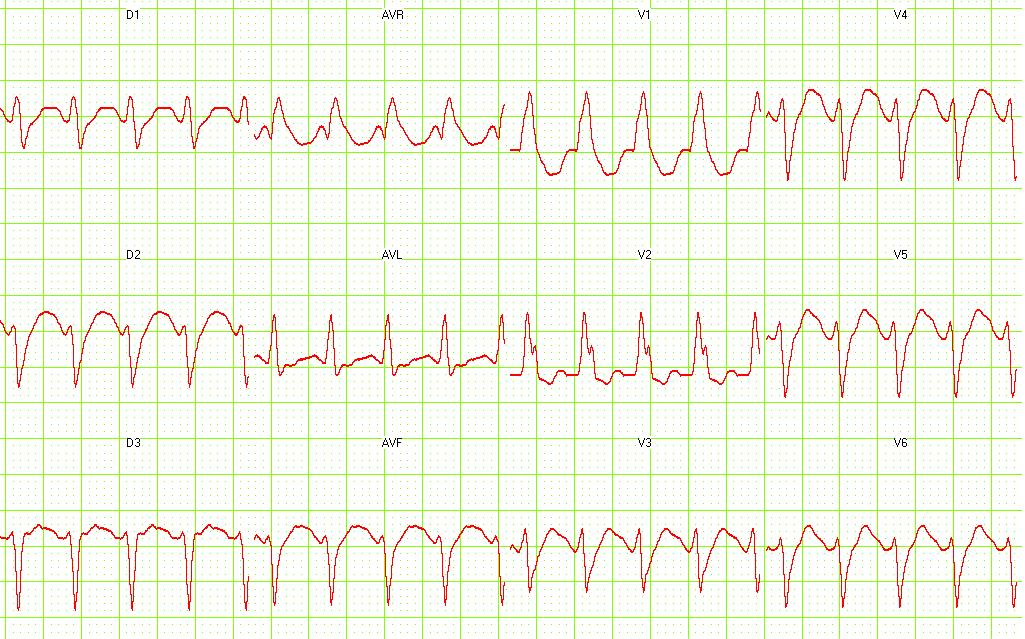 12 lead EKG: Ventricular tachycardia.
 -
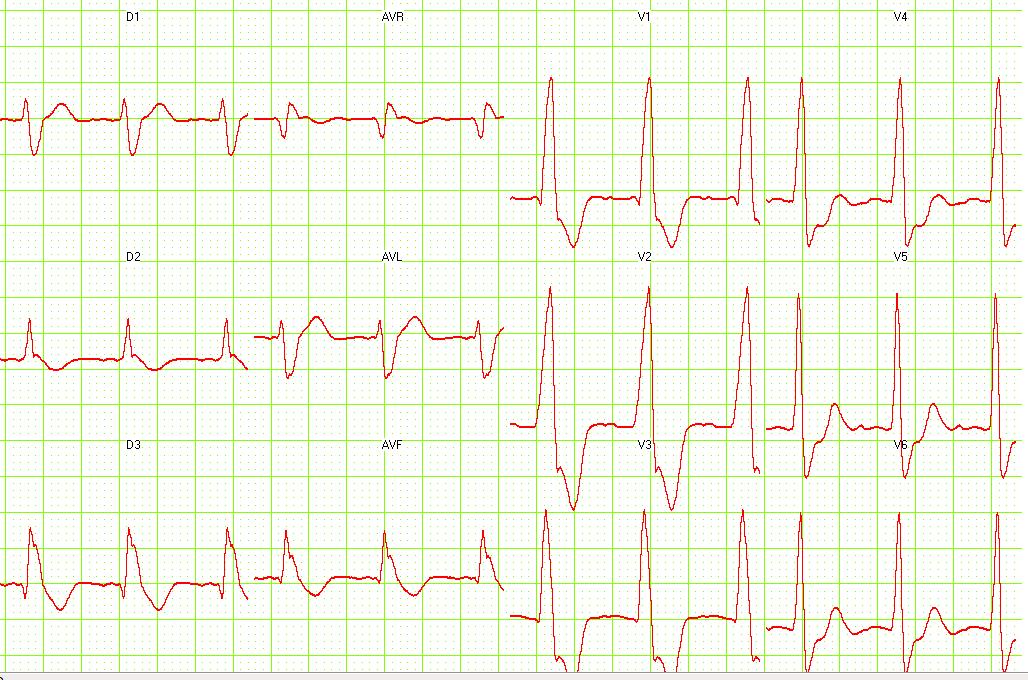 12 lead EKG: Ventricular tachycardia. Image courtesy of Dr Jose Ganseman


-
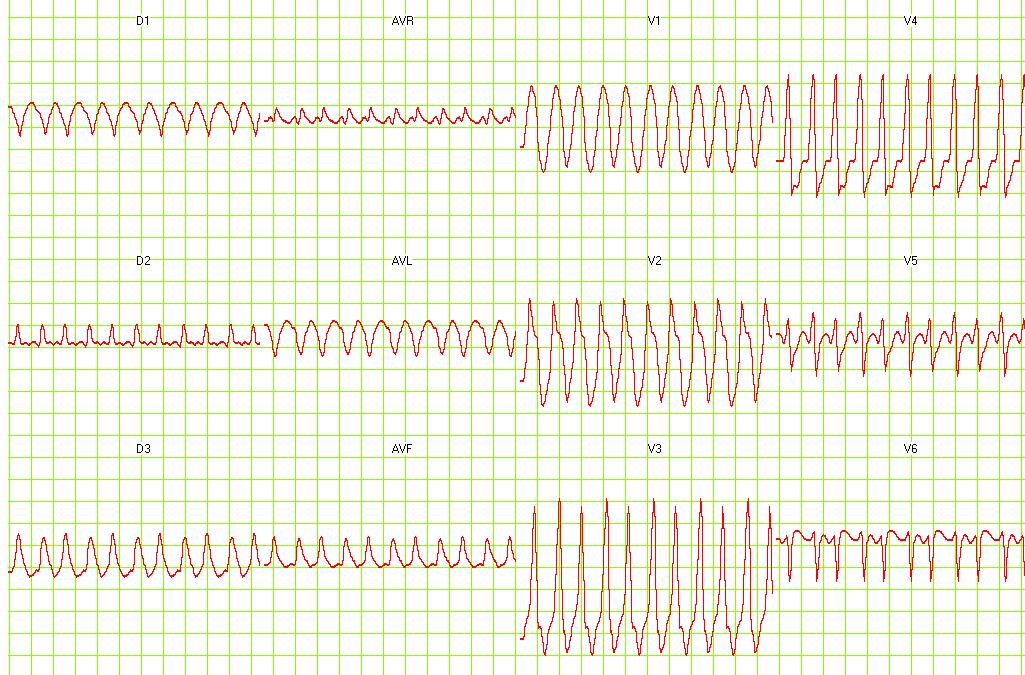 12 lead EKG: Ventricular tachycardia. Image courtesy of Dr Jose Ganseman
 -
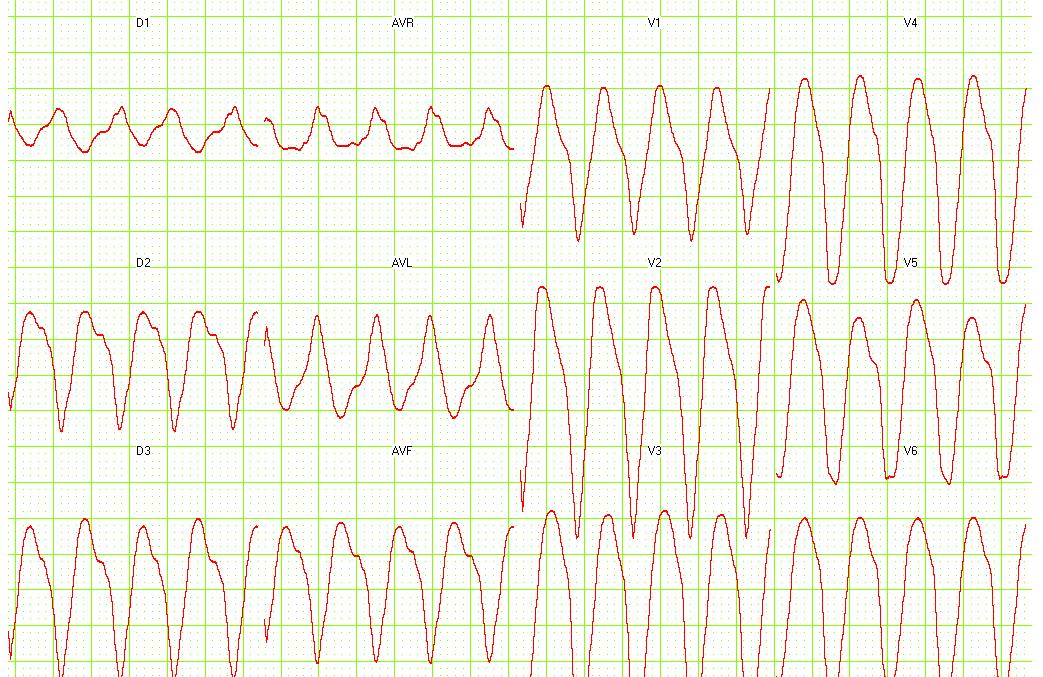 12 lead EKG: Ventricular tachycardia. Image courtesy of Dr Jose Ganseman


-
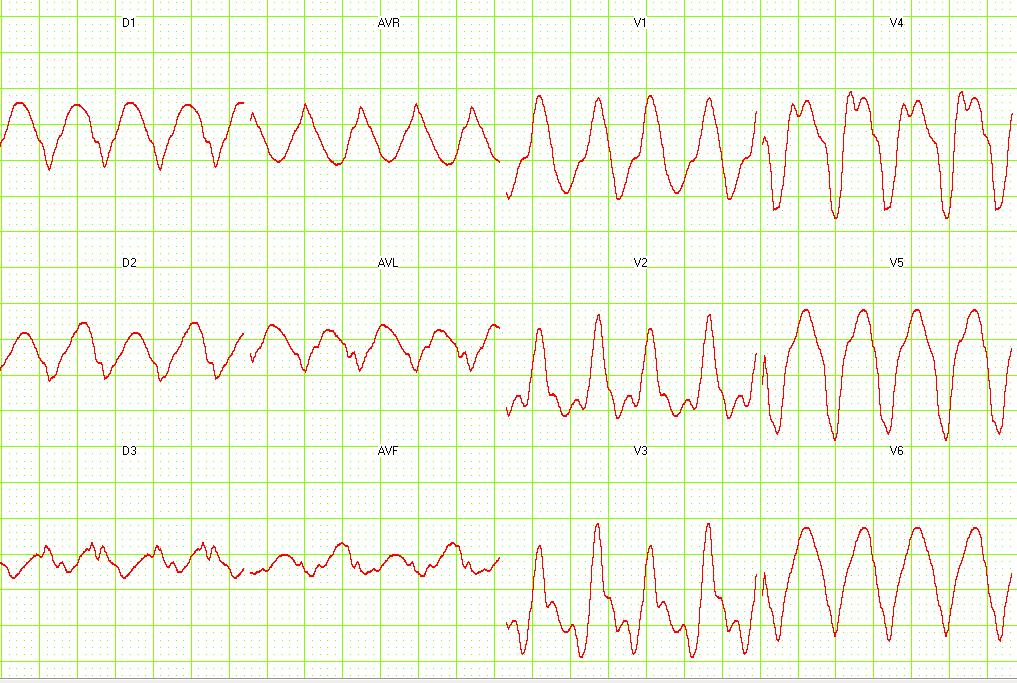 12 lead EKG: Ventricular tachycardia. Image courtesy of Dr Jose Ganseman
 -
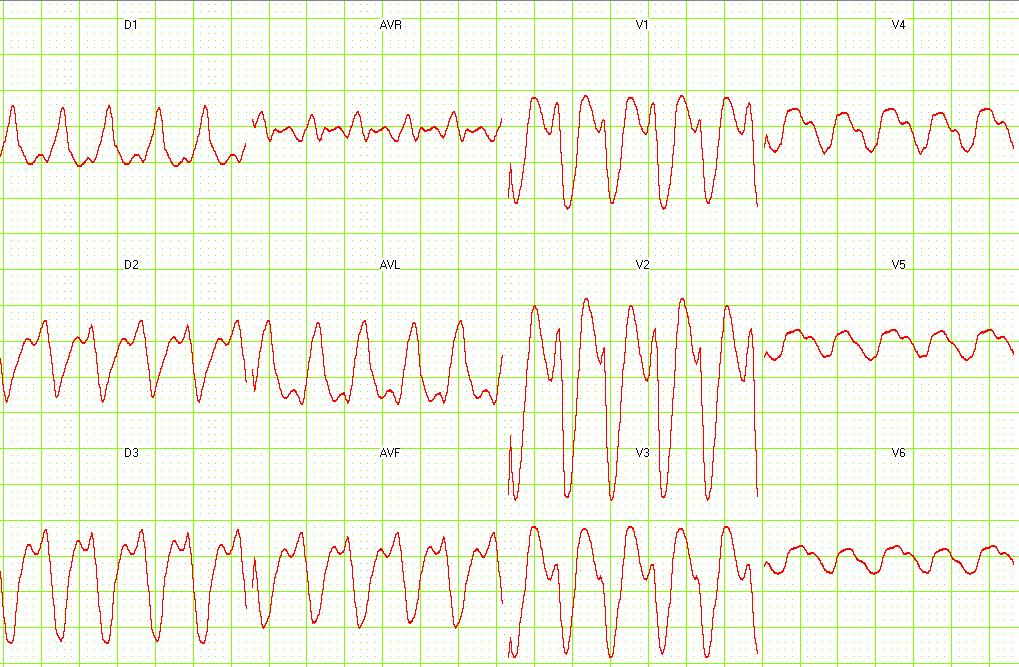 12 lead EKG: Ventricular tachycardia. Image courtesy of Dr Jose Ganseman


-
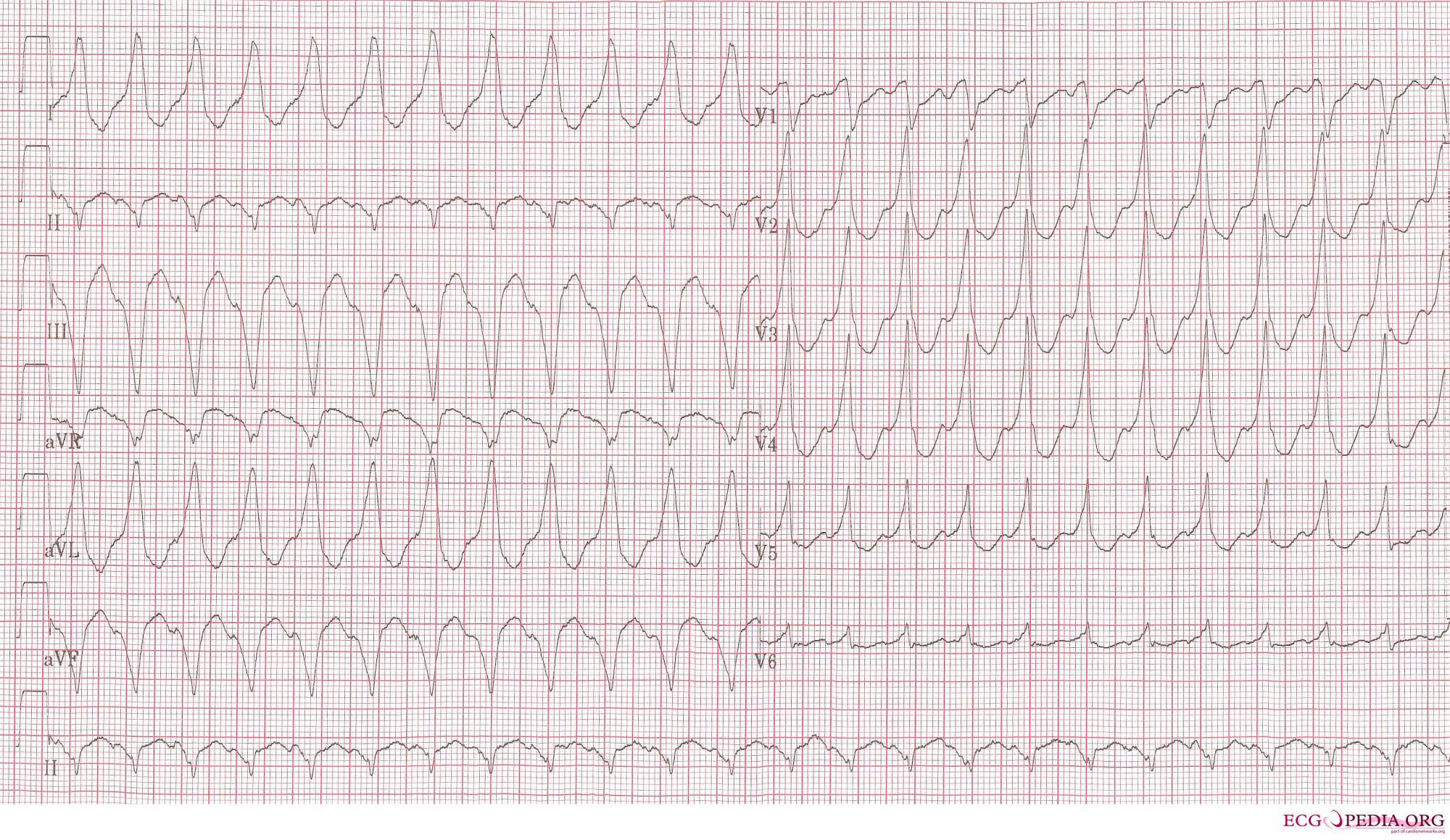 Ventricular tachycardia of 140 bpm with a left bundle branch block pattern and left heart axis.
 -
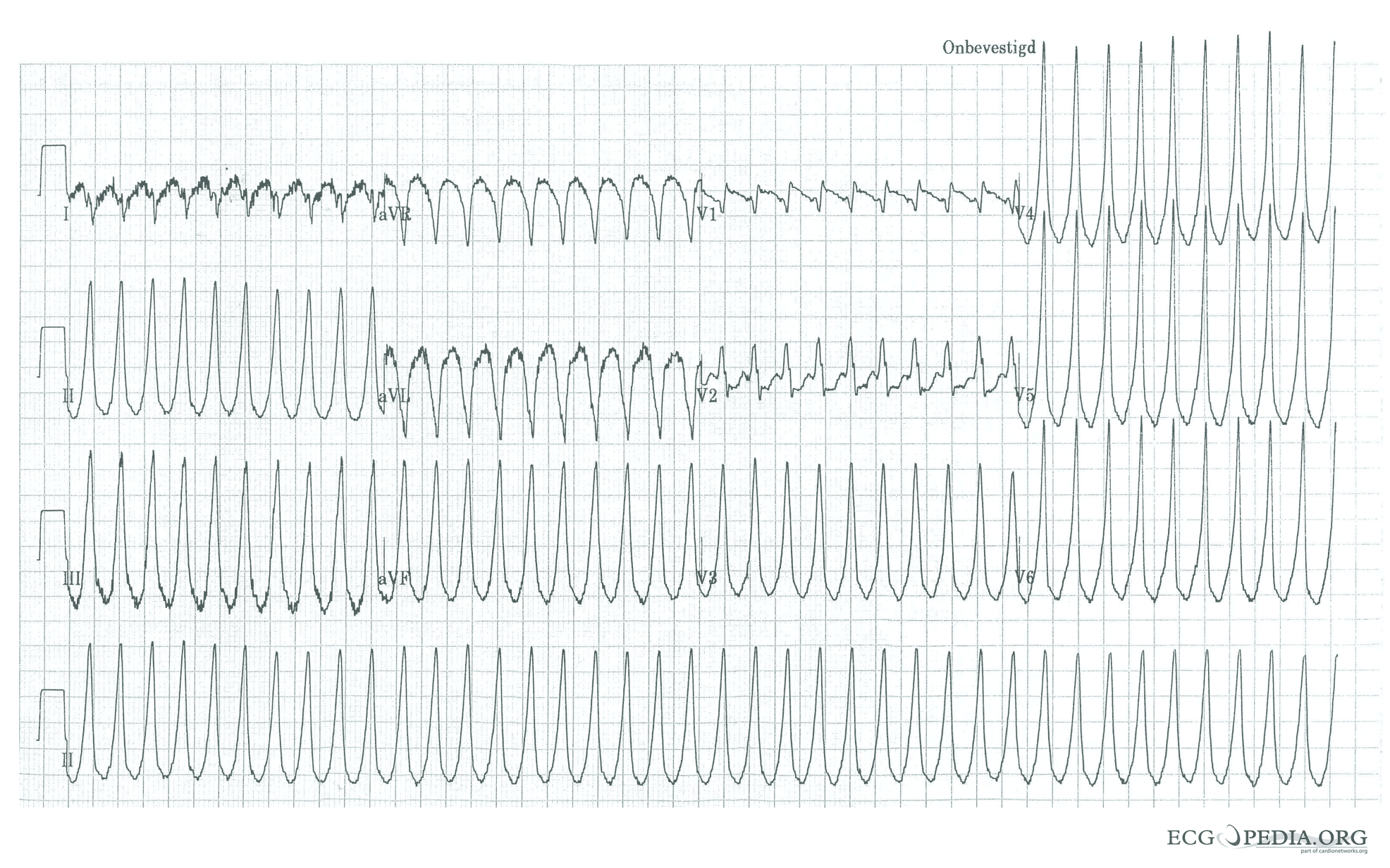 Ventricular tachycardia of 250 bpm with a right bundle branch block pattern and right heart axis.


-
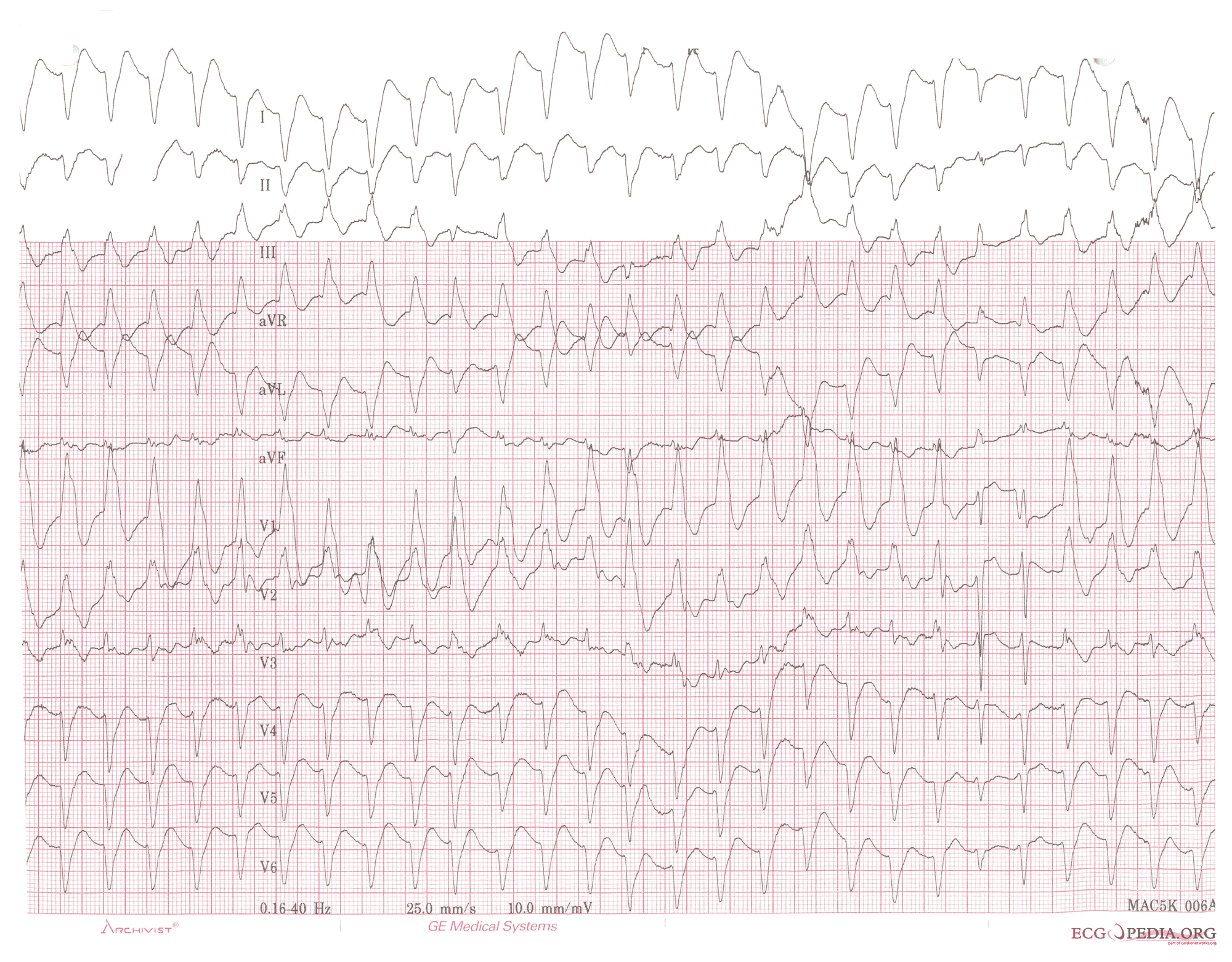 Ventricular tachycardia of 150 bpm with a right bundle branch block pattern and right heart axis. Note the 5th and 6th complex from the right side. These are fusion complexes.
 -
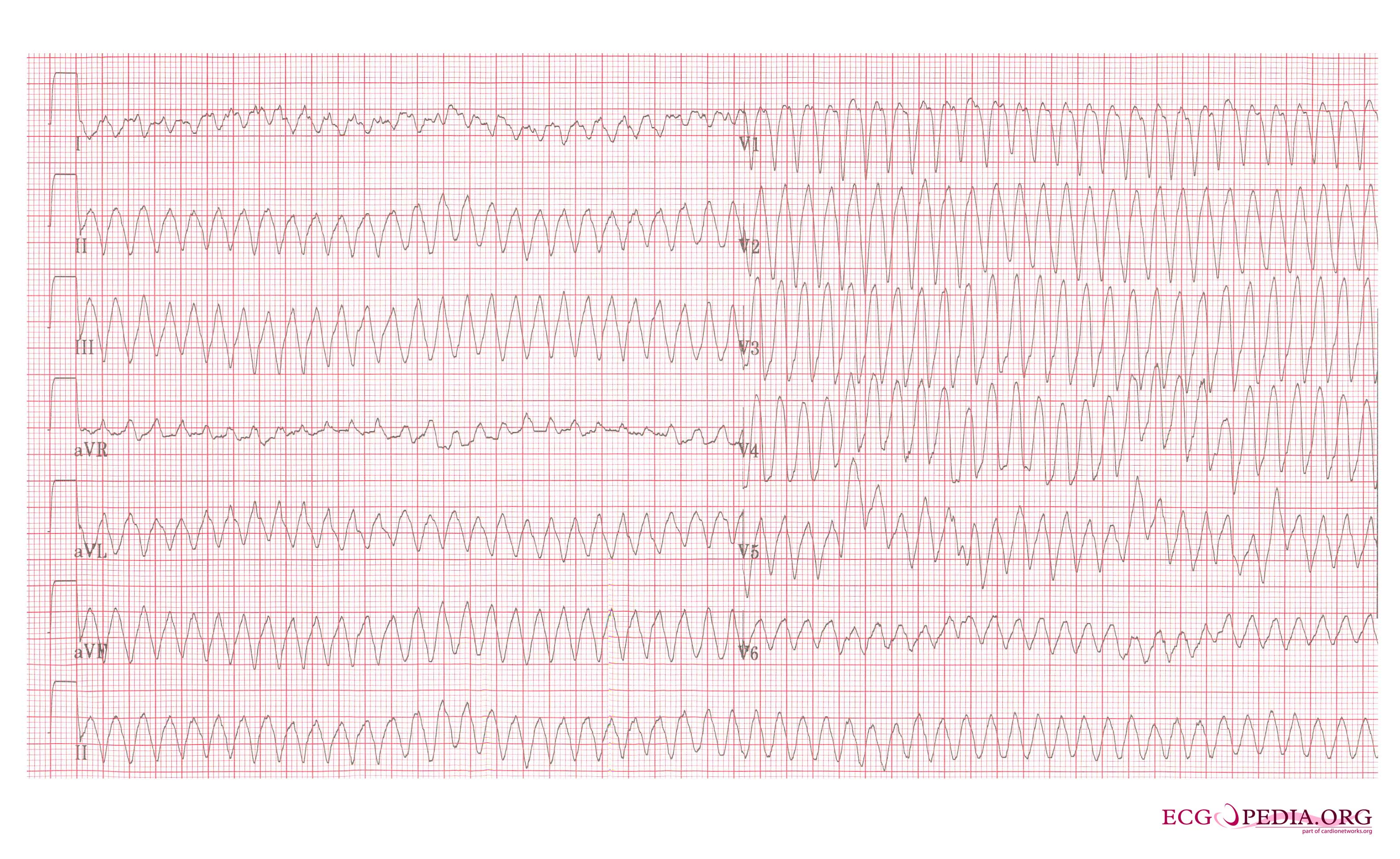 Ventricular flutter on a 12 lead ECG


Differential Diagnosis of Underlying Causes of Ventricular Tachycardia
- Caffeine
- Cardiomyopathy
- Cocaine
- Congenital Heart Disease
- Congestive heart failure
- Electrolyte imbalance
- Hypertrophic cardiomyopathy
- Hypocalcemia
- Hypokalemia
- Hypomagnesia
- Iatrogenic due to pulmonary artery catheter, right heart catheterization, or electrophysiologic sutdy
- Methamphetamine
- STEMI
- Ventricular aneurysm
References
- ↑ Wellens HJ, Bar FW, Lie KI. (1978). “The value of the electrocardiogram in the differential diagnosis of a tachycardia with a widened QRS complex”. Am J Med. 64 (1): 27–33. PMID 623134.
- ↑ Brugada P, Brugada J, Mont L, Smeets J, Andries EW. (1991). “A new approach to the differential diagnosis of a regular tachycardia with a wide QRS complex”. Circulation. 83 (5): 1649–59. PMID 2022022.
- ↑ Baerman JM, Morady F, DiCarlo LA Jr, de Buitleir M. (1987). “Differentiation of ventricular tachycardia from supraventricular tachycardia with aberration: value of the clinical history”. Ann Emerg Med. 16 (1): 40–3. PMID 3800075.
- ↑ Stewart RB, Bardy GH, Greene HL. (1986). “Wide complex tachycardia: misdiagnosis and outcome after emergent therapy”. Ann Intern Med. 104 (6): 766–71. PMID 3706928.
- ↑ Chou’s Electrocardiography in Clinical Practice Third Edition, pp. 398-409.
- ↑ Sailer, Christian, Wasner, Susanne. Differential Diagnosis Pocket. Hermosa Beach, CA: Borm Bruckmeir Publishing LLC, 2002:194 ISBN 1591032016
- ↑ Hammill S. C. Electrocardiographic diagnoses: Criteria and definitions of abnormalities, Chapter 18, MAYO Clinic, Concise Textbook of Cardiology, 3rd edition, 2007 ISBN 0-8493-9057-5
Editor-In-Chief: C. Michael Gibson, M.S., M.D. [1] Cafer Zorkun, M.D., Ph.D. [2]
Treatment
Treatment
Medical Therapy | Electrical Cardioversion | Ablation | Surgery | Primary Prevention | Secondary Prevention | Cost-Effectiveness of Therapy | Future or Investigational Therapies
Treatment of ventricular tachycardia
Therapy may be directed at either terminating an episode of the arrhythmia or for suppressing a future episode from occurring. The treatment is tailored to the specific patient, with regard to how well the individual tolerates episodes of ventricular tachycardia, how frequently episodes occur, their comorbidities, and their wishes.
The details of the guidelines for treatment are explained better in the guidelines section later in this article
Electrical Cardioversion / Defibrillation
It is usually possible to terminate a VT episode with a direct current shock across the heart. This is ideally synchronised to the patient’s heartbeat. As it is quite uncomfortable, shocks should be delivered only to an unconscious or sedated patient. A patient with pulseless VT will be unconscious and treated as an emergency on a cardiac arrest protocol. Elective cardioversion is usually performed in controlled circumstances with anaesthetic and airway support.
The shock may be delivered to the outside of the chest using an external defibrillator, or internally to the heart by an implantable cardioverter-defibrillator (ICD) if one has previously been inserted.
An ICD may also be set to attempt to overdrive pace the ventricle. Pacing the ventricle at a rate faster than the underlying tachycardia can sometimes be effective in terminating the rhythm. If this fails after a short trial, the ICD will usually stop pacing, charge up and deliver a defibrillation grade shock.
Antiarrhythmic drug therapy
Drugs such as amiodarone, epinephrine and vasopressin may be used in addition to defibrillation to terminate VT while the underlying cause of the VT can be determined. Possible causes or contributing factors to VT can be remembered as the six H’s and five T’s: Hypovolemia, Hypoxia, Hydrogen ion (acidosis), Hypo- or Hyperglycemia, Hypothermia; and Toxins, Tamponade (cardiac), Tension pneumothorax, Thrombosis, Trauma.
Long term anti-arrhythmic therapy may be indicated to prevent recurrence of VT. Beta-blockers and a number of class III anti-arrhythmics are commonly used.
For some of the rare congenital syndromes of VT, other drugs, and sometimes even catheter ablation therapy may be useful.
The implantation of an ICD is more effective than drug therapy for prevention of sudden cardiac death due to VT and VF, but may be constrained by cost issues, and well as patient co-morbidities and patient preference.
Guidelines in Ventricular Tachycardia Treatment[1]
Recommendations in Ablation of Ventricular Tachycardia
| “ |
1. Ablation is indicated in patients who are otherwise at low risk for Sudden Cardiac Death(SCD) and have sustained predominantly monomorphic ventricular tachycardia that is drug resistant, who are drug intolerant, or who do not wish long-term drug therapy.(Level of Evidence: C) 2. Ablation is indicated in patients with Bundle branch reentrant ventricular tachycardia.(Level of Evidence: C) 3. Ablation is indicated as adjunctive therapy in patients with an Implantable cardioverter-defibrillator(ICD) who are receiving multiple shocks as a result of Sustained VT that is not manageable by reprogramming or changing drug therapy or who do not wish long-term drug therapy. (Level of Evidence: C)[2][3] 4. Ablation is indicated in patients with WPW syndrome resuscitated from sudden cardiac arrest due to AF and rapid conduction over the accessory pathway causing VF. (Level of Evidence: B))[4] 1. Ablation can be useful therapy in patients who are otherwise at low risk for SCD and have symptomatic nonsustained monomorphic VT that is drug resistant, who are drug intolerant or who do not wish long-term drug therapy.(Level of Evidence: C) 2. Ablation can be useful therapy in patients who are otherwise at low risk for SCD and have frequent symptomatic predominantly monomorphic PVCs that are drug resistant or who are drug intolerant or who do not wish long-term drug therapy.(Level of Evidence: C) 3. Ablation can be useful in symptomatic patients with WPW syndrome who have accessory pathways with refractory periods less than 240 ms in duration. (Level of Evidence: B)[4] 1. Ablation of Purkinje fiber potentials may be considered in patients with ventricular arrhythmia storm consistently provoked by PVCs of similar morphology. (Level of Evidence: C)[5] 2. Ablation of asymptomatic PVCs may be considered when the PVCs are very frequent to avoid or treat tachycardia-induced cardiomyopathy. (Level of Evidence: C)[6] Ablation of asymptomatic relatively infrequent PVCs is not indicated. (Level of Evidence: C) |
” |
Recommendations for Acute Management Of Ventricular Tachycardia(and other arrhythmias)
| “ |
2005 Guidelines[1]1. After establishing the presence of definite, suspected, or impending cardiac arrest, the first priority should be activation of a response team capable of identifying the specific mechanism and carrying out prompt intervention. (Level of Evidence: B) 2. Cardiopulmonary resuscitation (CPR) should be implemented immediately after contacting a response team. (Level of Evidence: A) 3. In an out-of-hospital setting, if an AED is available, it should be applied immediately and shock therapy administered according to the algorithms contained in the documents on CPR[7][8] developed by the AHA in association with the International Liaison Committee on Resuscitation (ILCOR) and/or the European Resuscitation Council (ERC). (Level of Evidence: C) 4. For victims with ventricular tachyarrhythmic mechanisms of cardiac arrest, when recurrences occur after a maximally defibrillating shock (generally 360 J for monophasic defibrillators), intravenous amiodarone should be the preferred antiarrhythmic drug for attempting a stable rhythm after further defibrillations. (Level of Evidence: B) 5. For recurrent ventricular tachyarrhythmias or nontachyarrhythmic mechanisms of cardiac arrest, it is recommended to follow the algorithms contained in the documents on CPR[7][8] developed by the AHA in association with ILCOR and/or the ERC. (Level of Evidence: C) 6. Reversible causes and factors contributing to cardiac arrest should be managed during advanced life support, including management of hypoxia, electrolyte disturbances, mechanical factors, and volume depletion. (Level of Evidence: C) For response times greater than or equal to 5 min, a brief (less than 90 to 180 s) period of CPR is reasonable prior to attempting defibrillation. (Level of Evidence: B) A single precordial thump may be considered by health care professional providers when responding to a witnessed cardiac arrest. (Level of Evidence: C) 2010 Guidelines(from the section on cardioversion and wide complex tachycardia only – incomplete and will be made better once the new guidelines after 2006 are released)[9]1.Cardioversion with monophasic waveforms should begin at 200 J and increase in stepwise fashion if not successful. (Level of Evidence: B) 2.If the etiology of the rhythm cannot be determined, the rate is regular, and the QRS is monomorphic, recent evidence suggests that IV adenosine is relatively safe for both treatment and diagnosis.[10] (Level of Evidence: B) 3.If IV antiarrhythmics are administered, procainamide can be considered. (Level of Evidence: B) 4.If antiarrhythmic therapy is unsuccessful, cardioversion or expert consultation should be considered. (Level of Evidence: C) 1.Monomorphic VT with a pulse responds well to monophasic or biphasic waveform cardioversion(synchronized) shocks at initial energies of 100 J. If there is no response to the first shock, it may be reasonable to increase the dose in a stepwise fashion. (Level of Evidence: C) 2.Precordial thump may be considered for patients with witnessed, monitored, unstable ventricular tachycardia if a defibrillator is not immediately ready for use. (Level of Evidence: C) 3.If IV antiarrhythmics are administered, amiodarone or sotalol can be considered. (Level of Evidence: B) 1.Adenosine should not be given for unstable or for irregular or polymorphic ventricular tachycardias, as it may cause degeneration of the arrhythmia to VF. (Level of Evidence: C) 2.Verapamil is contraindicated for wide-complex tachycardias unless known to be of supraventricular origin. (Level of Evidence: B) 3.If one of these antiarrhythmic agents is given, a second agent should not be given without expert consultation. (Level of Evidence: B) |
” |
Recommendation for Specific Kinds of Ventricular Arrhythmias
References
- ↑ 1.0 1.1 Zipes DP, Camm AJ, Borggrefe M, Buxton AE, Chaitman B, Fromer M; et al. (2006). “ACC/AHA/ESC 2006 Guidelines for Management of Patients With Ventricular Arrhythmias and the Prevention of Sudden Cardiac Death: a report of the American College of Cardiology/American Heart Association Task Force and the European Society of Cardiology Committee for Practice Guidelines (writing committee to develop Guidelines for Management of Patients With Ventricular Arrhythmias and the Prevention of Sudden Cardiac Death): developed in collaboration with the European Heart Rhythm Association and the Heart Rhythm Society”. Circulation. 114 (10): e385–484. doi:10.1161/CIRCULATIONAHA.106.178233. PMID 16935995.
- ↑ Bhandari AK, Shapiro WA, Morady F, Shen EN, Mason J, Scheinman MM (1985). “Electrophysiologic testing in patients with the long QT syndrome”. Circulation. 71 (1): 63–71. PMID 2856866.
- ↑ Silva RM, Mont L, Nava S, Rojel U, Matas M, Brugada J (2004). “Radiofrequency catheter ablation for arrhythmic storm in patients with an implantable cardioverter defibrillator”. Pacing Clin Electrophysiol. 27 (7): 971–5. doi:10.1111/j.1540-8159.2004.00567.x. PMID 15271018.
- ↑ 4.0 4.1 Pappone C, Santinelli V, Manguso F, Augello G, Santinelli O, Vicedomini G; et al. (2003). “A randomized study of prophylactic catheter ablation in asymptomatic patients with the Wolff-Parkinson-White syndrome”. N Engl J Med. 349 (19): 1803–11. doi:10.1056/NEJMoa035345. PMID 14602878.
- ↑ Haïssaguerre M, Shoda M, Jaïs P, Nogami A, Shah DC, Kautzner J; et al. (2002). “Mapping and ablation of idiopathic ventricular fibrillation”. Circulation. 106 (8): 962–7. PMID 12186801.
- ↑ Takemoto M, Yoshimura H, Ohba Y, Matsumoto Y, Yamamoto U, Mohri M; et al. (2005). “Radiofrequency catheter ablation of premature ventricular complexes from right ventricular outflow tract improves left ventricular dilation and clinical status in patients without structural heart disease”. J Am Coll Cardiol. 45 (8): 1259–65. doi:10.1016/j.jacc.2004.12.073. PMID 15837259.
- ↑ 7.0 7.1 ECC Committee, Subcommittees and Task Forces of the American Heart Association (2005). “2005 American Heart Association Guidelines for Cardiopulmonary Resuscitation and Emergency Cardiovascular Care”. Circulation. 112 (24 Suppl): IV1–203. doi:10.1161/CIRCULATIONAHA.105.166550. PMID 16314375.
- ↑ 8.0 8.1 Nolan JP, Deakin CD, Soar J, Böttiger BW, Smith G, European Resuscitation Council (2005). “European Resuscitation Council guidelines for resuscitation 2005. Section 4. Adult advanced life support”. Resuscitation. 67 Suppl 1: S39–86. doi:10.1016/j.resuscitation.2005.10.009. PMID 16321716.
- ↑ Neumar RW, Otto CW, Link MS, Kronick SL, Shuster M, Callaway CW; et al. (2010). “Part 8: adult advanced cardiovascular life support: 2010 American Heart Association Guidelines for Cardiopulmonary Resuscitation and Emergency Cardiovascular Care”. Circulation. 122 (18 Suppl 3): S729–67. doi:10.1161/CIRCULATIONAHA.110.970988. PMID 20956224.
- ↑ Staudinger T, Brugger S, Röggla M, Rintelen C, Atherton GL, Johnson JC; et al. (1994). “[Comparison of the Combitube with the endotracheal tube in cardiopulmonary resuscitation in the prehospital phase]”. Wien Klin Wochenschr. 106 (13): 412–5. PMID 8091765.
Editor-In-Chief: C. Michael Gibson, M.S., M.D. [1]; Associate Editor-in Chief: Avirup Guha, M.B.B.S.[2]
Related Chapters
Related Chapters
- Tachycardia
- Ventricular fibrillation
- Supraventricular tachycardia
- Pulseless ventricular tachycardia
- Catecholaminergic polymorphic ventricular tachycardia
- Right ventricular outflow tract ventricular tachycardia
- Polymorphic ventricular tachycardia
- ↑ 1.00 1.01 1.02 1.03 1.04 1.05 1.06 1.07 1.08 1.09 Al-Khatib SM, Stevenson WG, Ackerman MJ, Bryant WJ, Callans DJ, Curtis AB, Deal BJ, Dickfeld T, Field ME, Fonarow GC, Gillis AM, Granger CB, Hammill SC, Hlatky MA, Joglar JA, Kay GN, Matlock DD, Myerburg RJ, Page RL (2018). “2017 AHA/ACC/HRS Guideline for Management of Patients With Ventricular Arrhythmias and the Prevention of Sudden Cardiac Death”. J Am Coll Cardiol. 72 (14): e91–e220. doi:10.1016/j.jacc.2017.10.054. PMID 29097296.
- ↑ 2.0 2.1 2.2 2.3 2.4 2.5 Shivkumar K (2019). “Catheter Ablation of Ventricular Arrhythmias”. N Engl J Med. 380 (16): 1555–1564. doi:10.1056/NEJMra1615244. PMID 30935556.
- ↑ 3.0 3.1 John RM, Tedrow UB, Koplan BA, Albert CM, Epstein LM, Sweeney MO, Miller AL, Michaud GF, Stevenson WG (2012). “Ventricular arrhythmias and sudden cardiac death”. Lancet. 380 (9852): 1520–9. doi:10.1016/S0140-6736(12)61413-5. PMID 23101719.
- ↑ 4.0 4.1 4.2 Dukkipati SR, Koruth JS, Choudry S, Miller MA, Whang W, Reddy VY (2017). “Catheter Ablation of Ventricular Tachycardia in Structural Heart Disease: Indications, Strategies, and Outcomes-Part II”. J Am Coll Cardiol. 70 (23): 2924–2941. doi:10.1016/j.jacc.2017.10.030. PMID 29216988.
- ↑ Sapp JL, Tang A, Parkash R, Stevenson WG, Healey JS, Gula LJ, Nair GM, Essebag V, Rivard L, Roux JF, Nery PB, Sarrazin JF, Amit G, Raymond JM, Deyell MW, Lane C, Sacher F, de Chillou C, Kuriachan V, AbdelWahab A, Nault I, Dyrda K, Wilton S, Jolly U, Kanagasundram A, Wells GA (2025). “Catheter Ablation or Antiarrhythmic Drugs for Ventricular Tachycardia”. N Engl J Med. 392 (8): 737–747. doi:10.1056/NEJMoa2409501. PMID 39555820 Check
|pmid=value (help). Vancouver style error: initials (help) - ↑ Kahle AK, Jungen C, Alken FA, Heeger CH, Tilz RR, Kuck KH, Ouyang F, Schäffer B, Willems S (2022). “Management of Ventricular Tachycardia in Patients With Ischaemic Cardiomyopathy: Contemporary Armamentarium”. Europace. 24 (4): 538–551. doi:10.1093/europace/euab274. PMID 34967892 Check
|pmid=value (help).
Editor-In-Chief: C. Michael Gibson, M.S., M.D. [1]; Sara Zand, M.D.[2] Cafer Zorkun, M.D., Ph.D. [3], Avirup Guha, M.B.B.S.[4] Nehal Eid, M.D.[5]